
The divine union of Radha and Krishna — celebrated across scriptures, songs, and centuries — finds its most enduring form not in words, but in sculpture. In the sacred workshops of Chandpole Bazar, Jaipur, master artisans have been carving this eternal love into pure Makrana marble since 1950, birthing what devotees reverently call the Jugal Jodi — the divine pair. Each Jugal Jodi murti is not merely a decorative sculpture; it is a vigraha, a living form of the divine, meticulously shaped through generations of ancestral craftsmanship.
Table of Contents
- What is Jugal Jodi? The Sacred Meaning
- Symbolism of Radha-Krishna as Divine Pair
- Why Makrana Marble is Sacred for Jugal Jodi
- The 6-Step Craftsmanship Journey
- Popular Jugal Jodi Styles & Postures
- Vastu Placement for Jugal Jodi at Home
- How to Choose the Right Jugal Jodi Statue
- Caring for Your Marble Jugal Jodi
- Featured Jugal Jodi Sculptures
- Frequently Asked Questions
What is Jugal Jodi? The Sacred Meaning
The Sanskrit word Jugal means "pair" or "couple," while Jodi reinforces the same essence in colloquial Hindi. Together, Jugal Jodi refers to a sacred pair — most commonly Radha and Krishna — depicted together as a single divine unit rather than two separate figures. In Hindu devotional tradition, a Jugal Jodi marble statue represents more than iconography; it embodies the philosophical union of Prakriti and Purusha, the eternal feminine and masculine principles that sustain the cosmos.
For centuries, Vaishnava saints, poets, and sculptors have chosen the Jugal Jodi as the ultimate expression of bhakti (devotional love). Unlike a solitary deity statue that invites individual meditation, a Jugal Jodi installation invites the devotee into a witness relationship — one that honours love itself as the highest form of the divine. This is why homes with a Radha Krishna statue as their central mandir figure often report a distinctive atmosphere of gentleness, harmony, and sattvic warmth.
Symbolism of Radha-Krishna as Divine Pair
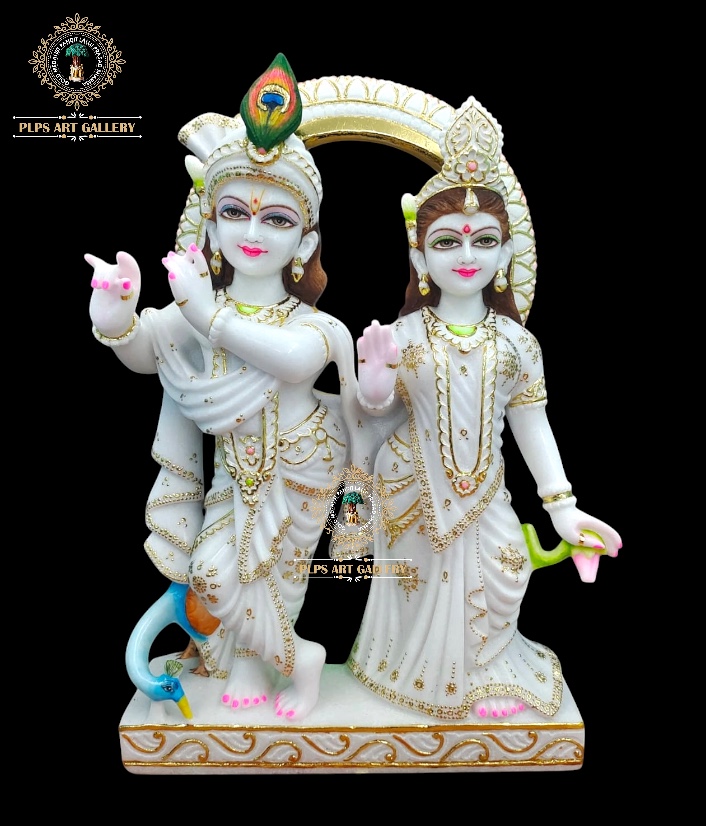
Every element of a Jugal Jodi vigraha carries philosophical weight. Krishna, holding his flute (bansuri), stands in the classic tribhanga pose — three graceful bends of the body — symbolising his role as the source of divine music and cosmic play (leela). Radha, adorned in her flowing lehenga and dupatta, represents the perfected soul yearning for union with the Supreme.
The Deeper Philosophical Layer
In Gaudiya Vaishnavism, Radha is not merely Krishna's consort — she is Hladini Shakti, the pleasure-giving potency of the divine itself. The Jugal Jodi therefore is not a couple in the worldly sense; it is a single reality expressing itself as two, revealing the profound truth that love is the very fabric of existence. Owning a hand-carved Makrana marble Radha Krishna Jugal Jodi is, in this tradition, an invitation for that same principle of unified love to permeate one's daily life.
- ✦ Krishna's flute — the sound that awakens the soul to its divine origin
- ✦ Peacock feather — Krishna's crown ornament, symbol of watchful, all-seeing divinity
- ✦ Radha's gaze — always turned toward Krishna, embodying single-pointed devotion
- ✦ The lotus base — signifying the divine emergence from primordial waters
- ✦ The tribhanga posture — three bends signifying grace, rhythm, and cosmic dance
Why Makrana Marble is Sacred for Jugal Jodi
Not all marble is fit for a vigraha. Traditional silaipati (stone masters) of Rajasthan hold that only Makrana marble — quarried from the ancient hills of Nagaur district — possesses the sattva (purity) required to house divine energy. The same stone that gave form to the Taj Mahal and Victoria Memorial has, for centuries, been the preferred material for sacred sculpture across India.
The Unique Qualities of Makrana
Geologically, Makrana marble is dolomitic — meaning it contains higher calcium-magnesium ratios that give it exceptional density. This translates to three practical qualities that make it perfect for Jugal Jodi sculpture:
- ✦ Fine grain structure — allows the artisan's chisel to hold intricate detail; every strand of Radha's hair, every fold of Krishna's dhoti, remains crisp for generations
- ✦ Non-porous surface — resists yellowing, cracking, and moisture damage; heirloom-grade longevity
- ✦ Milky-white sattvic colour — considered pure and auspicious in Vedic tradition, ideal for housing divine tejas (radiance)
This is why, at PLPS Art Gallery, every 4ft Makrana Marble Radha Krishna Jugal Jodi statue is sourced directly from selected quarries where the stone carries the requisite sattva. Cheaper Chinese or Vietnamese marbles may appear similar to the untrained eye but lack the density, luminance, and spiritual pedigree of authentic Makrana stone.
75 Years of Sacred Craftsmanship
Since 1950, PLPS Art Gallery has been sculpting divine moortis by hand — recognised with the Shilp Guru Award, National Award, and Gold Medal from the Government of India, under the visionary leadership of Shilp Guru Pandit Lallu Prasad Sharma.
The 6-Step Craftsmanship Journey of a Jugal Jodi
Every hand-carved Handcrafted Marble Radha Krishna with Cow Statue passes through six deliberate stages — a rhythm perfected over four generations of master sculptors in Jaipur.
Step 1 — Stone Selection (Shila Pariksha)
The master artisan visits the quarry personally, tapping each raw block with a small hammer to hear its inner song. A stone with cracks, air pockets, or dull resonance is rejected — even before the client has seen it. Only stones with a clear, bell-like ring proceed to the workshop.
Step 2 — Sacred Marking (Rekhankan)
Using traditional charcoal and geometric proportions defined in ancient Shilpashastra texts, the artisan marks the primary contours of Radha and Krishna on the raw stone. This stage cannot be rushed — the proportions are said to determine whether the finished vigraha can receive prana pratishtha (life-installation) in a proper ritual.
Step 3 — Rough Shaping (Sthula Nirmiti)
Broad strokes with heavier chisels release the two figures from the surrounding marble. This is often the loudest, most physical stage — but never careless. A single misjudged strike can compromise weeks of work.
Step 4 — Detailed Carving (Sukshma Nirmiti)
Faces, hands, ornaments, folds of clothing, hair strands — this stage can take weeks. Master carvers use progressively finer chisels, sometimes no larger than a pencil tip, to bring out delicate features like Krishna's flute embouchure and Radha's bindi.
Step 5 — Polishing (Chikni)
Successive grades of natural abrasives — from coarse to increasingly fine — coax the marble into its signature milky lustre. A well-polished Jugal Jodi will hold light softly, appearing to glow from within rather than shine on its surface.
Step 6 — Hand-Painting & Gold Detailing (Rang & Swarna)
Optional but transformative — traditional mineral pigments and real gold leaf are applied to jewellery, ornaments, and clothing. This is what distinguishes premium pieces like the Swarna-Kanti Divine Radha Krishna in Real Gold Artistry from more understated pieces.
Popular Jugal Jodi Styles & Postures
Traditional Radha Krishna Jugal Jodi statues come in several distinct postures, each carrying its own devotional significance and aesthetic mood.
1. Classical Standing (Trishula Sthanaka)
The most iconic form. Krishna stands in tribhanga pose with his flute at his lips, Radha beside him in gentle contrapposto. This is the traditional choice for a formal mandir setting and is featured in our Marble Radha Krishna Jugal Jodi Idol collection.
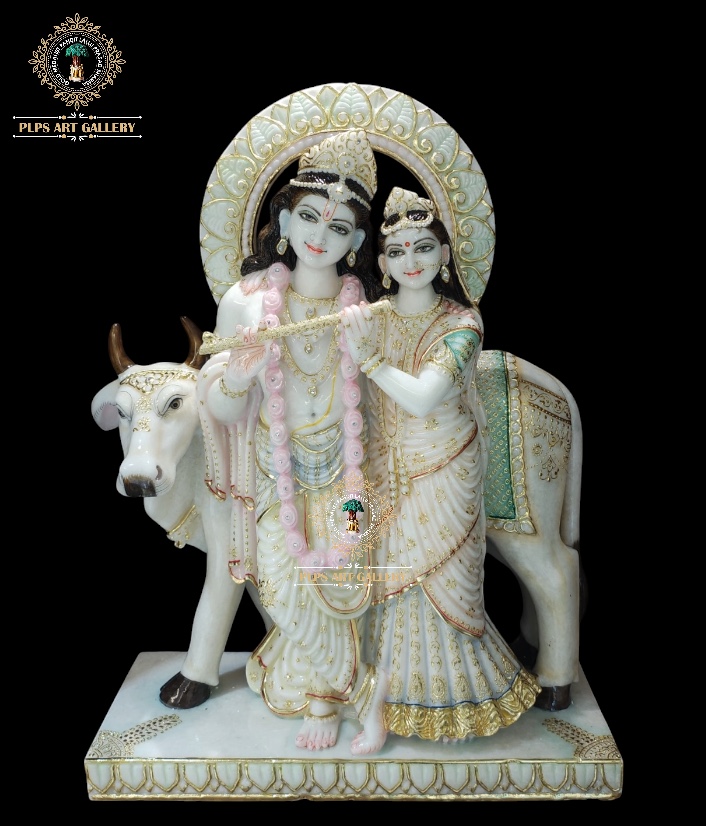
2. Divine Pair with Cow (Go-Palan Jugal)
Krishna as Gopala — the cowherd — with a calf beside the divine couple, symbolising his pastoral life in Vrindavan. These pieces convey warmth and everyday sanctity, ideal for home mandirs where devotion mingles with family life.
3. Royal Splendour (Rajasi Jugal)
Radha and Krishna adorned in royal garments — pagdi, jewellery, elaborate lehenga. Our Braj-Vilas Royal Pagdi & Lehenga Swaroop exemplifies this majestic style — perfect for larger temple settings.
4. Motherly Grace (Vatsalya Swaroop)
A softer interpretation where Radha's expression carries maternal tenderness. Our Vatsalya-Mridu Radha Krishna murti captures this rare devotional angle beautifully.
5. Premium Grand Scale (4ft+)
For temple installations, banquet halls, and grand entrances — pieces like our signature 4ft Makrana Marble Radha Krishna Jugal Jodi Statue stand as commanding vigrahas that anchor an entire sacred space.
Vastu Placement for Jugal Jodi at Home
Placing a Jugal Jodi vigraha in your home is a sacred responsibility. According to Vastu Shastra, the following principles maximise the divine energy the pair radiates:
✧ Vastu Wisdom for Jugal Jodi Placement
Place the Jugal Jodi in the north-east corner (Ishan Kon) of your home — the direction of Ishwara, most receptive to sacred energies. Krishna should face west, so the devotee bowing before them naturally faces east — the direction of rising light.
- ✦ Never place directly on the floor — always on a raised, clean chowki or wooden platform
- ✦ Keep away from bathrooms, storage rooms, or areas of noise/disturbance
- ✦ Never place in the bedroom (except in a dedicated mandir alcove)
- ✦ Ensure the base of the statue is above the level of your heart when seated
- ✦ Perform prana pratishtha ritual on an auspicious muhurta before daily worship
How to Choose the Right Jugal Jodi Statue
Selecting a Jugal Jodi vigraha is a deeply personal act. These guiding questions help clarify what will resonate in your home:
Size & Space
A general rule — the Jugal Jodi should not overwhelm the mandir shelf yet should command visual reverence. For a home mandir, 15–24 inches is ideal. For dedicated puja rooms, 3–4 feet. For temple installations, 5 feet or more. Our Divine 15-Inch Handcrafted Makrana Marble Radha Krishna is perfectly proportioned for home mandirs.
Style Compatibility
A traditional Rajasthani home welcomes classical standing forms; a modern minimalist interior often gains warmth from a smaller Jugal Jodi with white-and-gold accents. Consider how the sculpture will interact with your existing décor.
Marble Quality Verification
Authentic Makrana marble has a distinct milky-white body with subtle grey veining. Cheaper substitutes often show yellowish undertones or uniform, artificial-looking colouration. Reputable studios like PLPS Art Gallery provide certificates of authenticity for premium pieces. Get in touch with our specialists for verification guidance.
Caring for Your Marble Jugal Jodi
A well-cared-for Makrana marble vigraha will glow for generations. The essentials:
- ✦ Daily dusting with a soft, dry cotton cloth — never abrasive materials
- ✦ Periodic cleaning with plain water or mildly diluted natural soap; dry immediately with a lint-free cloth
- ✦ Never use vinegar, lemon, or citrus-based cleaners — these etch the marble surface
- ✦ Reapply marble-safe protective wax once or twice yearly for enduring lustre
- ✦ Shield from harsh direct sunlight and excessive humidity to prevent long-term degradation
Featured Jugal Jodi Sculptures
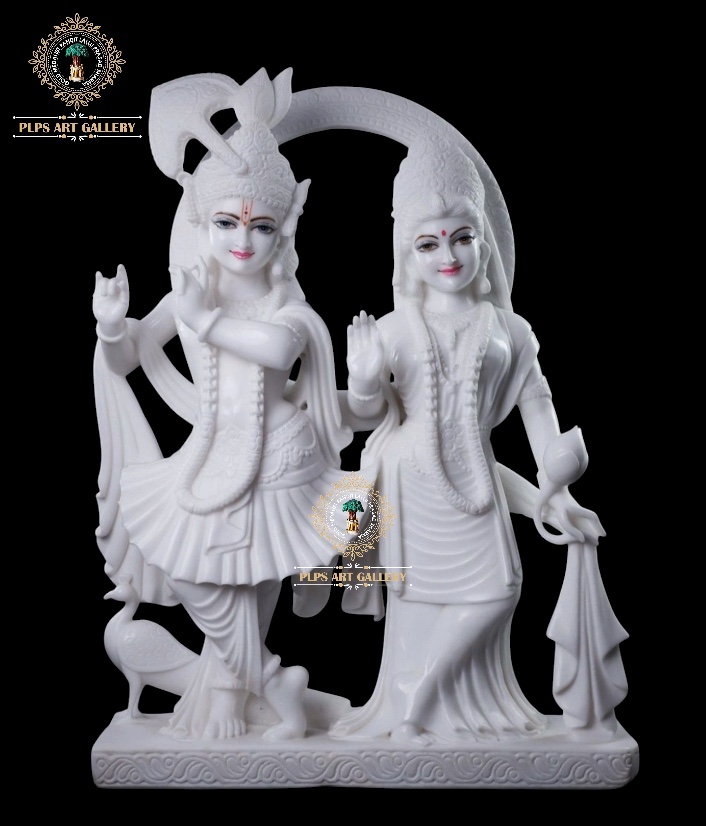
Makrana Marble Radha Krishna Jugal Jodi
Classical standing pose in pure Makrana marble — the signature Jugal Jodi.
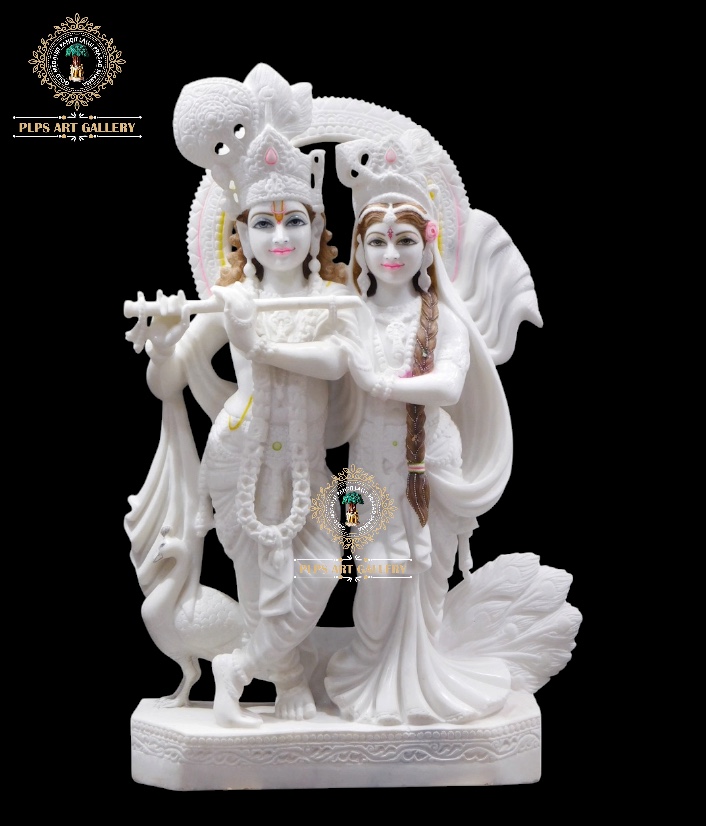
4ft Grand Radha Krishna Jugal Jodi
Commanding 4-foot masterpiece for temples and grand mandir spaces.
Radha Krishna with Cow — Gopala Form
Krishna as cowherd — pastoral Jugal Jodi carrying warmth and grace.
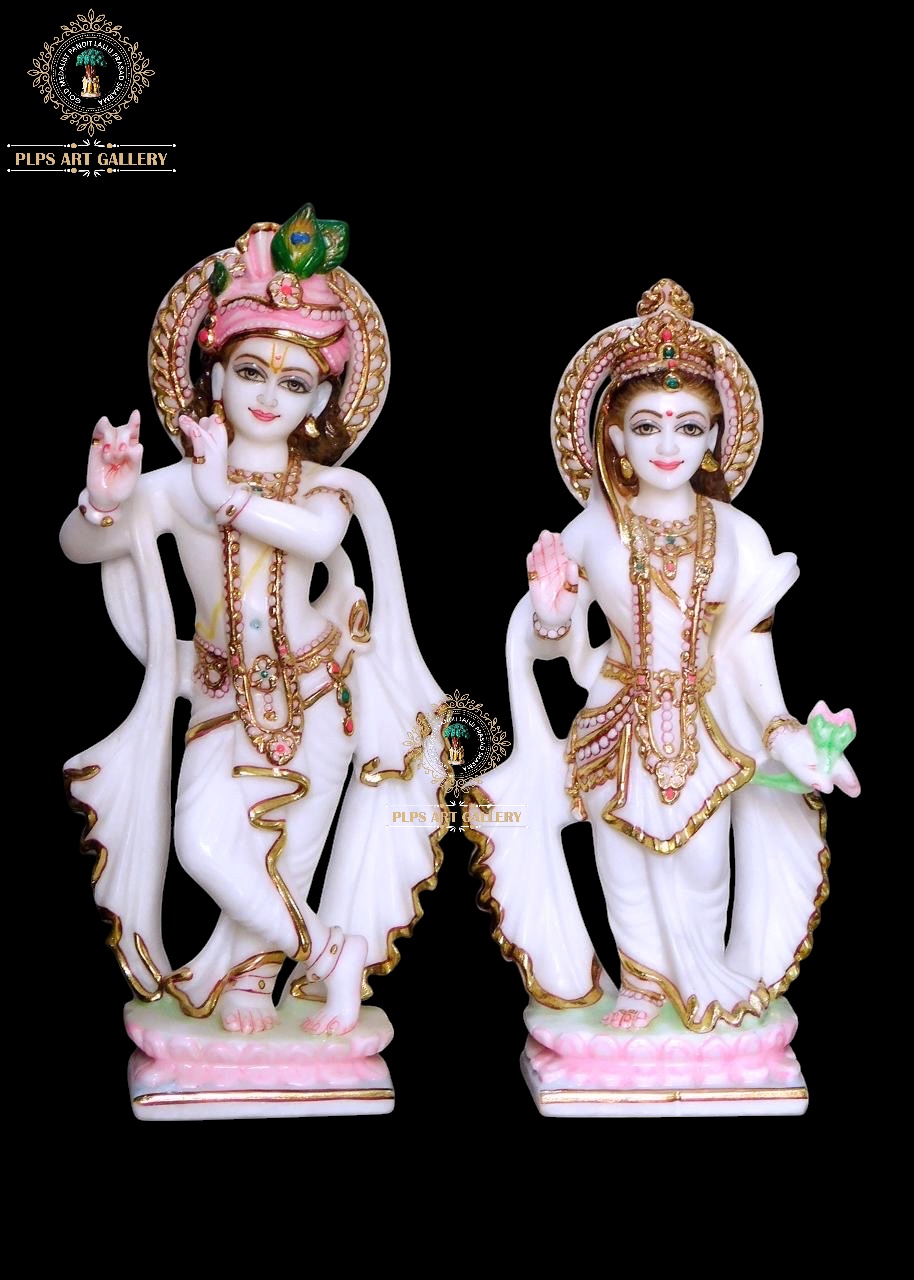
The Eternal Bond Radha Krishna
Exquisite hand-carved masterpiece embodying eternal divine love.
Bring Divine Love Home in Marble
Discover the complete Jugal Jodi collection — hand-carved in Makrana marble by our master artisans since 1950. Every piece is a vigraha, ready for seva in your sacred space.
Explore Jugal Jodi Collection Request Custom OrderFrequently Asked Questions
What exactly is a Jugal Jodi statue?
A Jugal Jodi statue is a sacred sculpture depicting a divine pair — most commonly Radha and Krishna — carved together as a single unified vigraha. The Sanskrit word Jugal means "pair," representing the union of the eternal feminine and masculine principles in Hindu devotional tradition. Explore our full Jugal Jodi collection to see traditional and contemporary interpretations.
Why choose Makrana marble specifically for a Jugal Jodi?
Makrana marble is dolomitic, non-porous, and possesses the milky-white sattva considered ideal for housing divine energy in Vedic tradition. Its dense grain structure holds intricate carving detail — essential for the delicate features of Jugal Jodi vigrahas. The same marble was chosen for the Taj Mahal, testifying to its unmatched heritage-grade quality. All our Radha Krishna statues use certified Makrana stone.
Where should I place a Jugal Jodi statue in my home?
According to Vastu Shastra, the ideal placement is the north-east corner (Ishan Kon) of your home. Krishna should face west so the devotee bowing before them naturally faces east — the direction of the rising sun. Place on a raised, clean platform (never directly on the floor), keep the base above heart-level when seated, and avoid bedrooms, bathrooms, or storage areas. A dedicated home mandir is ideal.
What is the ideal size for a home Jugal Jodi statue?
For a home mandir, 15-24 inches is ideal — visible without dominating the space. For dedicated puja rooms, 3-4 feet works well. For temples or grand entrances, 5 feet and above. Our 15-inch Makrana Marble Radha Krishna is perfect for home mandirs, while our 4ft Jugal Jodi suits larger sacred spaces.
How do I clean a marble Jugal Jodi without damaging it?
Dust daily with a soft, dry cotton cloth. For deeper cleaning, use plain water or mildly diluted natural soap, then dry immediately with a lint-free cloth. Never use vinegar, lemon, or acidic cleaners — these permanently etch marble. Reapply a marble-safe protective wax once or twice yearly to preserve the milky lustre. Protect from harsh direct sunlight and excessive humidity for enduring beauty.
Can I request a custom Jugal Jodi with specific features?
Yes — bespoke commissions are our specialty. You can specify size, posture, ornamentation style (traditional or royal), and even request real gold detailing or hand-painted mineral pigments. Our master artisans typically deliver custom Jugal Jodis within 30-60 days depending on complexity. Get in touch with our specialists to discuss your vision — every piece is a co-creation between devotee and craftsman.
How can I verify the marble authenticity before buying?
Authentic Makrana marble has a milky-white body with subtle grey veining, a bell-like ring when gently tapped, and doesn't yellow with age. Reputable studios like PLPS Art Gallery provide certificates of authenticity for premium pieces and are transparent about the source quarry. Read our detailed guide on Radha Krishna statue quality or reach out for personal guidance from our team.
Does PLPS Art Gallery ship Jugal Jodi statues internationally?
Yes — we ship to 30+ countries worldwide including the USA, UK, UAE, Australia, Canada, Singapore, and Malaysia. Every Jugal Jodi is professionally packaged with custom crating for safe international transit. Domestic delivery within India takes 7-15 days; international delivery varies by destination. Contact our team for a specific shipping quote to your location.
Continue Your Journey Into Marble Art
Our blog archive is growing — check back regularly for more articles on marble craftsmanship, deity significance, and the sacred art of hand-carving.