
A devotee’s guide
Where the destroyer sits still — bringing Shiva into your home in marble.
Whether you seek the abstract Shivling, the cosmic dance of Nataraja, or the meditative Adiyogi — choosing a marble Shiva for your home is unlike choosing any other deity. His forms are many. His placement is exact. His marble must be genuine. Everything you need to know is below.
Om Tryambakam Yajamahe Sugandhim Pushtivardhanam
Urvarukamiva Bandhanan Mrityor Mukshiya Mamritat
“We worship the three-eyed one, the fragrant, the nourisher of all —
as a ripe cucumber is freed from its stem, may we too be freed from death, into immortality.”
Maha Mrityunjaya Mantra
Section I
The Four Forms You’ll Choose Between
Shiva is worshipped in dozens of forms — these four cover almost every home and temple choice. Each carries a distinct energy and belongs in a different kind of space.
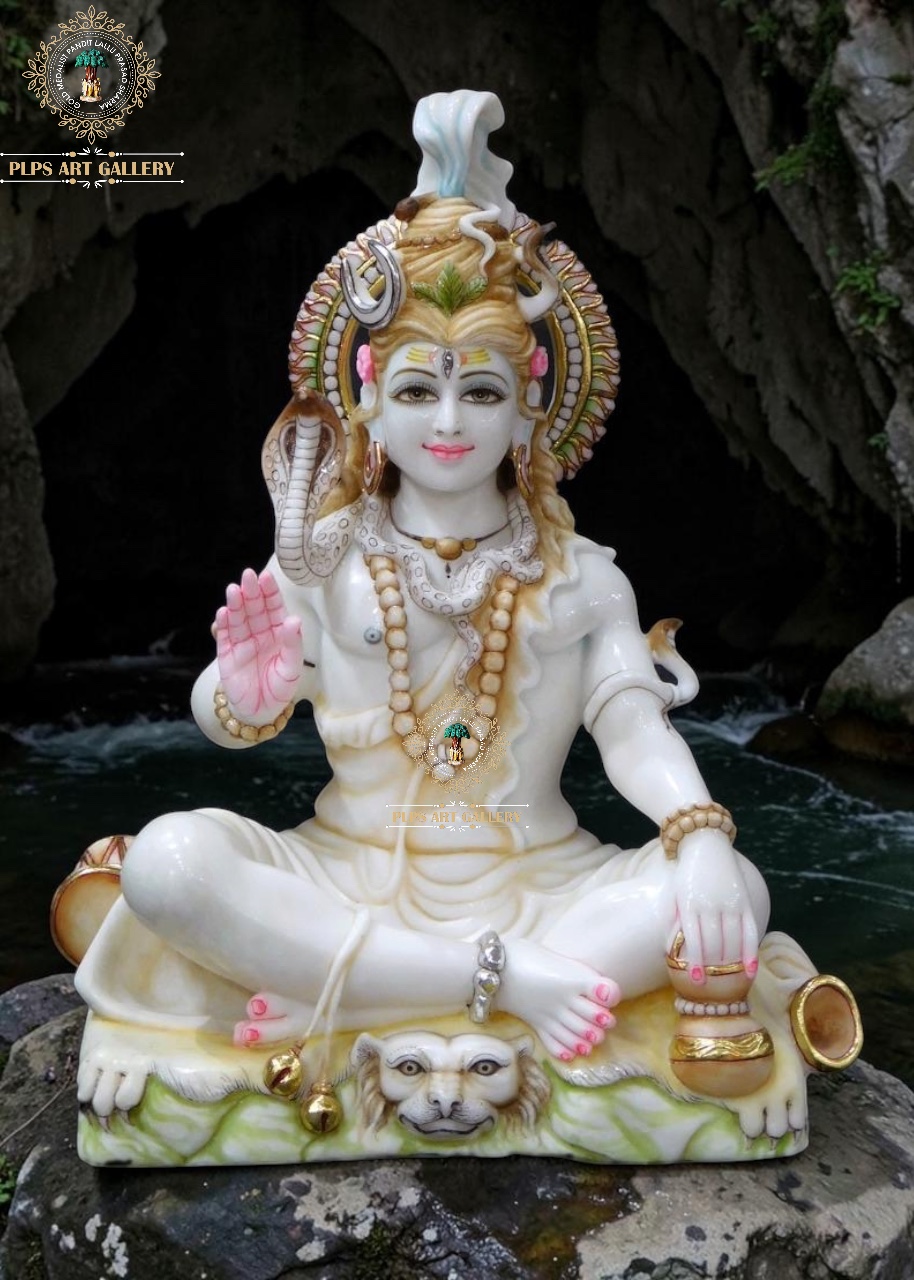
The Abstract Divine · Home Puja
The Shivling (Lingam)
A smooth stone pillar rising from a circular yoni base — Shiva as pure consciousness, beyond image and name. The most traditional home worship form, favoured for its cool, meditative energy and daily abhishekam.
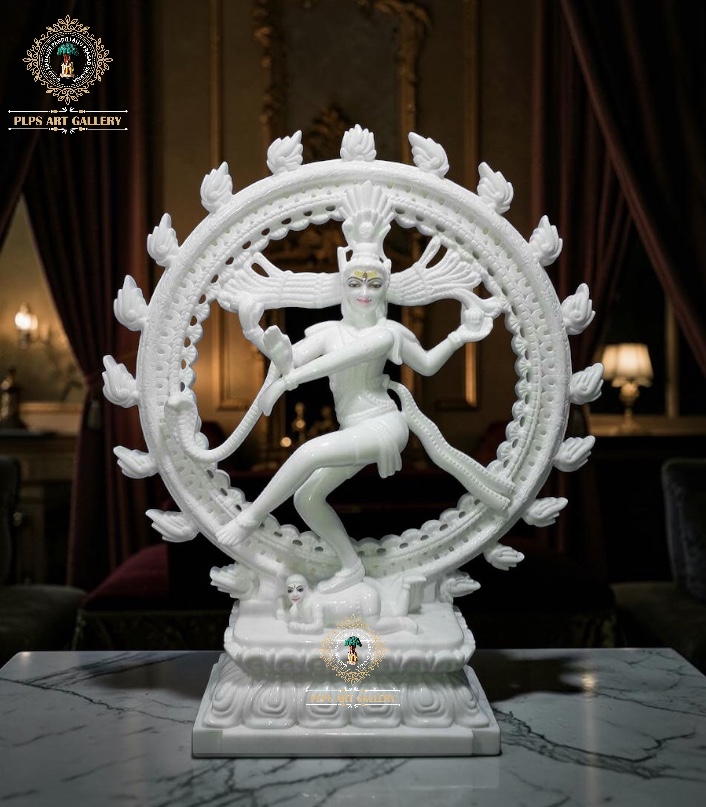
The Cosmic Dancer · Study / Living Room
Nataraja
Shiva as the cosmic dancer — one leg raised, ring of fire around, demon of ignorance beneath. Every element of the pose is coded philosophy: creation, preservation, destruction, illusion, liberation.
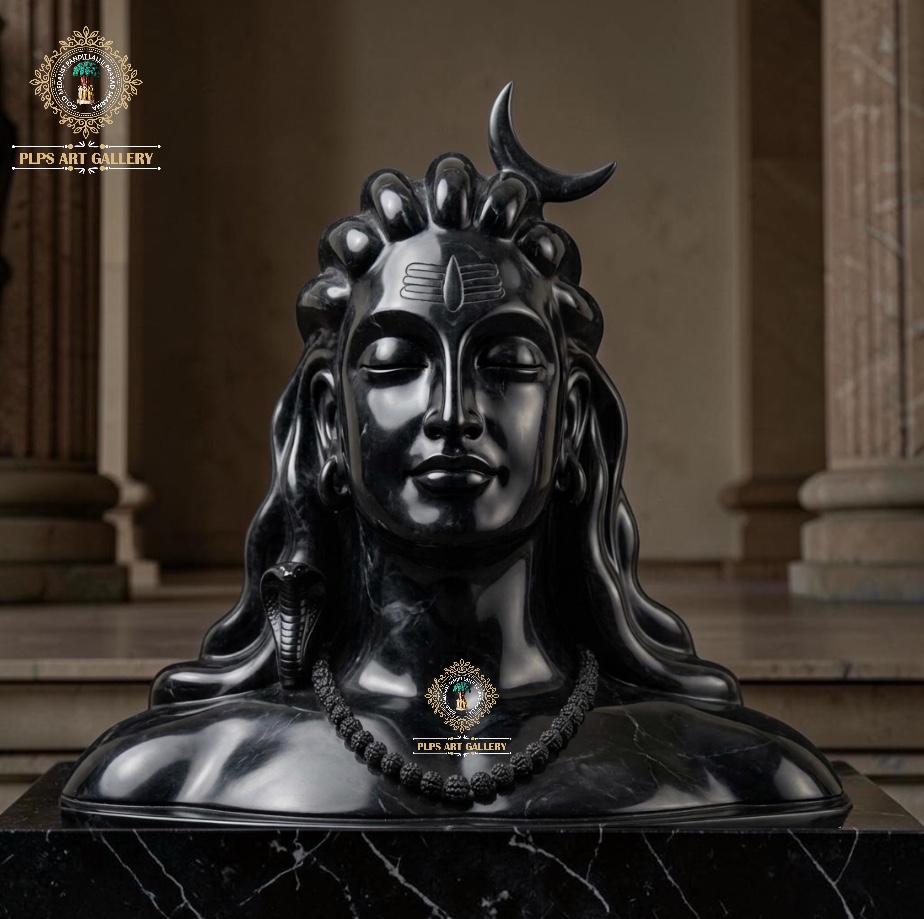
The First Yogi · Meditation Room
Adiyogi
Shiva as the seated ascetic in perfect meditation — matted hair, half-closed eyes, absolute stillness. The archetypal yogi from whom yoga descended. Ideal for meditation corners and quiet spaces.
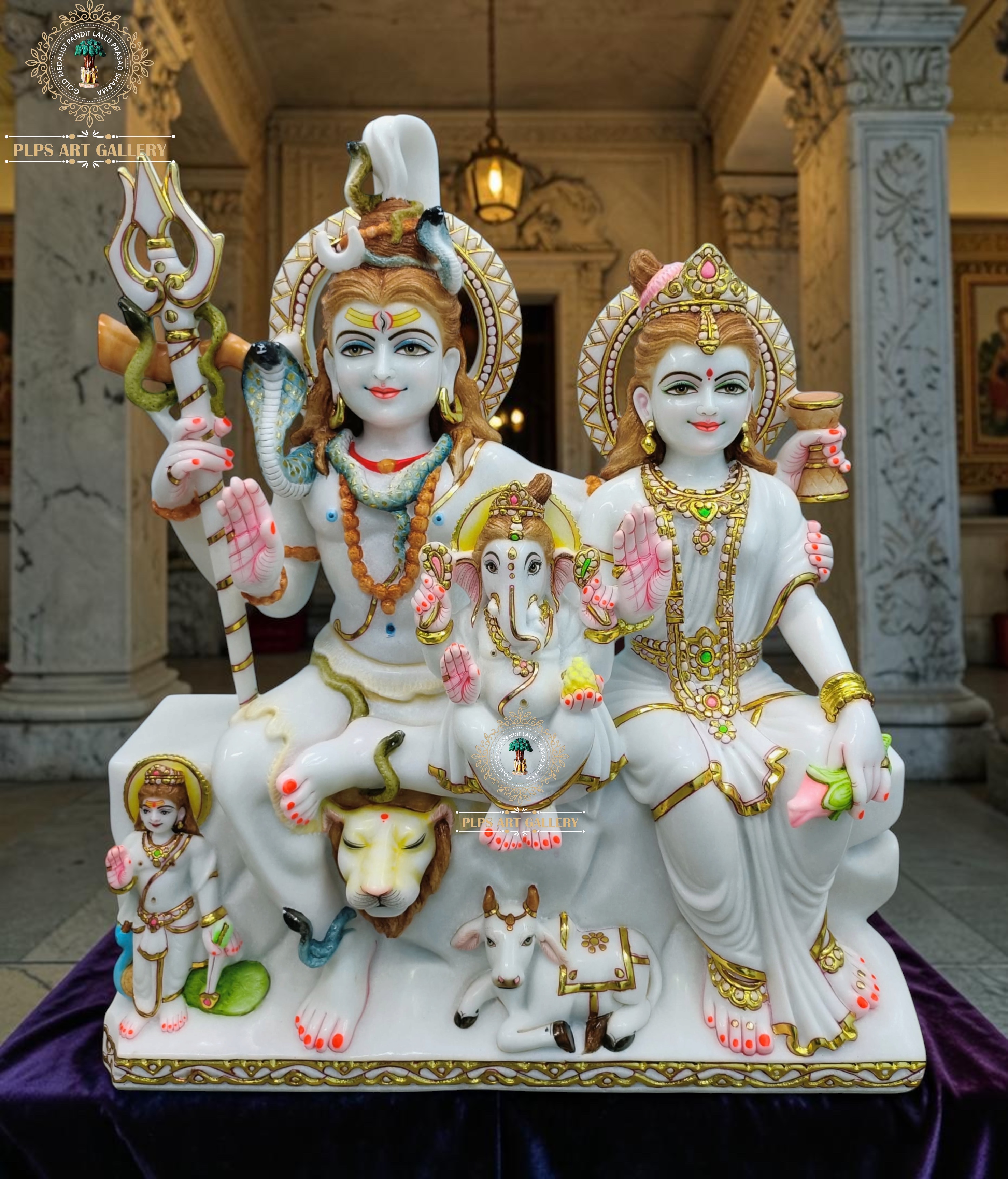
The Divine Family · Family Mandir
Shiv Pariwar — Gaurishankar
Shiva as the loving householder — carved with Parvati beside Him, Ganesha and Kartikeya at Their feet. A warm, family-oriented form for those seeking the divine family’s complete presence.
Section II
Reading His Iconography
A properly carved marble Shiva should render each of His symbols with the correct meaning intact. If any of these are missing or wrongly placed, the sculpture is not shastra-compliant.
The Third Eye
Wisdom that sees beyond appearance. When opened, it burns illusion itself to ash.
The Crescent Moon
Mastery over time. The waxing moon in His hair marks His command over cycles of change.
The Trishul
The three gunas — sattva, rajas, tamas — held in perfect balance. His signature weapon.
The Damru
The primordial sound of creation — the drumbeat from which the Sanskrit alphabet emerged.
Ganga in His Hair
The celestial river tamed — grace that flows through Him to earth without destroying it.
The Serpent Vasuki
Fear itself, subdued around His neck. The Neelkanth — He who drank poison to save creation.
Section III
Shivling or Statue — Which for Your Home?
Devotees often ask which form to bring home first. Both are entirely valid — they invite different practices.
The Abstract Form
Marble Shivling
- ♦ Daily abhishekam — pour water, milk, honey
- ♦ Requires a Nandi placed facing it
- ♦ Must sit on a raised chowki, never on floor
- ♦ Best for daily ritual worship
- ♦ Traditional home mandir choice
The Iconic Form
Marble Shiva Statue
- ♦ Nataraja, Adiyogi, or seated Shiva form
- ♦ Worshipped through darshan and aarti
- ♦ No Nandi requirement
- ♦ Suited to meditation rooms or living areas
- ♦ Contemplative, artistic presence
Traditional guidance: If you seek a formal daily puja routine, the Shivling is the ancient choice. If you seek Shiva’s presence and contemplation without daily ritual, the statue form suits better.
Section IV
Vastu — Where Shiva Belongs in Your Home
Shivling placement
- Direction: North or North-East
- Facing: East (spout to North)
- Nandi: facing the Shivling
- Base: raised chowki/brass
What to avoid
- Bedroom placement
- Under staircases
- Adjacent to bathroom walls
- Kitchen or cluttered spaces
A home Shivling must be accompanied by a small Nandi, placed directly in front and facing the Shivling. In traditional homes, the Nandi is treated as guardian — without His presence, the installation is considered incomplete.
Section V
The Marble — What to Look For
Most “marble” Shivlings sold cheaply online are cast composites — marble dust bound in resin. A real Makrana marble Shivling has qualities you can verify at a glance.
- ✥ Cool to the touch — genuine marble stays noticeably cool even in a warm room. Resin composites warm quickly.
- ✥ Dense weight — a genuine Makrana Shivling is roughly 2.7× the weight of the equivalent composite.
- ✥ Subtle veining — look for faint grey grain patterns under strong light. Perfectly uniform white = suspicious.
- ✥ Smooth curve at the yoni — hand-carved Shivlings have a subtle, flowing curve where lingam meets yoni base. Cast pieces show a sharp seam.
- ✥ Ask for the quarry — genuine artisans will name Makrana or Bhainslana without hesitation.
Custom Commissions
Commission a Shiva for Your Home or Temple
Marble Shivlings from 4″ to 5ft. Nataraja, Adiyogi, Bholenath, Ardhanarishvara — hand-carved in Makrana marble by the fourth generation of the family Shilp Guru Pandit Lallu Prasad Sharma founded. Speak with our team about your vision.
Begin a CommissionCommon Questions
What Devotees Ask Most
Can I keep a marble Shivling at home?
Yes — there is no scriptural prohibition. Traditional guidance simply asks for a proper installation: raised chowki, placement in the North or North-East, a Nandi facing the Shivling, and daily abhishekam (water offering). A small size (2–4 inches) is recommended for home worship.
Which direction should the Shivling face?
Place the Shivling in the North or North-East of your puja room. The lingam should face East, with the drainage spout of the yoni base facing North. This is the traditional Vastu placement, drawing on the north-flowing sacred rivers of Bharat.
Is Nandi required with a home Shivling?
Yes. A home Shivling should always be accompanied by a small Nandi placed directly in front, facing the lingam. Nandi is Shiva’s eternal devotee and guardian — His presence completes the installation. Without Him, the puja is considered incomplete in traditional practice.
What size Shivling is best for home puja?
For home worship, a small Shivling of 2–4 inches (thumb-sized to angusht-pramana) is traditionally recommended. Larger sizes are reserved for temple installations. A palm-sized marble Shivling on a proper chowki with Nandi in front is the ideal home configuration.
Can I commission a large Nataraja or Adiyogi statue?
Yes. We commission Nataraja, Adiyogi, Ardhanarishvara, and seated Shiva forms in sizes from 12 inches to 6 feet, hand-carved in Makrana, Vietnam, or Bhainslana marble. Nataraja is our most requested large-scale form — typical delivery is 60–120 days depending on scale.
Do you ship marble Shiva sculptures internationally?
Yes — we ship worldwide including the US, UK, Canada, Australia, UAE, Singapore, and beyond. Every sculpture is professionally crated with insurance and full export documentation. Contact us for a delivery estimate to your city.
Speak With Our Team
Sanctuary
PLPS Art Gallery
B-149, Khazane Walon Ka Rasta
Chandpole Bazar, Jaipur 302001