
Adiyogi Shiva
Adiyogi means 'the first yogi' — Shiva in his oldest and most essential aspect, the one who first transmitted the science of yoga to the seven Saptarishis in the Himalayan foothills. Since the Isha Foundation's 112-foot Adiyogi bust was unveiled at the base of the Velliangiri hills in Coimbatore in 2017, this contemporary iconic form has travelled far beyond Tamil Nadu: it now anchors yoga studios, meditation halls and quiet home altars across the world. It is important to distinguish this form from classical Shiva iconography. There is no trishul, no damaru, no dancing Nataraja pose, no Parvati beside him. As Sadhguru himself has articulated, Adiyogi is 'an iconic inspiration' — a meditation-object more than a puja-deity — and that framing shapes every craft decision that follows.
At our Chandpole Bazaar workshop, an Adiyogi commission is treated differently from a conventional Shiv Ji murti. Ninety per cent of the emotional charge of the finished piece must live in the face alone, because there are no attributes, no companion figures and no elaborate mudras to carry the eye. Our Shilpis begin with Shila Pariksha on a Makrana or Vietnam White block chosen specifically for a flawless facial plane. Then comes the piled crown of jatas — a genuine cantilever problem in stone, since the matted locks rise high above the skull and lean forward, requiring an intuitive understanding of grain direction and load distribution that only four generations of practice can teach. The closed eyes are the peak facial challenge in our workshop: they must read as inward-turned meditation, not simply shut. Chikni polishing then draws out the serenity for weeks.
Adiyogi is offered in three principal compositions. The face-only bust (echoing the Isha original) suits large statement walls in yoga studios and meditation halls. The half-body form — head, shoulders and crossed hands emerging from a plinth — reads beautifully on a home meditation altar. The full-body seated meditative form (padmasana, hands resting in dhyana mudra) is preferred by those who want a complete darshan piece for a dedicated silent room. Iconographically we hold to the essentials only: closed eyes, matted jatas piled high, crescent moon on the crown, serpent hood grazing the neck, the third eye a barely-perceptible vertical mark on the forehead. Placement is straightforward — a quiet corner, ideally East-facing or directly facing the seated meditator, in a space kept free of clutter, television and noise.
Sizes span from an 8-inch tabletop meditation-altar piece to 6-foot studio installations, with 24-inch to 48-inch sizes being the most requested by yoga-studio owners worldwide. We work in pure Makrana white, softer Vietnam White for finer facial modelling, deep-black Bhainslana for those who want an earthen hue, and a hand-applied matte black finish for devotees who wish to mirror the aesthetic of the Isha original. Gold leaf (Swarna Karya) is deliberately restrained on Adiyogi — often omitted entirely — because the silent, monochrome brief is central to the form. Custom lotus or Kailash-motif bases are available.
PLPS has served the international yoga and meditation community for four generations. Speak with our team to commission an Adiyogi shaped precisely to your practice space, anywhere in the world.

Frequently Asked Questions
A traditional Shiv Ji statue depicts Lord Shiva with his full iconographic vocabulary — trishul, damaru, Vasuki around the neck, Ganga flowing from the jatas, sometimes flanked by Parvati, Ganesha and Nandi. Adiyogi is a stripped-back, contemporary form popularised by Sadhguru and the Isha Foundation's 112-foot bust at Coimbatore, unveiled in 2017. It shows Shiva purely as the first yogi in deep meditation — closed eyes, matted jatas piled high, no weapons, no consort, no attributes. As Sadhguru himself frames it, Adiyogi is 'an iconic inspiration', a meditation-object rather than a classical deity murti.
The bust form concentrates every symbolic element into the head and face, because in yogic understanding the seat of transformation is above the neck. The closed eyes represent complete inward focus and meditative stillness — the moment consciousness turns from the outer world to the inner. The jatas piled high on the crown represent contained spiritual energy and the sahasrara chakra. The crescent moon signifies the cyclical nature of time and mind, and the serpent hood grazing the neck symbolises awakened kundalini. Together the bust distils the entire yogic path into one silent, unmoving face.
Treat Adiyogi as the visual anchor of the practice space rather than as a puja shrine. Position the statue where it faces the practitioners directly — usually the front-centre wall — so that eye level of a seated practitioner meets the lower third of the face. Elevate the piece on a plain plinth or low pedestal; avoid crowded shelving, incense clutter or competing imagery. Warm, indirect lighting from above and to the side brings out the meditative facial modelling beautifully. Keep the space silent, uncluttered, and free of electronics. East-facing installation is auspicious but not strictly required — facing the meditator matters more.
All three are legitimate choices. Pure Makrana or Vietnam White suits studios and homes where a calm, luminous presence is wanted — the white reads as peace and clarity. Bhainslana black marble carries a dense, grounding tonality chosen by devotees who prefer a grounded, sun-touched aesthetic. A hand-applied matte black finish over dense marble mirrors the visual language of the 112-foot Coimbatore Adiyogi and is often requested by yoga studios that want that specific gravitas. Our team helps you match the finish to the room's lighting, wall colour and intended emotional register.
Yes. We regularly execute Adiyogi commissions in the 4-foot to 6-foot range for yoga studios, meditation centres, wellness retreats and ashrams around the world. Anything above 3 feet is carved from a single hand-selected Makrana block, engineered so that the piled jatas — always a cantilever challenge — remain structurally sound for decades. Timelines for larger pieces run from 60 to 120 days depending on scale, finish and detailing. We share in-progress photographs at every stage, and every installation ships in a bespoke wooden crate designed for the specific dimensions of the piece.
The most delicate zone on an Adiyogi is the piled crown of jatas — the deep undercuts between the matted locks trap dust and, if wiped wet, can darken over time. Dust weekly with a soft, dry natural-hair brush; a shaving brush works perfectly for those interlocking grooves. Wipe the smooth planes of the face and shoulders with a barely-damp muslin cloth and dry immediately. Avoid all citrus, vinegar and acidic cleaners. Yes — PLPS ships worldwide. Every Adiyogi is packed in a custom wooden crate with foam cradles for the crown, and we handle export documentation to the US, UK, EU, UAE, Australia and beyond.
Looking for a custom Adiyogi Shiva?
Every piece is hand-carved to order in our Chandpole Bazaar workshop, Jaipur. Share your size, marble type and iconography — our 4th-generation artisans will craft it for you.
Request a Quote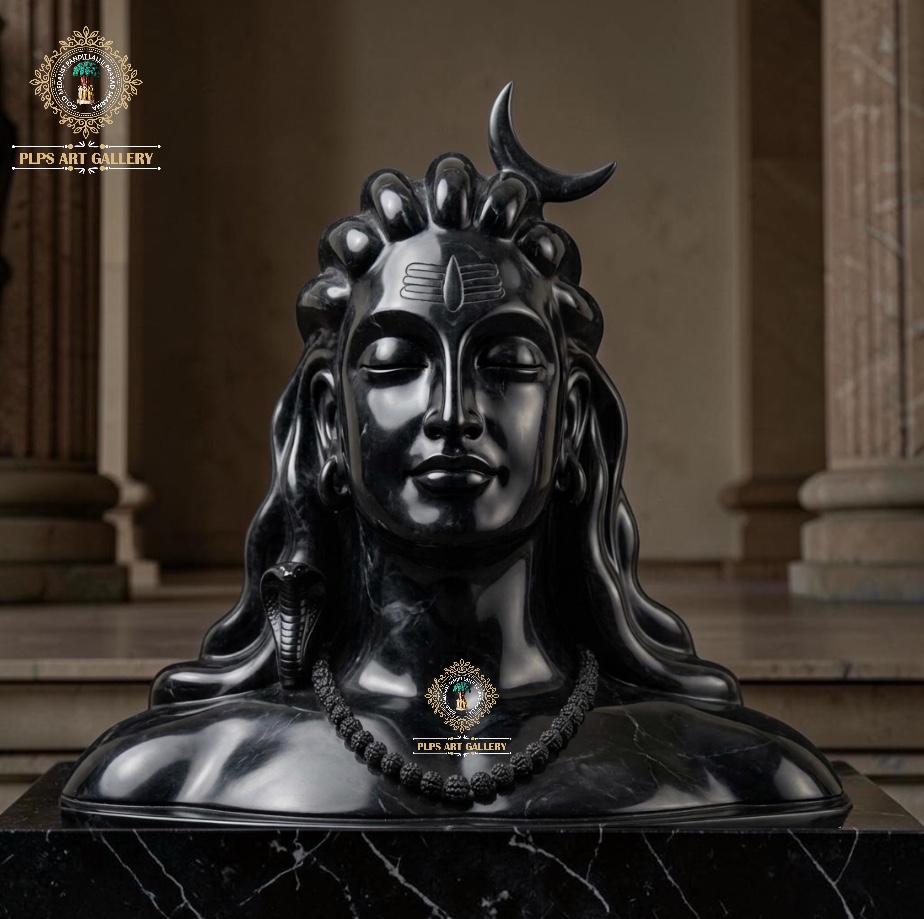
Made-to-Order Only
Our adiyogi shiva are crafted exclusively on commission. Share your size, marble type and iconography — our fourth-generation artisans will begin your piece at our Chandpole Bazaar workshop, Jaipur.
Start a Commission