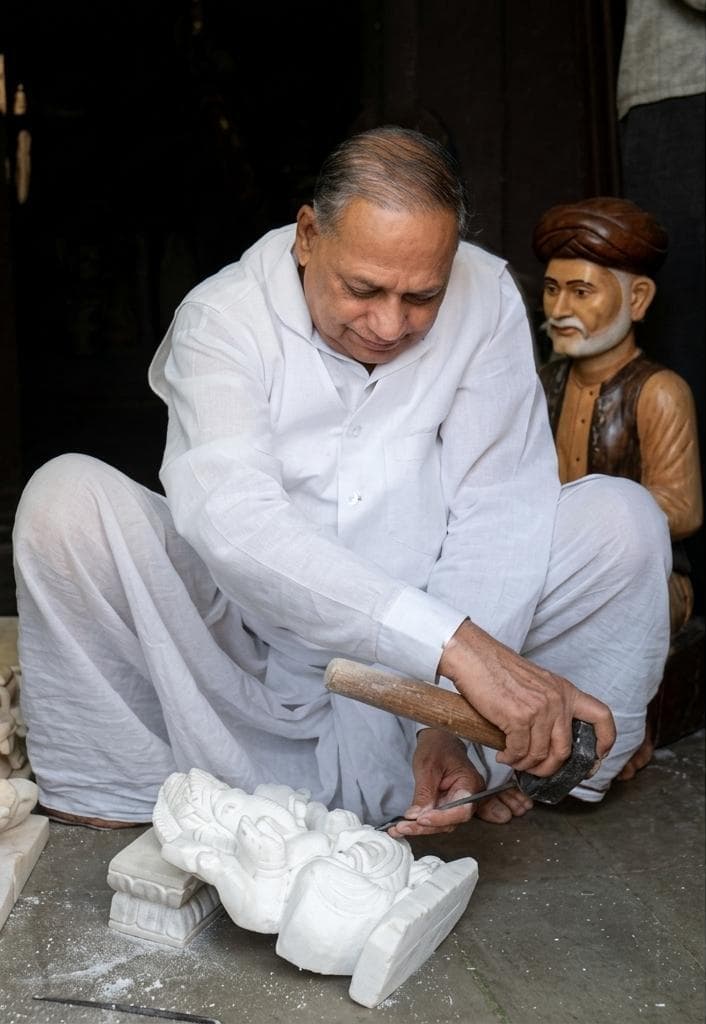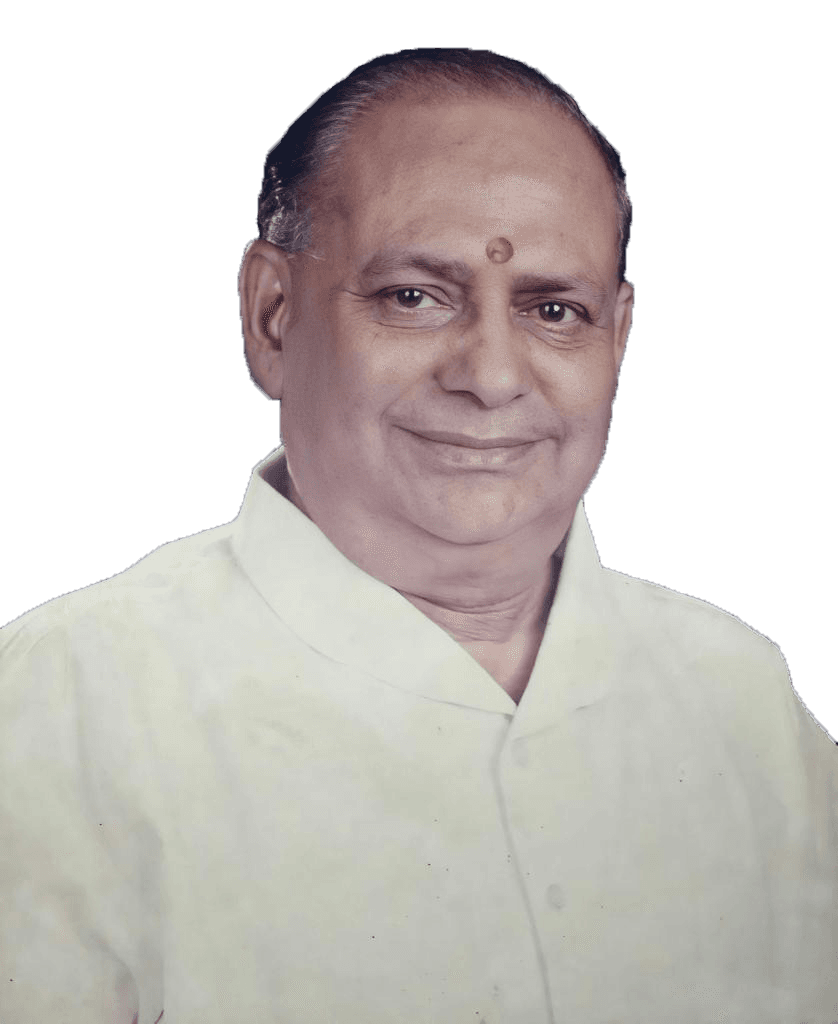
Portrait of Shilp Guru Pandit Lallu Prasad Sharma, founder of PLPS Art Gallery, Chandpole Bazar, Jaipur
Shilp GuruPandit Lallu Prasad Sharma Prithvipurawale · 1938
Founder · PLPS Art Gallery · Prithvipura, Rajasthan

Pandit Lallu Prasad Sharma

Master marble sculptor. National Award winner. Founder of PLPS Art Gallery, Chandpole Bazar, Jaipur. Creator of Ekta Vriksh and Jaipur Darshan — two of the most celebrated marble sculptures to come out of Rajasthan in the last half-century.

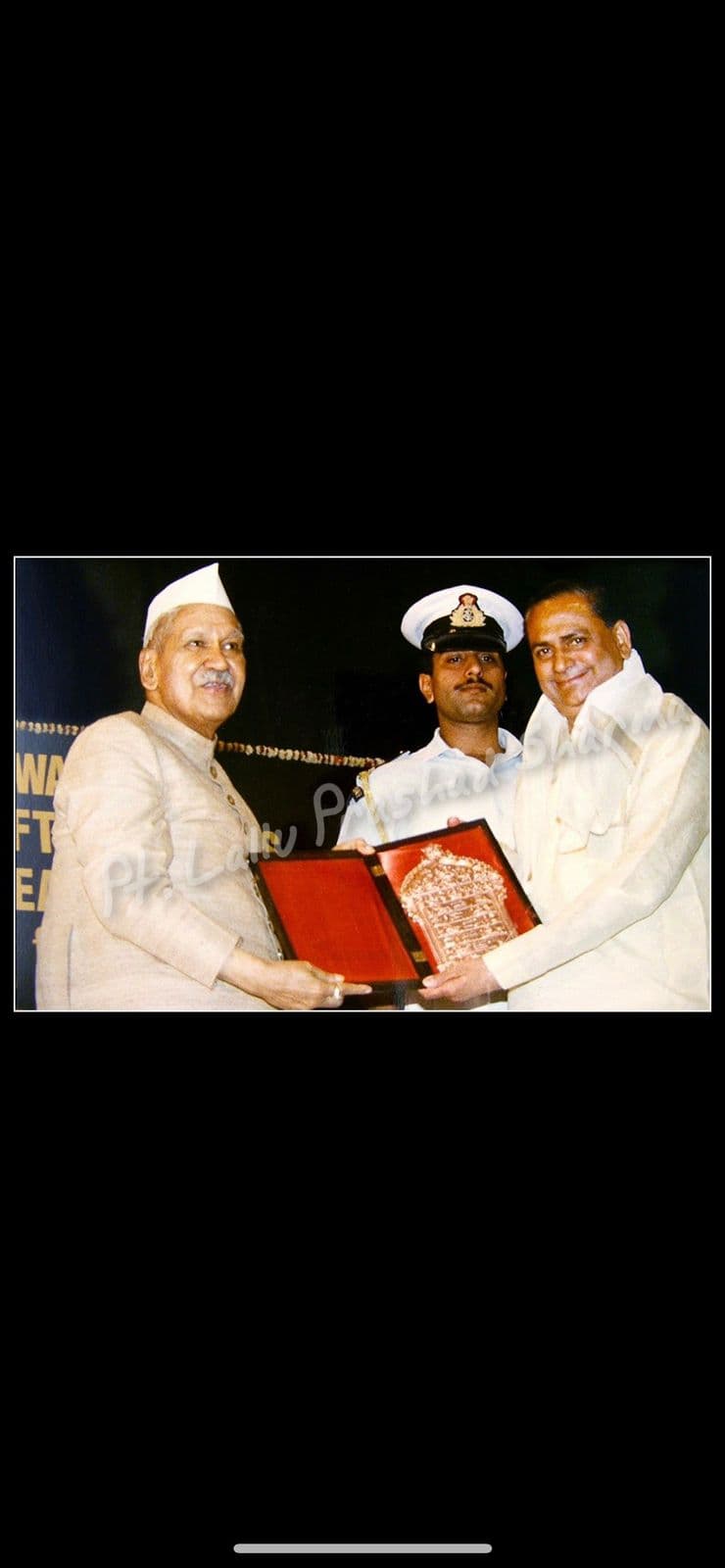
Shilp Guru Award, 2006National Award, 2005Presidential Award, 1991
Shilp Guru2006 · Government of India
National Award2005 · Master Craftpersons
Born 1938Prithvipura, Rajasthan
4th Generation LegacyPLPS Art Gallery, Chandpole

Shilp Guru Pandit Lallu Prasad Sharma Prithvipurawale — his complete formal name, with Prithvipurawale being the family lineage suffix that identifies his branch as originating from Prithvipura village — was one of India's most decorated master marble sculptors. Honoured with the Shilp Guru Award (2006, conferred at Vigyan Bhawan in December 2008), the National Award for Master Craftpersons in 2005, and a Presidential Award in 1991, his life spans nearly seven decades of active work in stone.

He founded what today operates as PLPS Art Gallery, working out of the same lane in Chandpole Bazar, Jaipur — a workshop now run by the fourth generation of his family. Beyond the awards and the workshop, two of his sculptures in particular sit in the country's cultural memory: Ekta Vriksh (also called Sab Dharm Saman) — his statement of religious harmony carved from a single 21-inch Makrana marble block over three years — and Jaipur Darshan, the four-foot relief that maps the old Pink City in stone.

The Story

From Prithvipura to Chandpole Bazar

01

A village boy who lost his father early

Pandit Lallu Prasad Sharma was born in 1938 in Prithvipura, a small village in Rajasthan. He lost his father when he was still a child, and the family faced hard financial years. To help at home, he first took up Panditai — the traditional priestly work of a Brahmin household — and travelled to Kashi (Varanasi) to formally study Sanskrit, Jyotish (astrology), and Vedic ritual.

It was in Kashi that he became fluent in the shastra vocabulary that would later shape every deity he carved. He was eleven when he first picked up a chisel; the sculpting apprenticeship and the priestly training grew up alongside each other in the same young man.
02

Eleven years with two masters

At eighteen he moved to Ahmedabad looking for work and a chance to develop as an artist. From Ahmedabad he returned to Jaipur, and here the real training began — eleven consecutive years under two of the city’s most respected sculpture masters.

Shri Devi Sahay Ji Kishoriwala taught him the intricate iconographic detail that separates a devotional idol from a decorative statue — the way an eye is opened up, how the fingers of the vardamudra should fall. Shri Narayan Lal Ji Tiwari gave him the broader Rajasthani sculpture school tradition — proportion, drapery, the compositional grammar of a temple piece. Together, these two masters wrote the technical dictionary Pandit ji would use for the rest of his life.

03

A workshop of his own in Chandpole Bazar

The family firm traces back to 1950, but Pandit ji set up his own independent workshop in 1987, first at Girja Sadan, Khazane Walon Ka Rasta, and eventually at the current flagship at B-149 in the same lane. He picked Chandpole Bazar deliberately — this has been Jaipur’s marble artisan quarter for centuries, the address every serious buyer eventually finds their way to.

From that workshop came the pieces that would carry his name — moortis for homes and temples across India, exports abroad, custom commissions from collectors, and the two masterworks that would eventually bring him the Shilp Guru honour.

Government Recognitions

A career decorated by the Republic

Six national honours over four decades — the highest set of formal recognitions available to a traditional Indian craftsman.

1985

Heritage Artisan Recognition

One of his earliest formal recognitions — acknowledged among the master artisans preserving traditional Indian marble sculpture.

1991

Presidential Award

Conferred by the President of India for distinguished contribution to the craft.

1992

National Media Recognition

Feature coverage in leading national newspapers. The 1992 press clipping is still preserved in the workshop.

2005

National Award for Master Craftpersons & Weavers

Government of India's National Award — recognising a lifetime of technical mastery in marble sculpture.

2006

Shilp Guru Award

The highest honour the Government of India bestows on a master craftsman. The 2006 Shilp Guru Award was conferred on him at Vigyan Bhawan, New Delhi on 15 December 2008. This is the award that gave him the title he was addressed by for the rest of his life.

Gold Medal, Ministry of Textiles, Government of India

Awarded by the Ministry of Textiles for excellence in traditional handicrafts.

The Two Masterworks

Sculptures that carried his name across the country

Every sculptor has a body of work. A few have one or two pieces that permanently enter the cultural memory. Pandit ji had two.

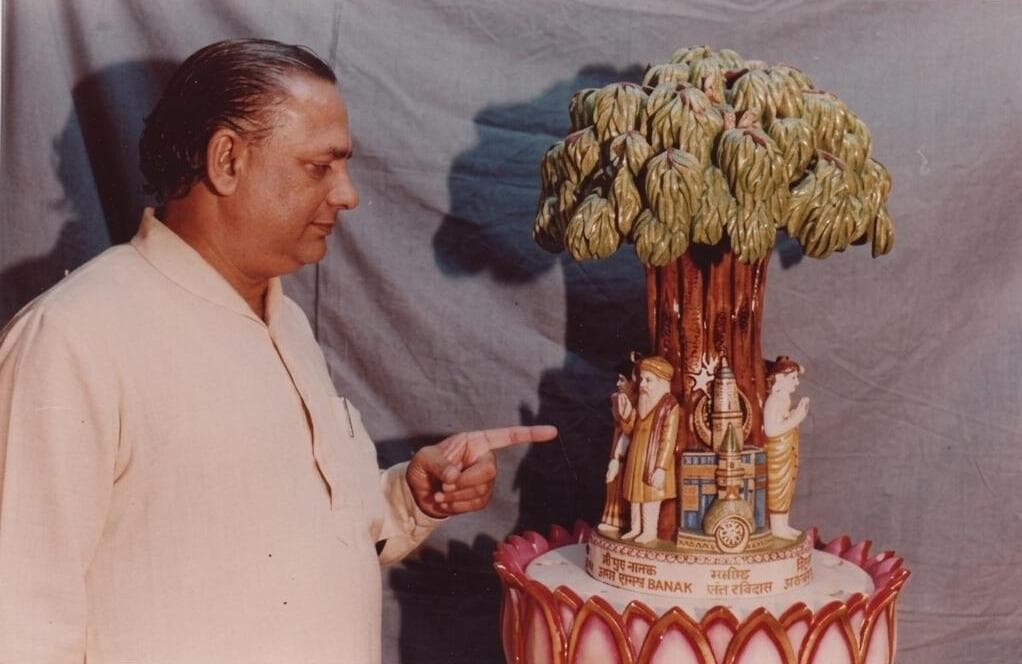
Ekta Vriksh — Sab Dharm Saman — Tree of Unity marble sculpture by Pandit Lallu Prasad Sharma
Ekta Vriksh · Sab Dharm SamanMakrana marble · 21 inches · 3 years of work · Completed 1990
Masterwork · 01

Ekta Vriksh — The Tree of Unity

Also known as Sab Dharm Saman — “All religions are equal.” A single 21-inch block of Makrana marble, carved continuously over three years, completed in 1990. Six spiritual traditions converge under one Kalpavriksha: Ram and Sita, Guru Nanak Dev Ji, Jesus Christ, Gautam Buddha, Mahavir Swami, and the symbols of Mecca and Madina.

The engineering is as remarkable as the meaning. It is hollow-carved from a single stone, has a six-petal opening technique, a 360-degree rotating mechanism, and each of the six 8-inch figures is a fully-detailed sculpture in its own right. There is no other piece quite like it.

Pandit ji made it during a period of communal tension — his personal argument that religion is a matter of faith, but humanity and nature are larger than any one faith. The ancient Sanskrit formulation is Vasudhaiva Kutumbakam: the world is one family.

The original still sits in the PLPS Art Gallery workshop in Chandpole Bazar, where it can be viewed on request.

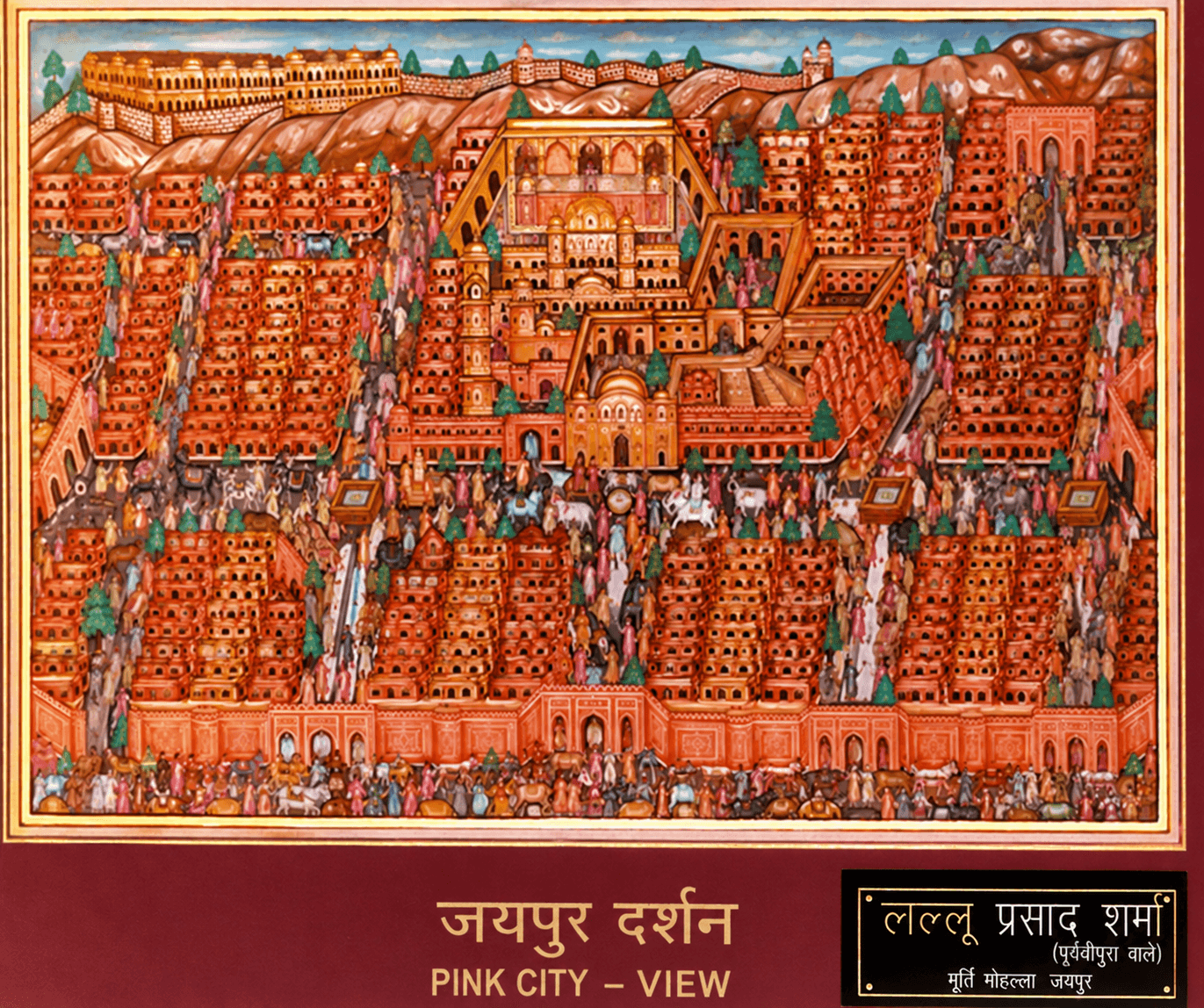
Jaipur Darshan — marble relief sculpture depicting the Pink City by Pandit Lallu Prasad Sharma
Jaipur DarshanMarble relief · Approx. 4 ft × 3 ft · Single-stone composition
Masterwork · 02

Jaipur Darshan

A marble relief that reads like a love letter to the old Pink City. Roughly four feet by three feet, carved from a single stone. Every important landmark of Jaipur is compressed into it: Chandra Mahal, the City Palace, Jantar Mantar, Hawa Mahal, Albert Hall, Amer Fort, Govind Dev Ji Temple, and the three great chaurasars — plus M.I. Road running through the piece.

What sets it apart is what fills the streets. Pandit ji added bus drivers, rickshaw pullers, cart vendors, women carrying water pots, tangas moving between the monuments. It is not a monument map — it is a portrait of a city that actually lives. The blend of architectural documentation and everyday street life is what gave it the ethnographic weight critics noted.

Jaipur Darshan is understood to have been the key work in the selection committee's decision to award him the Shilp Guru title (2006). It is displayed at the workshop and visitors are welcome to see it.

Visit the Workshop

Both sculptures still sit where they were made

Ekta Vriksh and Jaipur Darshan are displayed at the PLPS Art Gallery workshop in Chandpole Bazar, Jaipur — a 15-minute drive from Jaipur Junction. Visitors are welcome. Please message ahead so a family member of the fourth generation can walk you through the pieces.

In His Own Words

The craft, as he understood it

A sculptor does not carve stone. He listens to it — and releases the divine that is already within.

— Pandit Lallu Prasad Sharma · On what sculpture is

A Brahmin must first master the mantra. A sculptor must first master the shastra. When both live in one man, the deity carved by his hand truly comes alive.

— Pandit Lallu Prasad Sharma · On his own dual training as priest and sculptor

A father teaches his son. His son teaches his son. His son teaches his son. That is how you know a craft is truly alive — four generations later, the stone still speaks with the same voice.

— Pandit Lallu Prasad Sharma · On lineage
Community & Continuation

Adi Gaur Brahmin Murti Samaj — and four generations after

Pandit ji belonged to the Adi Gaur Brahmin Murti Samaj — the traditional community of Shilpi Brahmins, twice-born practitioners of sacred craft. Membership meant something specific: iconographic canons drawn from the Shilpashastra texts, ritual purity protocols during the sculpting itself, generational transmission of technique, and a shared guardianship of Sanatan iconography.

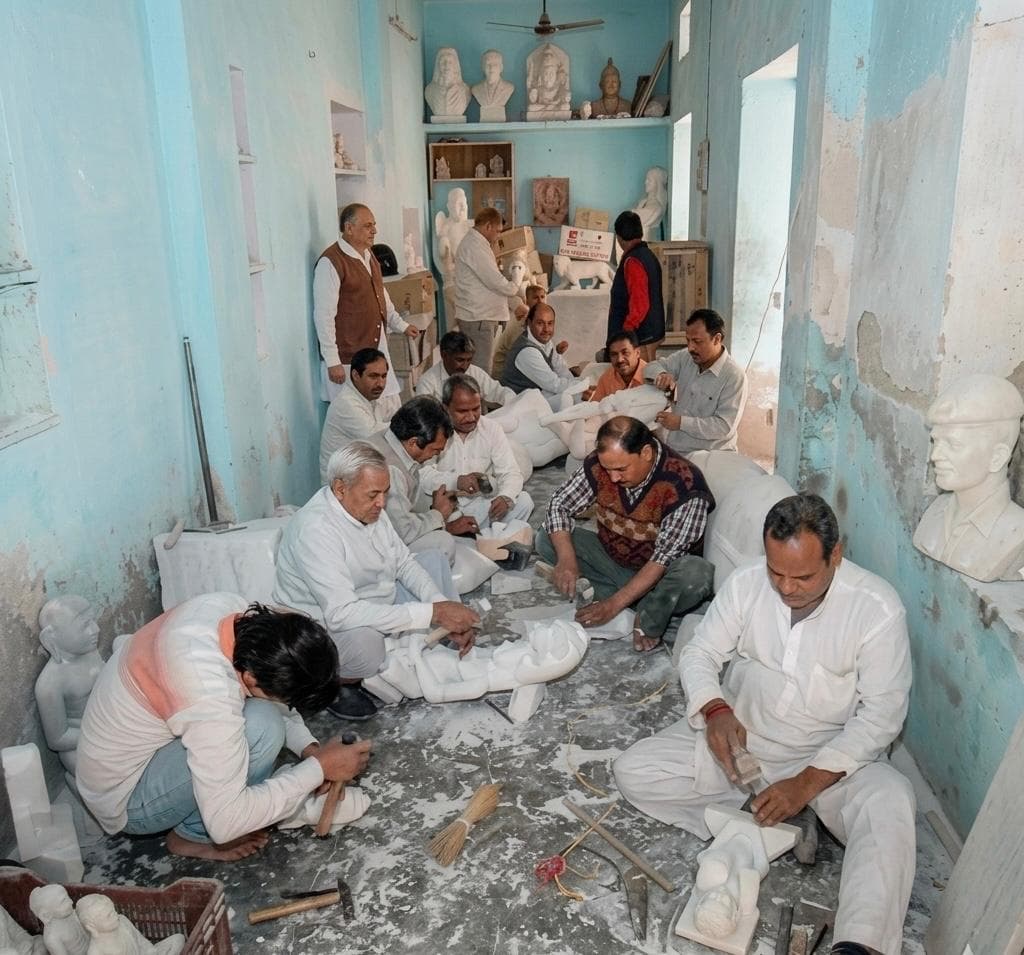
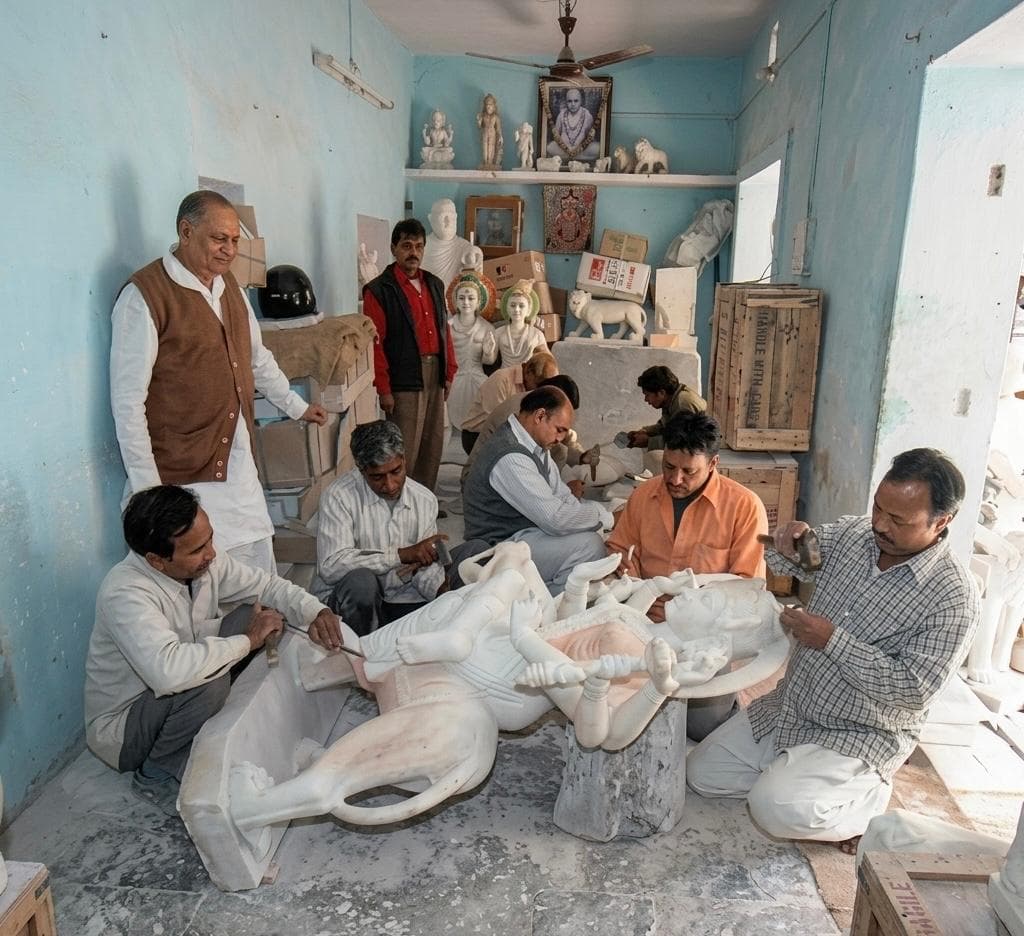
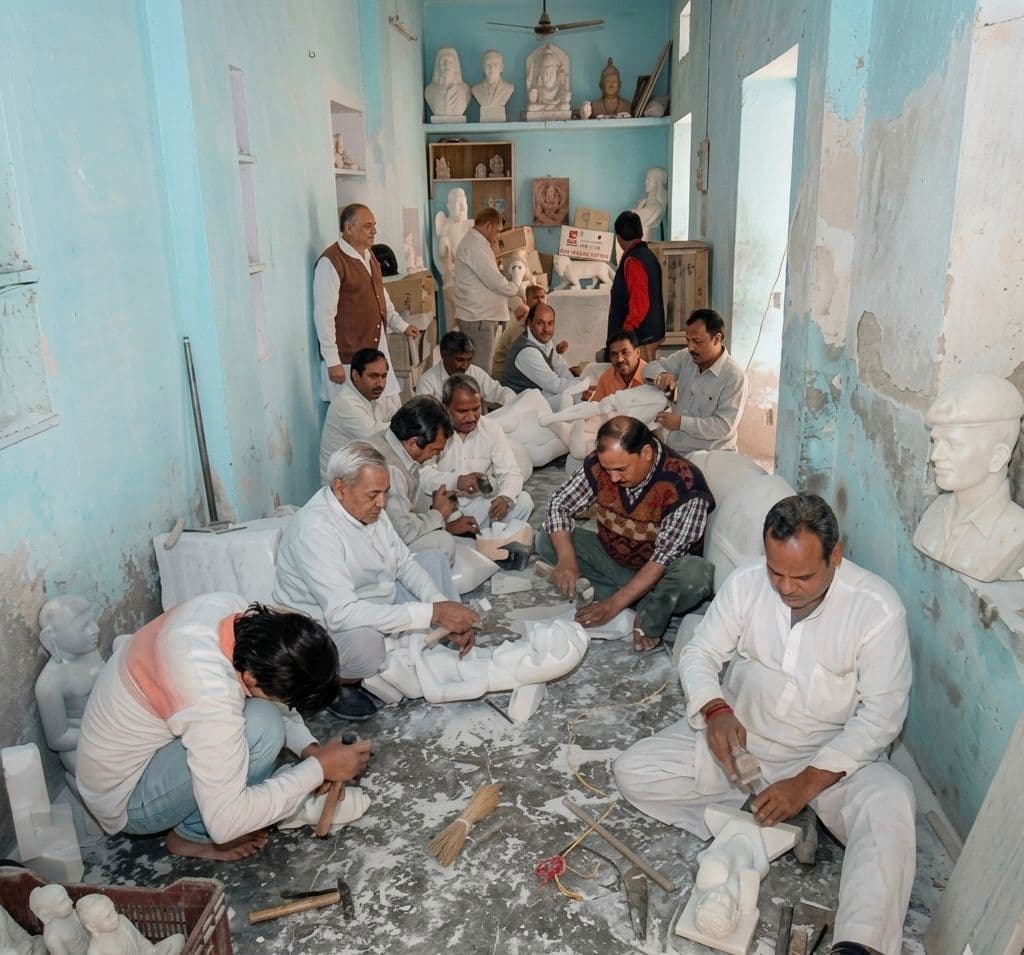
That community discipline is the reason his workshop looks the way it does today. His sons trained under him. His grandsons trained under his sons. The current floor at PLPS Art Gallery is run by the fourth generation of the family — his grandchildren and great-grandchildren — supported by more than 50 skilled artisans, all trained in the same hand-carving methods he inherited and refined.

The tools have been upgraded. The polish is better. But the sequence of cuts, the way an eye is opened up, the way a drapery fold gets undercut — those come directly from his teaching. Every apprentice on the floor still learns them first.

Pandit Lallu Prasad Sharma teaching his descendants at the family workshop

Pandit ji teaching at the workshop — the transmission that made four generations possible

Continue The Tradition

Order a marble moorti from the same workshop

The workshop Pandit ji built is still hand-carving marble moortis in Chandpole Bazar, Jaipur — now run by the fourth generation of his family. If you would like a piece made by the artisans he trained, the fastest way to start a conversation is WhatsApp.