
Ambaji Mata murti
Ambaji Mata is one of the most beloved forms of Devi in Western India — the presiding goddess of the Ambaji temple in Banaskantha, Gujarat, revered as one of the 51 Shakti Peethas where the heart of Sati is said to have fallen. In Gujarati households she is worshipped as the maternal Shakti, radiant and benevolent, and is deliberately distinct from Durga's fierce Mahishasura-slaying form. From Navratri altars in Ahmedabad and Rajkot to diaspora mandirs in New Jersey, Leicester and Nairobi, Gujarati families commission her marble murti for daily aarti and generational puja. At PLPS Art Gallery, four generations of Jaipur artisans since 1950 have shaped Ambaji Mata's radiant form — the softly smiling face, the multiple arms bearing chakra, shankha, trisula and abhaya mudra, and the lion vahana beneath her. Founded by Late Pandit Lallu Prasad Sharma, Shilp Guru and Presidential Awardee (1991), our workshop uses traditional mineral pigments for the signature red-pink saree, Swarna Karya gold-leaf on the mukut, haar and weapons, and hand-painted natural colours on the lion. We ship insured to Gujarati families in the USA, UK, East Africa and the Gulf. Classical Ambaji iconography depicts her with four or eight arms bearing chakra, shankha, padma, gada, dhanush-bana, trisula and khadag, with one hand raised in abhaya mudra. She rides a lion or tiger — hence her Gujarati name Vaghesari — and unlike Kali or Chamunda her face is serene and maternal, crowned with an ornate mukut. Vastu Shastra places her in the North-East corner (Ishaan Kon) of the home mandir, facing East. During Navratri her murti receives special sthapana with the akhand jyot, and the family's garba and dandiya are dedicated at her feet. Our Ambaji Mata murtis range from 6-inch personal shrine pieces to 5-foot temple installations, with 12 to 24 inch sizes most popular for Gujarati household mandirs. Every element accepts customisation: the traditional saree can be shaded to deep sindoori red for classical Ambaji or the softer gulabi pink favoured by Kathiawadi families; the lion can be rendered pale golden or classical white; and the mukut, nath and haar can receive full Swarna Karya gold-leaf. Wedding-gift sets pair a 9-inch Ambaji with a matching wooden mandir, and our diaspora shipping includes moisture-safe crating and replacement guarantees for transit damage. For Gujarati families in Ahmedabad, Rajkot, London, Newark or Nairobi seeking an heirloom Ambaji Mata murti, contact PLPS Art Gallery at Chandpole Bazaar, Jaipur. Custom orders take 30 to 90 days with worldwide insured shipping.

Frequently Asked Questions
Ambaji Mata and Durga are both supreme forms of Devi, but they are worshipped and depicted differently. Ambaji is the presiding goddess of the Ambaji Shakti Peetha in Gujarat, revered primarily in her maternal, benevolent aspect — radiant and softly smiling, seated or standing gracefully on her lion, dressed in a red or pink saree. Durga is more commonly shown in her Mahishasura-mardini form, actively slaying the buffalo demon with a fierce expression. An Ambaji murti will show a serene face and abhaya mudra, while a Durga murti carries the full array of weapons with Mahisha at her feet. Gujarati families almost always choose Ambaji.
The Ambaji temple in Banaskantha is one of the 51 Shakti Peethas — the sacred sites where parts of Sati's body fell after Shiva carried her charred remains across the cosmos. Ambaji marks the spot where her heart fell, giving the shrine its status as a Mahashakti Peetha of immense tantric and devotional power. Uniquely, the temple itself contains no physical idol; the goddess is represented only by the Shree Visa Yantra. For home worship, however, Gujarati families install marble murtis in her iconographic form and draw the same Shakti through consecrated pran pratishtha rituals performed by a family priest.
For a Gujarati household mandir, a 12 to 18 inch Ambaji Mata murti in Makrana or Vietnam White marble is the most popular choice. The four-armed standing form on a lion vahana suits most home altars, with the traditional red-pink saree and gold-leaf mukut giving the shringar its authentic Gujarati character. Families who host large Navratri gatherings often prefer 24 to 36 inch pieces so the murti reads clearly from across a garba floor. Placement in the North-East corner facing East, with an akhand jyot beside her, follows the traditional Vastu convention observed at the Ambaji temple itself.
For Navratri sthapana, which usually falls in late September or early October, we strongly recommend placing your order by mid-June. A custom Ambaji Mata murti takes 30 to 90 days from Shila Pariksha stone selection through Rekhankan sacred marking, main carving, Chikni polishing, mineral pigment saree painting, and Swarna Karya gold-leaf finishing. Larger 24-inch and above pieces sit at the longer end of that range. Add another 10 to 15 days for insured shipping within India, and up to 4 weeks by sea for the USA, UK or East Africa. Air freight is available for last-minute Navratri deliveries.
White marble is the traditional base — Makrana for heritage-grade heirlooms, Vietnam White for a softer bright modern finish, or black Bhainslana if you prefer a dramatic dark-toned murti. The saree colour is applied over the finished marble using mineral pigments that Gujarati devotional tradition prescribes: deep sindoori red for classical Ambaji, or the softer gulabi pink favoured in Kathiawad and Saurashtra households. Both are hand-painted in fine layered brushwork with the border edged in Swarna Karya gold-leaf. Colours are sealed with a natural fixative but remain reversible, so the shringar can be refreshed by our workshop after many years of daily worship.
Yes — PLPS ships worldwide with full transit insurance and specialised moisture-safe crating designed to protect the mineral pigment saree and Swarna Karya gold-leaf finishes. To the USA and UK, sea freight takes 5 to 7 weeks and air freight 7 to 10 days; East Africa and the Gulf are typically 3 to 5 weeks. Once installed, dust the murti daily with a soft dry cloth. Never use a damp cloth on the painted saree or gold-leaf, as moisture lifts pigment; wipe only the exposed marble face and lion with a barely-damp cloth using plain water, avoiding all acidic cleaners.
Looking for a custom Ambaji Mata murti?
Every piece is hand-carved to order in our Chandpole Bazaar workshop, Jaipur. Share your size, marble type and iconography — our 4th-generation artisans will craft it for you.
Request a Quote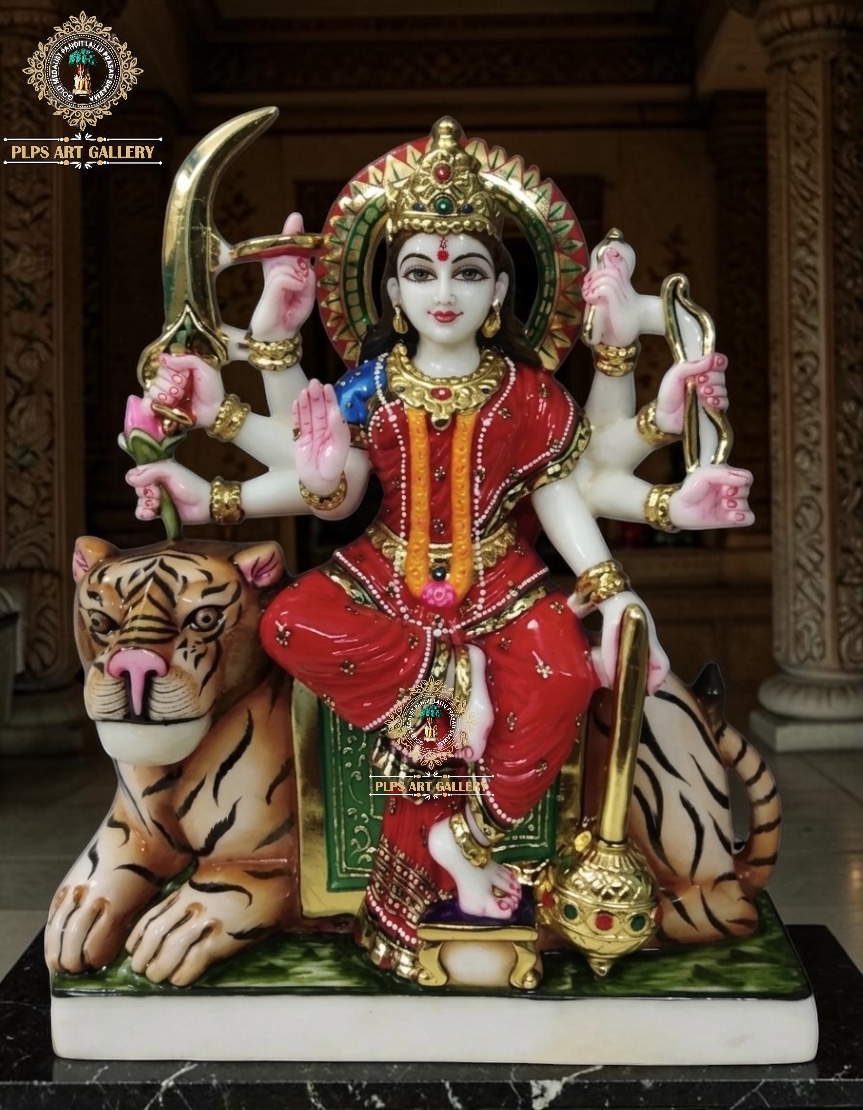
Made-to-Order Only
Our ambaji mata murti are crafted exclusively on commission. Share your size, marble type and iconography — our fourth-generation artisans will begin your piece at our Chandpole Bazaar workshop, Jaipur.
Start a Commission