
Ardhanarishvara
Ardhanarishvara is unlike any other form in the Hindu pantheon. Where Shiva-Parvati Jugal Jodi shows the god and goddess as a devoted couple, Ardhanarishvara shows them as one single body — the right half Shiva, the left half Parvati, joined seamlessly down a central midline. The Shiva Purana narrates that when Parvati asked how to share in Shiva's ecstatic state, he did not prescribe austerity; he offered her his left side, and she entered him. The composite figure that resulted is Hinduism's most philosophically radical iconography: the assertion that Purusha (pure consciousness) and Prakriti (creative energy) are not two forces to be reconciled but a single, indivisible reality. It is the form sought by yoga philosophers, Kashmir Shaivism practitioners, Sri Vidya sadhaks, Samkhya students and every seeker whose path centres on non-duality.
At our Chandpole Bazaar workshop, carving an Ardhanarishvara is the sculptural test our Shilpis prepare for over years. The challenge is a paradox: one silhouette must house two anatomies. The right shoulder must carry Shiva's musculature and half-chest; the left shoulder must carry Parvati's softer curve and single breast. The right leg stands in ascetic firmness; the left bends in tribhanga grace. The head wears a jata-mukuta of matted locks on the right and a karanda-mukuta with braided flowers on the left, meeting at a hairline no wider than a chisel edge. The right side is bare-chested with a serpent yagnopavita and tiger-skin lower garment; the left side is draped in a silk saree flowing to the ankle. A single seam of stone joins them. This is why Shila Pariksha — the ritual reading of the block for veins — matters more here than for any symmetric deity: one vein crossing the midline will visually split the figure into two, destroying the entire theological point. We reject blocks other studios would accept.
Iconography must be scripturally exact. Right is always Shiva; left is always Parvati — never reverse this, as the Shiva Purana, Linga Purana and Skanda Purana are unanimous. In the four-armed form, the upper right hand holds the parashu (axe) or trishul, the lower right rests in abhaya mudra or holds an akshamala; the upper left holds a nilotpala (blue lotus) or darpana (mirror), the lower left rests on Nandi's head in kataka hasta. The right eye is Shiva's tapasvi gaze, the left eye is Parvati's lotus-shaped saumya glance; the forehead carries a half-vertical vibhuti mark on the right and a half-round kumkum bindi on the left. For Vastu, Ardhanarishvara is best placed in a dedicated sadhana room, meditation space or philosophical study — its energy is contemplative, not domestic. East-facing placement on an elevated lotus or Nandi-carved base is ideal; avoid bedrooms and never place on the floor.
Sizes range from 6-inch scholarly desk pieces for philosophers and yoga teachers to 5-foot statement installations for ashrams, yoga schools and dedicated meditation halls. Tabletop 8"-12" sizes are favoured by practitioners who want the icon at eye level during seated sadhana. For larger works, Swarna Karya (gold leaf) can be applied selectively to Parvati's karanda-mukuta, jewellery and saree border — deliberately not touching the Shiva half, so the asymmetry reads as intentional. Mineral pigments can tint the saree, the tiger skin and the blue nilotpala. Bases are commonly a plain lotus, a Nandi-carved plinth, or a stepped Kailash pedestal.
Because the Shilpi is effectively carving two figures inside one silhouette, custom Ardhanarishvara orders take longer than any other deity in our catalogue — typically 60 to 150 days depending on size and detailing. Four generations of PLPS craftsmen, trained in the disciplines of Late Pandit Lallu Prasad Sharma (Shilp Guru, Presidential Award 1991), have carved this form for sadhaks, philosophers and non-dualist teachers across India, Europe and North America. If your path centres on the union of masculine and feminine, on Shiva-Shakti as one, speak with our team to commission a piece worthy of the seat you will place it on.

Frequently Asked Questions
Ardhanarishvara is Sanskrit for 'the Lord who is half-woman' — Ardha (half) + Nari (woman) + Ishvara (lord). Iconographically it is a single figure whose right half is Shiva and left half is Parvati. Philosophically it is Hinduism's clearest statement of non-duality (Advaita): Purusha (pure consciousness, Shiva) and Prakriti (creative energy, Shakti) are not two separate forces that unite — they are, and always were, one indivisible reality. Kashmir Shaivism, Sri Vidya and Samkhya schools all treat this form as the visual axiom of their philosophy. It teaches that liberation is not the joining of masculine and feminine but the recognition that they were never apart.
No — the convention is scripturally fixed and must never be reversed. The Shiva Purana narrates that Parvati asked Shiva to share his ecstatic state; Shiva invited her to sit on his left lap, and from that union the composite form emerged. Because Parvati entered Shiva from the left, the left half of the body is hers. This is reinforced across the Linga Purana, Vayu Purana and Skanda Purana. Iconographically, the right is the ascetic-active pole (Shiva, Purusha) and the left is the receptive-creative pole (Parvati, Prakriti). A reversed Ardhanarishvara is not a stylistic choice — it is a scriptural error, and we will politely refuse to carve one.
Because the Shilpi is not carving a symmetric deity — he is carving two figures inside one silhouette. The right shoulder must hold Shiva's musculature and flat half-chest; the left shoulder must hold Parvati's softer curve and single breast. The right leg stands ascetic-firm; the left bends in tribhanga. The head wears a jata-mukuta of matted locks on the right and a flower-braided karanda-mukuta on the left, meeting at a hairline no wider than a chisel edge. The right is draped in tiger skin; the left in silk saree to the ankle. Every one of these transitions crosses the midline of a single marble block. A moment's imprecision anywhere along that line, and the figure reads as two statues glued together instead of one being. This is why we treat it as the culmination of our Shilpis' training.
Marble choice matters more here than for any symmetric deity, because a single natural vein crossing the midline can visually split the figure into two. Dense Makrana Sangemarmar is our first choice — its tight grain accepts the finest chisel work on Parvati's jewellery and Shiva's serpent scales, and its uniform whiteness lets the two halves read as one body. Vietnam White is chosen when the client wants sharper facial features on smaller pieces (under 15 inches), as its softer grain carves crisper eyes and lips. Bhainslana marble, with its deep black tonality, is occasionally requested for a more grounded, tantric aesthetic. Whichever stone you choose, our Shila Pariksha inspection rejects any block whose veining would compromise the midline — a discipline other studios often skip.
Ardhanarishvara is a contemplative, philosophical icon rather than a domestic household deity, so its ideal placement is a dedicated sadhana room, meditation hall, yoga studio, or scholarly study — not the everyday family mandir where quick daily puja happens. Face the murti East (for morning meditation) or North (for study), placed on an elevated lotus base, Nandi-carved plinth or Kailash-stepped pedestal at seated eye level. Avoid bedrooms, kitchens, walls shared with bathrooms and floor-level placement. Sadhaks of Kashmir Shaivism and Sri Vidya often place the murti so it faces the practitioner's asana directly, making the figure a mirror of the union they cultivate internally.
The two halves need slightly different care. Shiva's side — the matted jatas, serpent yagnopavita and tiger-skin folds — has deep undercuts that trap dust; use a soft, dry natural-hair brush (a shaving brush works well) weekly and never a damp cloth in the undercuts, as trapped moisture darkens the shadows. Parvati's side — the karanda-mukuta, jewellery, saree pleats and any gold leaf (Swarna Karya) — should be dusted only, never wiped, as pigments and gold leaf can lift with friction. The smooth areas of the body may be wiped with a barely damp muslin cloth and dried immediately. Avoid all citrus, vinegar and acidic cleaners — they permanently etch marble. PLPS ships every Ardhanarishvara with a two-sided care card.
Custom Ardhanarishvara orders typically take 60 to 150 days from block selection to finished polish, depending on size and detailing — noticeably longer than other deities in our catalogue. The reason is structural: our Shilpi is effectively carving two figures inside one silhouette, and every transition across the midline (hair, brow, shoulder, chest, waist, garment, leg) has to be handled twice — once in Shiva's iconographic vocabulary and once in Parvati's — while never breaking the reading of a single body. Add Swarna Karya, mineral pigment and a Nandi-carved base and timelines extend further. We recommend starting the commission 4-6 months before an intended installation date, initiation ceremony or festival. Progress photographs are shared throughout so you see the form emerge.
Looking for a custom Ardhanarishvara?
Every piece is hand-carved to order in our Chandpole Bazaar workshop, Jaipur. Share your size, marble type and iconography — our 4th-generation artisans will craft it for you.
Request a Quote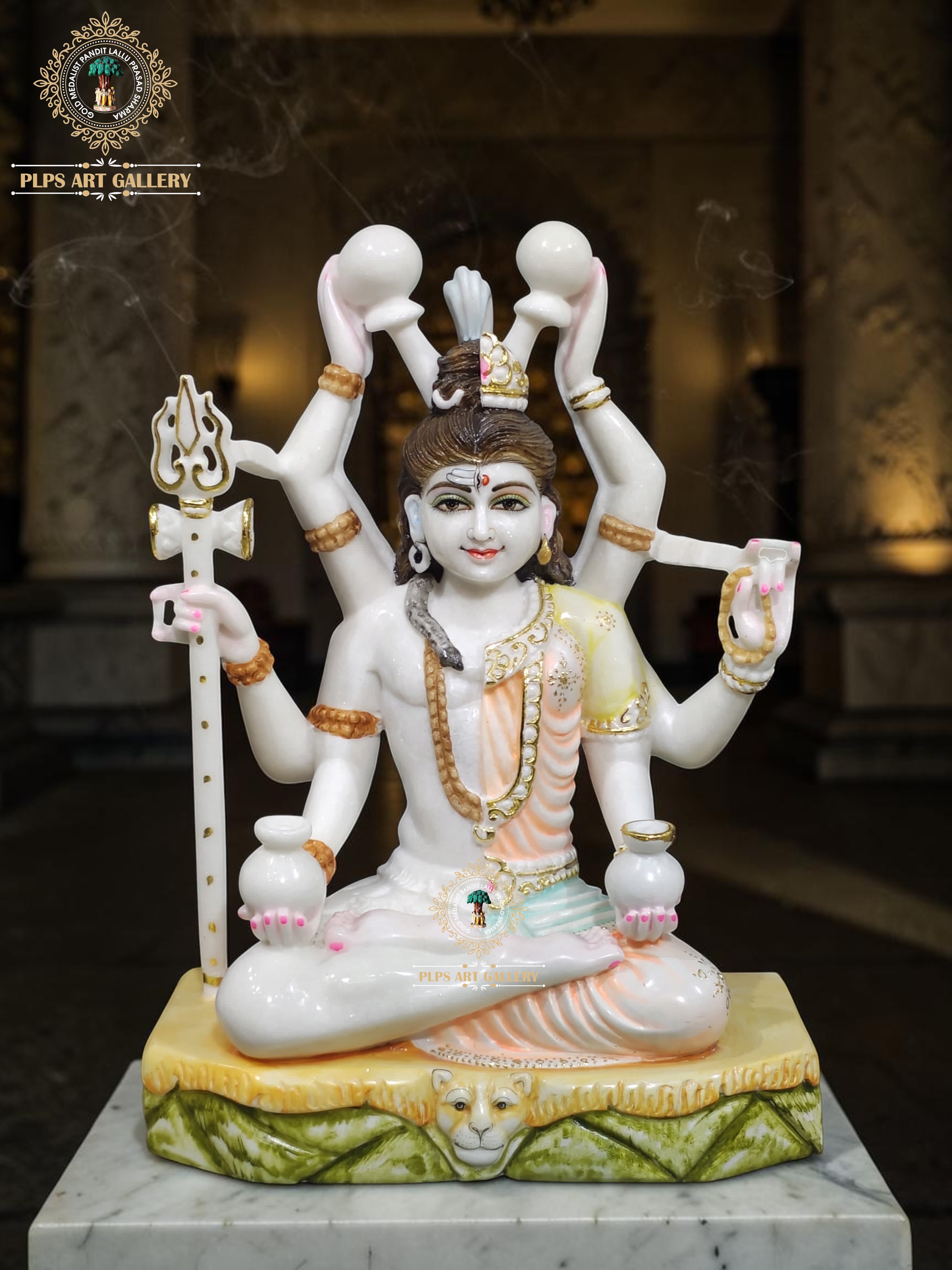
Made-to-Order Only
Our ardhanarishvara are crafted exclusively on commission. Share your size, marble type and iconography — our fourth-generation artisans will begin your piece at our Chandpole Bazaar workshop, Jaipur.
Start a Commission