
Artisanship
Artisanship is where PLPS Art Gallery opens its workshop rather than its catalogue. This is the signature-craftsmanship shelf — the four-generation Chandpole Bazaar karkhana carrying the Shilp Guru honour and the Presidential Award for handicrafts conferred on Late Pandit Lallu Prasad Sharma in 1991, the highest national recognition given to a living master carver by the President of India. Every piece on this shelf is master-directed from Shila Pariksha to final sign-off, documented with the paperwork a serious collector, institutional patron or museum curator expects, and carried by a floor of Shilpis whose lineage runs unbroken from Pandit-ji's generation to the descendants who train under his instruction today.
The artisanship signature is the four Sanskrit stages of the Shilpa Shastra carving discipline, named and observed in order. Shila Pariksha is the examination of the block at the quarry — Makrana, Bhainslana or Vietnam White inspected for crystalline density, vein pattern, edge translucence and any hairline before it leaves for Jaipur. Rekhankan is the master's sacred marking on the cleared block — central axis, proportional grid, eye placement, attribute anchors — a discipline no apprentice performs. Chikni is hand polishing through progressive natural-abrasive grits, drawing an interior glow rather than a mirror shine; the difference is felt under the palm before it is seen by the eye. Swarna Karya is gold leaf (varak) laid by hand on ornaments and sash borders — never brass paint or gilt lacquer. The karkhana apprenticeship progresses a Shilpi through years of graded work up to Rekhankan; it is why a museum-scale commission carries no fault line between master and journeyman hands.
The hero portfolio ranges across life-size Radha Krishna in Jugal Jodi choreography with the matched sway of the two figures resolved on the diagonal; multi-deity Pratishtha sets — Ram Darbar, Shiv Pariwar, Panchayatan — carried as a single commission with proportional and tonal continuity; life-size deities of 5 to 8 feet with Swarna Karya on ornaments and Pietra Dura (parchin kari) semi-precious inlay of lapis lazuli, malachite, carnelian and mother-of-pearl in the Mughal-Jaipur tradition; portrait discipline at institutional scale; and museum-quality tabletop pieces at 12 to 18 inches carved to the same standard as the life-size work — the format collectors and curators specify.
Size begins at a 15-inch museum-quality tabletop piece and runs through 6-foot institutional commissions with no fixed upper limit on complexity. Every commission opens with a consultation with the master, in-person at Chandpole or by video for international patrons. Every commission ships with a bound folio: quarry certificate for the block, Shila Pariksha notes, the Rekhankan drawing, staged workshop photography at defined milestones, the master's signed provenance letter, and care guidance specific to the piece.
For collectors, institutional patrons, museum curators and connoisseurs commissioning at the top of the craft — the Chandpole workshop is open to visit, and the master's consultation is the first step of the commission. Write to us to begin.

Frequently Asked Questions
Three things, each documented rather than asserted. First, lineage: PLPS is a fourth-generation Chandpole Bazaar karkhana carrying the Shilp Guru honour and the Presidential Award for handicrafts conferred on Late Pandit Lallu Prasad Sharma in 1991 — a national recognition held by only a small living membership of master craftsmen. Second, method: every signature piece is carved through the four named Sanskrit stages of the Shilpa Shastra discipline — Shila Pariksha, Rekhankan, Chikni and Swarna Karya — rather than 'handcrafted' as a marketing adjective. Third, provenance: every commission ships with a bound folio — quarry certificate, Rekhankan drawing, staged workshop photography and the master's signed letter — that a curator or collector can verify.
Shila Pariksha is stone examination at the quarry — every Makrana, Bhainslana or Vietnam White block inspected for crystalline density, vein pattern, edge translucence and hairlines before it leaves. Rekhankan is sacred marking — the master draws the central axis, the Shilpa Shastra proportional grid, eye placement and attribute anchors directly on the cleared block; no apprentice performs this. Chikni is hand polishing through progressive natural-abrasive grits over days or weeks, drawing an interior glow that is felt under the palm before it is seen. Swarna Karya is genuine gold leaf laid by hand on ornaments and borders after Chikni completes — never brass paint or lacquer. The four stages are the signature.
Shilp Guru is the highest national recognition given by the President of India to a living master craftsman — a small living membership across all Indian craft disciplines. Late Pandit Lallu Prasad Sharma carried the Shilp Guru honour along with the Presidential Award for handicrafts conferred in 1991. The Chandpole karkhana structure progresses an apprentice through years of graded work — from block preparation and rough cutting under supervision, to secondary carving under a senior journeyman, to independent secondary work, and only after long observation to primary iconographic carving and eventually Rekhankan. It is the same structure that produced the Shilp Guru generation and it is why the workshop carries a museum-scale commission without a fault line between master and journeyman hands.
The commission opens with a consultation with the master — in-person at Chandpole Bazaar, Jaipur, or by video for international patrons — where brief, references, iconography, intent, placement and deadline are agreed. The block is then sourced and cleared through Shila Pariksha at the quarry and photographed. The Rekhankan drawing is shared with you for iconographic approval before a chisel is struck. Progress photography is shared at defined milestones — rough form, secondary carving, facial resolution, Chikni polishing, Swarna Karya. The master inspects and signs off before crating. The piece ships in a custom-built export crate with insurance, a bound provenance folio and installation guidance.
Yes, and for a signature commission we consider the workshop visit the first proper step rather than an afterthought. PLPS's karkhana sits in Chandpole Bazaar, the marble-carving quarter immediately outside the Chandpole gate of Jaipur's walled city, where the workshop has operated across four generations. A visit lets you meet the master, walk the floor to see commissions at every stage — Rekhankan drawings on cleared blocks, secondary carving, Chikni polishing, Swarna Karya gold leaf being laid — and handle finished samples in Makrana, Bhainslana and Vietnam White. International patrons who cannot travel are welcome to a video consultation. Please write ahead so we can hold the master's time.
The commercial range is our repeatable catalogue — proven iconographic forms in Makrana, Bhainslana and Vietnam White at standard sizes, hand-carved by the karkhana to a high shelf-quality standard but priced by size and not master-directed at every stage. The Artisanship shelf is different: one-off, master-directed from Shila Pariksha through Rekhankan to sign-off, museum-documented with quarry certificate, Rekhankan drawing, staged workshop photography and provenance letter, and open to complexity — life-size deities, multi-deity Pratishtha sets, Jugal Jodi choreography, Pietra Dura semi-precious inlay, portrait discipline. If you are commissioning for a museum, a temple pratishtha, an institutional foyer or a serious private collection, this is the tier.
Looking for a custom Artisanship?
Every piece is hand-carved to order in our Chandpole Bazaar workshop, Jaipur. Share your size, marble type and iconography — our 4th-generation artisans will craft it for you.
Request a Quote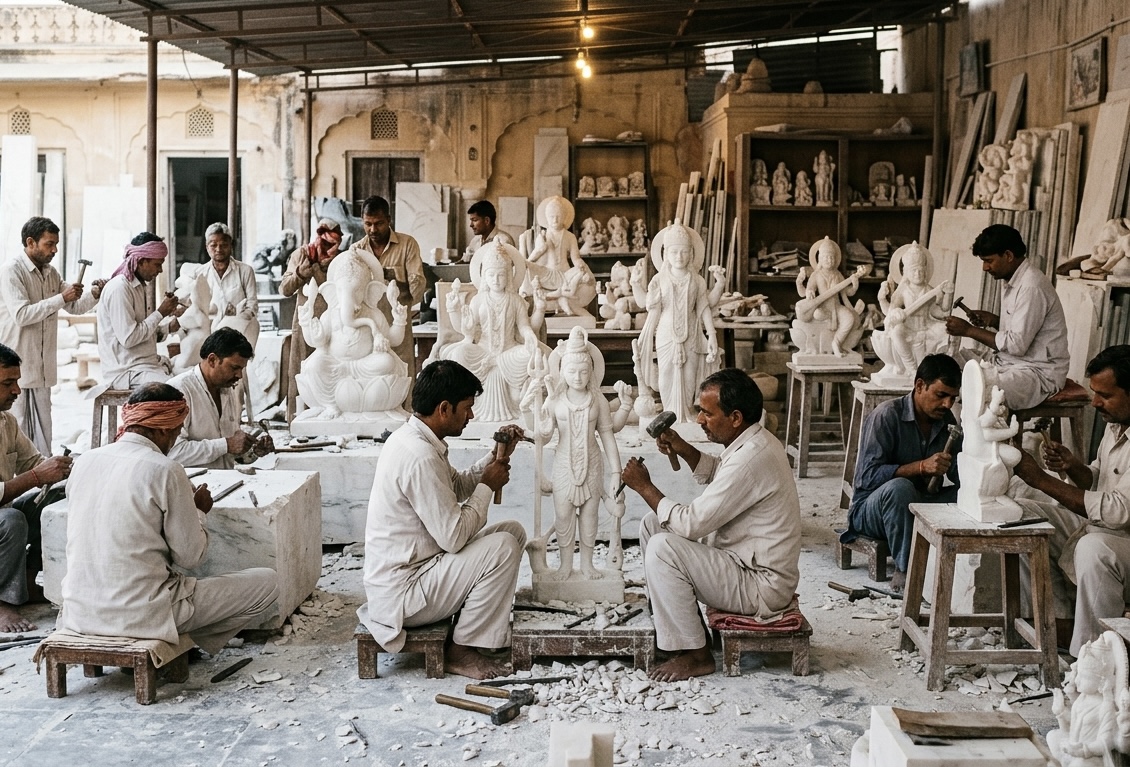
Made-to-Order Only
Our artisanship are crafted exclusively on commission. Share your size, marble type and iconography — our fourth-generation artisans will begin your piece at our Chandpole Bazaar workshop, Jaipur.
Start a Commission