
Buddha Statue
Few images in world art are as universally recognised as the seated Buddha with half-closed eyes and hands folded in the lap. Prince Siddhartha Gautama, born in the 5th century BCE at Lumbini and awakened at Bodh Gaya, became the historical Buddha whose teaching now moves through Theravada, Mahayana and Vajrayana lineages across Asia and, increasingly, across the entire modern West. A marble Buddha travels naturally beyond any single tradition — the same sculpture reads coherently to a Sri Lankan Theravadin household, a Kyoto Zen practitioner, a Manhattan yoga studio, a Berlin design apartment or a Bali wellness retreat. The image belongs to no one, which is precisely why it belongs everywhere. What PLPS brings to that universality is the origin: carved in Jaipur, in the country of Buddha's own birth and awakening, by a workshop that has kept the craft of stone-cut devotional sculpture alive for four generations.
A marble Buddha is, technically, the most demanding portrait our Shilpis carve. Every other Hindu deity carries ornamentation — a crown, weapons, jewellery, mount, consort — that lets the eye travel and forgives a slightly imperfect face. The Buddha has none of that. The sanghati robe drapes plainly, the hands sit in a defined mudra, the pedestal is a lotus, and everything else the sculpture has to say must be said by the closed-eye expression on the face. Getting that expression right — the exact turn of the lips into a serene non-smile, the weight of the closed eyelids, the alignment of the ushnisha crown protrusion, the length of the elongated earlobes remembering the discarded princely earrings — is portrait-level work, and it is the reason most workshops carve a mediocre Buddha and only a few carve a good one. Our Shilpis begin every commission with Shila Pariksha (block selection for a defect-free face zone), take Rekhankan proportions from the Gupta-Sarnath canon (or a Thai, Chinese or Tibetan reference if the client requests it), and reserve the finest chisels for the face, which is always cut last after the robe folds, mudra and pedestal are resolved. Chikni polish then brings the face to a soft satin — never a mirror gloss, which would flatten the expression.
Iconography and Vastu are the second axis. The four mudras most frequently commissioned each carry a distinct meaning and lend themselves to a distinct room. Dhyana mudra (both hands folded in the lap, right over left, thumbs touching) is the meditation gesture — the classic altar and meditation-room image. Bhumisparsha mudra (right hand reaching down to touch the earth) marks the moment of enlightenment under the Bodhi tree at Bodh Gaya and is often chosen for serious sadhana spaces and dedicated shrines. Abhaya mudra (right hand raised, palm outward) is the standing Buddha of fearlessness and protection, ideally suited to entrance foyers and gardens. Vitarka mudra (thumb and index finger joined) is the teaching gesture — a natural choice for a study, office or dharma-hall Buddha. Every image sits on a padma-pitha, the lotus rising unstained from muddy water. Vastu tradition places the Buddha facing East (the direction the historical Buddha himself faced under the Bodhi tree) or in the North-East Ishaan corner of a home, elevated on a pedestal or chowki, never on the floor and traditionally not in the bedroom.
We carve Buddha across the widest size range of any deity in our workshop — 8-inch tabletop meditation-altar pieces through 8-foot garden and hotel installations. The 8-inch to 18-inch range fits personal altars and desk practice; 18 to 36 inches anchors a home meditation room or a yoga studio; 4 to 6 feet reads powerfully as a garden meditation-corner statement or a boutique-hotel foyer; anything above 6 feet becomes an installation-scale commission for retreat centres, spa resorts and public gardens. Makrana marble gives the warm classical white of the Indian-Gupta lineage — the safest and most enduring choice for an indoor meditation piece. Vietnam White is cooler and brighter with a fine even grain that holds the closed-eye detail crisply at smaller scales. Bhainslana lends a deep black tonality that offers a striking counterpoint to the gilded Thai Sukhothai Buddha — the right choice when a client wants that Southeast Asian visual lineage in stone rather than bronze. Optional Swarna Karya (24-carat gold leaf) can be applied to the robe borders, the ushnisha, or an ornamental halo behind the head. Lotus pedestals are standard; custom bases inscribed with a mantra (most often the Heart Sutra fragment gate gate paragate parasamgate bodhi svaha, or om mani padme hum) or a dedicatee's name are commissioned regularly.
Because Buddha is a universal image, most PLPS Buddha commissions ship outside India. Yoga studios in California, meditation centres in Germany, spa hotels in Bali and private meditation gardens in Sydney and Dubai make up a majority of our export orders. We frame every conversation with the same respect: a marble Buddha is not a religious claim, it is an offering — and we help you choose the mudra, size, marble and pedestal that fits your practice and your space. Speak with our team at Chandpole Bazaar, Jaipur, to commission your Buddha.

Frequently Asked Questions
The four most commissioned mudras each carry a distinct meaning and fit a distinct setting. Dhyana mudra shows both hands folded in the lap with the right cradled over the left and thumbs lightly touching — the meditation gesture, ideal for a personal altar, meditation room or yoga studio. Bhumisparsha mudra shows the right hand reaching down to touch the earth, marking the exact moment of the Buddha's enlightenment at Bodh Gaya — often chosen for dedicated shrines and serious practice spaces. Abhaya mudra shows the right hand raised with palm outward — the fearlessness gesture, well suited to entrance foyers, hallways and garden alcoves where the Buddha greets those who arrive. Vitarka mudra joins the thumb and index finger to form a circle — the teaching gesture, a natural choice for a study, an office or a dharma hall. If you are unsure, Dhyana mudra is the most universal and the safest first commission.
The choice depends on the visual lineage you want the Buddha to speak in. Makrana white (Sangemarmar) is the warm, dense, temple-grade Rajasthani white — it reads as the classical Indian-Gupta Buddha of Sarnath and Bodh Gaya, and remains the safest and most enduring choice for an indoor meditation piece. Vietnam White is a cooler and brighter marble with a fine even grain that holds the closed-eye facial detail crisply, and is our first recommendation for smaller altar pieces where every micro-expression on the face matters. Bhainslana is the deep black marble of Rajasthan — it offers a striking alternative to the gilded Southeast Asian Buddha and is the right pick when a client wants the visual lineage of the Thai Sukhothai or Burmese tradition in stone rather than bronze. All three can be finished with optional Swarna Karya (gold leaf) on the robe borders or ushnisha for additional warmth.
Marble Buddhas work beautifully in both settings, and the market split is roughly even. For indoor meditation rooms, altars and yoga studios, Makrana or Vietnam White marble is the classical choice — the polished Chikni finish stays flawless year after year in a controlled interior environment. For garden placement, we recommend a denser Makrana block, a matte or lightly polished finish (highly polished marble is more prone to visible weathering marks over decades of monsoon and sun), and a raised stone or concrete plinth that keeps the Buddha's base clear of ground-water splash and lawn irrigation. In climates with hard freeze-thaw cycles (northern Europe, US North-East), we recommend a covered garden alcove, a pergola or a sheltered courtyard rather than fully exposed lawn placement. All our garden Buddhas ship with a written care schedule.
For a personal home meditation room, altar or bedside sadhana space, a 12-inch to 20-inch seated Dhyana Buddha on a raised chowki sits at seated eye level and reads intimately without dominating the space. For a dedicated meditation hall, yoga studio or dharma practice room, 24 to 36 inches is the working range — large enough to anchor the room from across the floor, small enough to remain a presence rather than a monument. For garden meditation corners, hotel foyers and spa lounges, 4 to 6 feet is the statement-piece scale. Above 6 feet, a Buddha becomes an installation commission — appropriate for retreat centres, wellness resorts, public gardens and boutique hotel lobbies, and best specified with our team from the outset so the marble block, base engineering and shipping crate are planned together.
An outdoor marble Buddha needs a light touch. Dust the sculpture weekly with a soft dry brush — a clean natural-hair paintbrush or a shaving brush works well for the ushnisha, hair-curls and mudra detail. Every three to four months, wipe the body with a barely damp muslin cloth using plain water and dry immediately with a second cloth; never use citrus, vinegar, bleach or any acidic household cleaner, as they will etch the marble permanently. In monsoon regions, ensure the pedestal drains freely so water does not pool at the base and stain the lotus. In freeze-thaw climates, cover or move small pieces indoors for the coldest months. Seal the base every two to three years with a food-safe stone sealer (we recommend specific brands on the care card that ships with each piece), and expect a gentle patina to develop over years — this is the marble living in your garden, not damage.
Yes, and it is one of our most requested customisations. Beyond the four commonly stocked mudras (Dhyana, Bhumisparsha, Abhaya, Vitarka), we regularly carve Dharmachakra mudra (both hands raised at chest height turning the Wheel of Dharma, associated with the first sermon at Sarnath), Varada mudra (right hand hanging down open-palm outward, the gesture of granting compassion and boons), and the Medicine Buddha (Bhaisajyaguru) form holding a small myrobalan-fruit bowl in the left hand. Standing, walking and reclining postures are also available on commission — the reclining Parinirvana Buddha is a specialist commission requiring a longer horizontal block and longer lead time. Share a reference image or describe the mudra and posture you have in mind, and our senior Shilpis will prepare a Rekhankan sketch for your approval before carving begins.
All five lineages depict the same historical Buddha but with distinct visual conventions. The Indian tradition (Gandharan and Gupta-Sarnath, roughly 2nd–6th century CE) established the base template that most of Asia inherited — serene half-closed eyes, ushnisha crown protrusion, elongated earlobes, sanghati robe usually falling from the left shoulder with the right shoulder bare, seated in padmasana on a lotus. The Thai Sukhothai tradition (13th–15th century) adds a flame-shaped ushnisha, more elongated fingers and a distinctive walking-Buddha posture with no Indian parallel, often gilded. The Chinese tradition can either follow the Indian meditative form or diverge into the plump, laughing Budai (Hotei) folk figure who is a different personage entirely, not the historical Buddha. Japanese sculpture is highly systematised — every mudra, halo shape and pedestal points to a specific Buddha or bodhisattva within a specific temple lineage. The Tibetan Himalayan tradition dresses the Buddha in ornaments, uses vivid mineral colour and includes multi-armed tantric forms drawn from the Vajrayana pantheon. When you commission from PLPS, tell us which lineage you want the sculpture to speak in and we will select the reference proportions accordingly.
Looking for a custom Buddha Statue?
Every piece is hand-carved to order in our Chandpole Bazaar workshop, Jaipur. Share your size, marble type and iconography — our 4th-generation artisans will craft it for you.
Request a Quote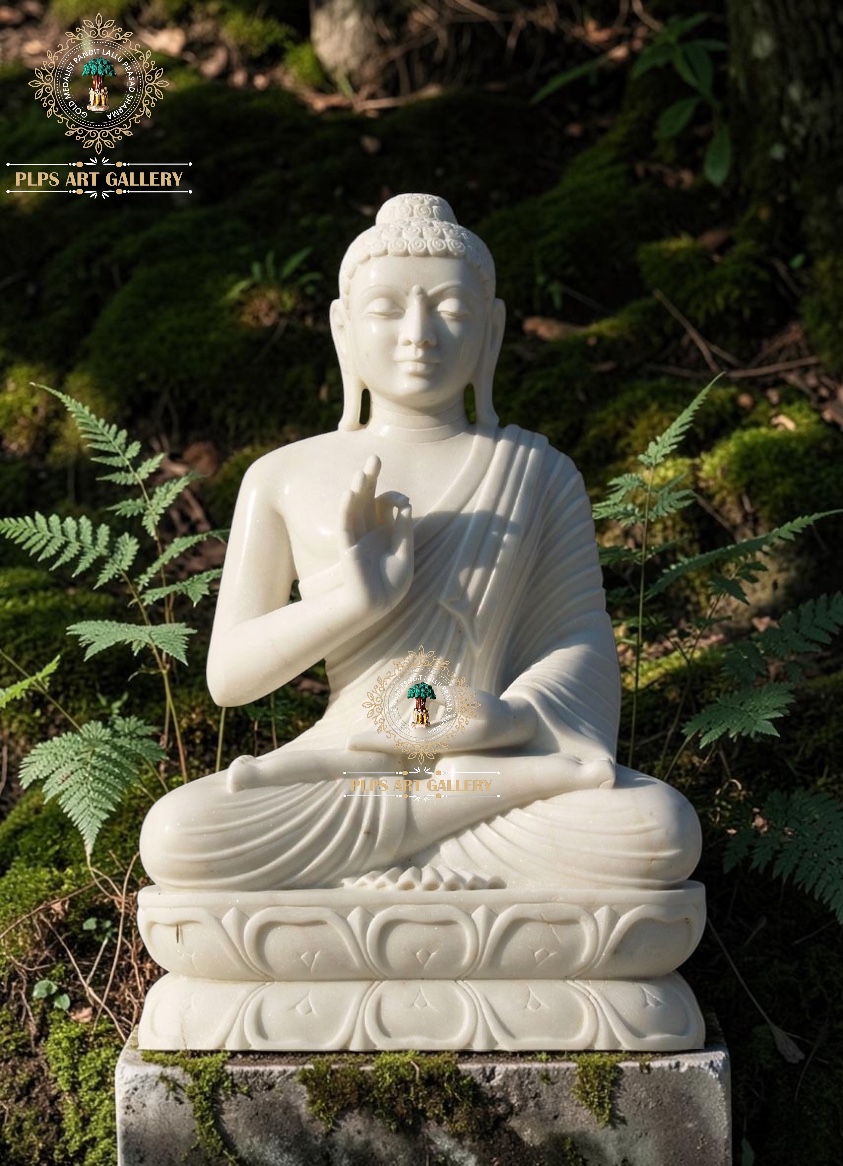
Made-to-Order Only
Our buddha statue are crafted exclusively on commission. Share your size, marble type and iconography — our fourth-generation artisans will begin your piece at our Chandpole Bazaar workshop, Jaipur.
Start a Commission