
Chamunda Mata murti
Chamunda Mata is the fiercest of the Sapta Matrika — the seven mother-goddesses of the Devi tradition — and the slayer of the demons Chanda and Munda whose defeat gave her name. Emerging in the Devi Mahatmyam as the wrathful protector who consumes evil at its root, she is enshrined at Chamunda Devi in Kangra (Himachal), Chamundeshwari on Chamundi Hills in Mysore, and as kuldevi of the Rathore royals of Jodhpur. Families install her to invoke protection against harm, illness and negativity.
Carving Chamunda is technically the opposite of every other deity we shape at PLPS. Where most murtis demand rounded fullness, Chamunda's iconography insists on skeletal emaciation — visible ribs, sunken belly, protruding collarbones and hollowed cheeks. Our Shilpis begin with Shila Pariksha to confirm the block will hold the deep undercuts of the munda-mala (skull garland) and multiple weapon-bearing arms without fracture. Rekhankan maps each rib, each skull and each arm. Chikni polishing lifts the individual detail of every carved skull. Both pure white marble and hand-painted (mineral pigment) options are offered, always to scripturally correct iconography.
Scriptural Chamunda is depicted with four, eight or ten arms bearing sword, trishul, damaru, noose, kapala (skull bowl) and severed head, wearing the munda-mala (garland of skulls) and often seated on a preta (corpse) or owl vahana. Because her energy is ugra (fierce), placement rules differ from benevolent forms: Chamunda belongs in a dedicated puja room — never a casual living area, bedroom or dining space. She faces East or North per Devi Mahatmyam convention, always on a raised chowki, with daily deepak worship considered essential in Shakta tradition.
PLPS carves Chamunda from 12-inch domestic murtis up to 60-inch temple installations. Devotees choose between pure white Makrana (for a stark, ascetic reading of the emaciated form) and hand-painted variants where mineral pigments render the ochre or crimson skin, kohl-lined eyes, red tongue and blackened munda-mala of the traditional Rajasthani icon. Vietnam White carves the finest facial detailing for smaller pieces; Bhainslana lends a dramatic dark base for painted work. Custom orders — including full Sapta Matrika sets — take 30 to 90 days depending on scale and pigment work.
Because Chamunda is a fierce Devi form, we strongly recommend a family purohit or spiritual guide consult before commissioning — especially on posture, arm-count and whether the murti is intended for home worship or a dedicated shrine. Speak with our team to begin.

Frequently Asked Questions
Both are fierce Devi forms and the Devi Mahatmyam even grants Kali the epithet Chamunda after she slays the demons Chanda and Munda, so the two are ritually linked. Iconographically they differ sharply. Chamunda is depicted as emaciated and skeletal — sunken belly, hollow cheeks, protruding ribs — often seated on a corpse or owl vahana. Kali is fuller-bodied, dark-hued, with a lolling red tongue, typically standing on the prostrate body of Shiva. Chamunda is one of the seven Matrikas; Kali stands alone as Adi Shakti. Regional worship also differs: Chamunda dominates Kangra, Mysore and Jodhpur, Kali the Bengal-Assam belt.
The Sapta Matrika are the seven mother-goddesses who emerged from the male deities during Durga's war on Andhakasura and Raktabija, as recounted in the Devi Mahatmyam and Matsya Purana. They are Brahmani, Maheshvari, Kaumari, Vaishnavi, Varahi, Indrani and Chamunda — each carrying the weapon and vahana of the god from whose power she was born. Chamunda holds the seventh, most ferocious position, born of the collective Shakti to consume Raktabija's blood. Temple traditions install the Matrikas as a group of seven; some devotees at PLPS commission the full Sapta Matrika set for pran-pratishtha at family shrines.
Yes, but under stricter rules than benevolent forms. Chamunda's energy is ugra — fierce and demon-consuming — so she should not be placed in an open living area, bedroom, dining space or child's room. A dedicated puja room or shrine niche is essential, with the murti facing East or North so the worshipper faces West or South. Always elevate on a chowki, never floor level. Daily lamp (deepak) worship is expected in Shakta tradition — a Chamunda murti installed without regular puja is actively discouraged. Consult a family purohit before pran-pratishtha for home worship.
Both are traditional. Pure white Makrana marble presents Chamunda as a stark, ascetic form — the skeletal ribs, hollow cheeks and skull-garland reading in luminous relief, favoured for meditative Shakta households and modern shrines. Hand-painted marble follows the Rajasthani folk tradition, with mineral pigments rendering the ochre or crimson skin, kohl-lined eyes, red tongue, blackened munda-mala and gilded weapons — the fierce, life-like reading familiar from Chamunda Mata temple deities across Kangra and Jodhpur. PLPS uses natural mineral pigments (never synthetic dyes) so painted work matches traditional temple iconography and remains stable for decades.
Chamunda's regional forms differ meaningfully. In Himachal's Kangra valley, Chamunda Devi is worshipped as the ferocious Nandikeshwar Dham deity — protector against illness, misfortune and negative energy. In Karnataka she is Chamundeshwari of Chamundi Hills, Mysore, where the Wodeyar dynasty worshipped her as royal Devi in a slightly more regal, Durga-like reading. In Rajasthan she is kuldevi of the Rathore royal family of Jodhpur, enshrined at Mehrangarh Fort as clan-protector. Devotees commissioning a Chamunda from PLPS often specify which regional iconography — Himachali fierce, Mysore regal or Rajasthani folk — they wish us to follow.
The most delicate zones on a Chamunda murti are the individually carved skulls of the munda-mala, the multiple weapon-bearing arms and the protruding ribs — all deep undercuts vulnerable to dust and moisture. Dust weekly with a soft, dry natural-hair brush (a shaving brush works well); never use a wet cloth around the skull garland, as trapped water darkens undercuts. Avoid citrus and vinegar cleaners — they etch marble permanently. Painted work should be dusted only, never wiped. Custom Chamunda orders take 30 to 90 days; painted and multi-armed forms sit at the higher end.
Looking for a custom Chamunda Mata murti?
Every piece is hand-carved to order in our Chandpole Bazaar workshop, Jaipur. Share your size, marble type and iconography — our 4th-generation artisans will craft it for you.
Request a Quote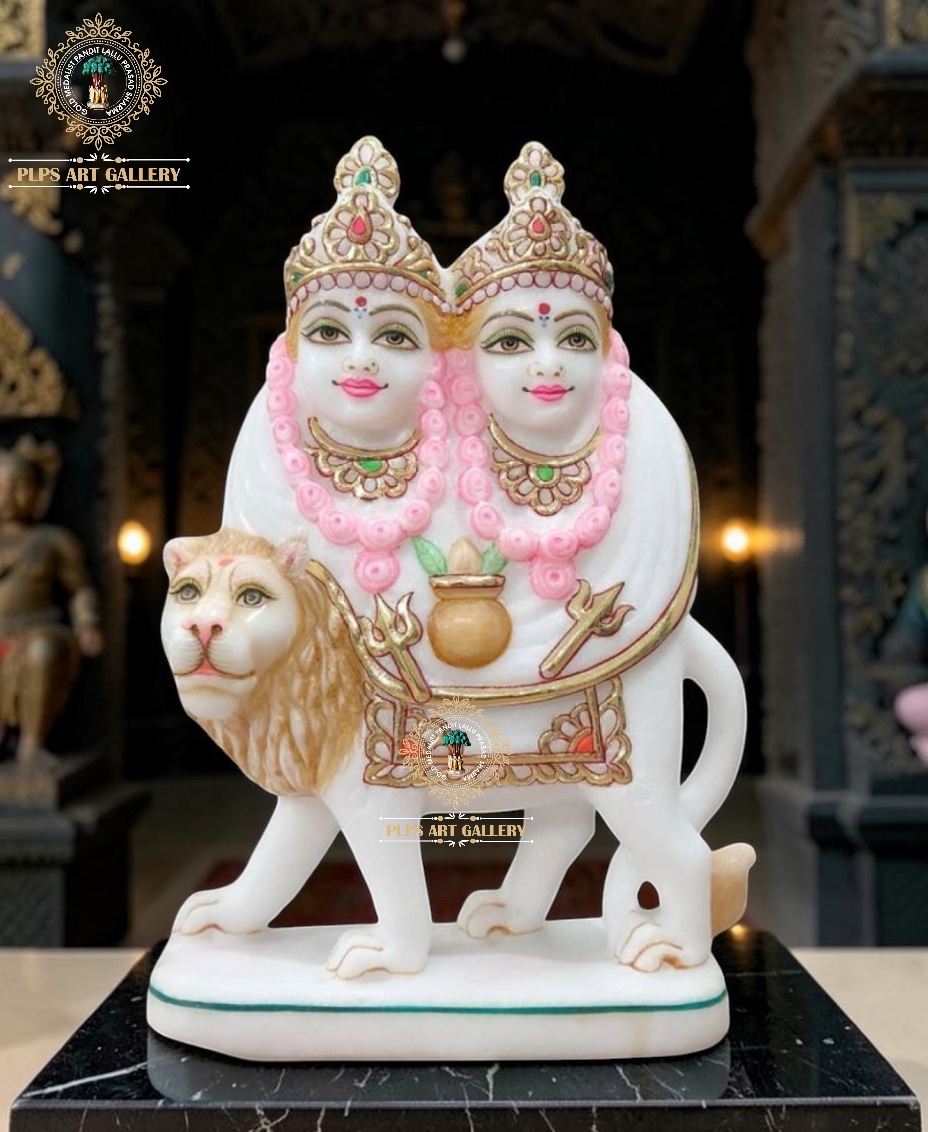
Made-to-Order Only
Our chamunda mata murti are crafted exclusively on commission. Share your size, marble type and iconography — our fourth-generation artisans will begin your piece at our Chandpole Bazaar workshop, Jaipur.
Start a Commission