
Dattbhagwan Statue
Datt Bhagwan is the singular incarnation in the Hindu canon where Brahma, Vishnu and Shiva do not appear as three deities in relationship but as one being with three faces — the Trimurti resolved into a single form. He is the guru of the Datta Sampradaya, the eternal presence of Girnar, the meditating master under the audumbar tree at Audumbar, and the deity whose Nirguna Padukas are worshipped at Ganagapur. For Maharashtrian, Karnataka, Andhra and Gujarati households — and the millions across the Nath, Aghori and Naga sadhu traditions who take Datt as their adi guru — He is worshipped every Thursday and celebrated on Datta Jayanti at Margashirsha Purnima in December.
Datt Bhagwan is the most compositionally complex single-deity commission in the marble canon. A Ganesha or a Krishna concentrates the sculptor's attention on one face, one silhouette. Datt asks for three faces harmonised at a single shoulder line — Brahma on the devotee's left, Vishnu at the centre facing forward, Shiva on the devotee's right, each with its own expression yet resolved as one head. Six arms must radiate outward without collision, each holding a distinct attribute — kamandalu and japa mala from Brahma, shankha and chakra from Vishnu, damaru and trishul from Shiva. At His feet, four dogs — the four Vedas — must be carved as four differentiated bodies, not four copies of the same figure. Beside Him stands Kamdhenu, the cow of Earth and dharma, in exact proportion so she neither dwarfs the dogs nor is dwarfed by the deity. Four generations of PLPS Shilpis, working under the lineage of Late Pandit Lallu Prasad Sharma — Shilp Guru and Presidential Awardee (1991) — bring the compositional discipline this piece demands. Shila Pariksha selects a Makrana block dense-grained enough to hold three faces at close quarters; Rekhankan lays out the twelve-limb radiation before the first cut; Chikni polish lifts the three expressions distinctly; Swarna Karya applies gold leaf sparingly to the six attributes so each weapon reads clean.
Iconography and Vastu. The canonical form is three-headed with six arms, four dogs and cow — the Datta Sampradaya standard. Many Maharashtrian and Karnataka households prefer the single-headed variant, which carries all six attributes and retains the dogs and cow — equally accepted by the Sampradaya. Place Datt Bhagwan in the North-East (Ishaan) corner of the home mandir facing East, or on a dedicated Datta altar with a matching marble paduka alongside — the paduka is inseparable from Datta worship at Ganagapur and every Sampradaya household honours this. For the scriptural three-headed form, install at standard mandir height above the devotee's heart; for a guru-form Datta bust in the sant lineage of Sripada Sri Vallabha, Sri Narasimha Saraswati or Swami Samarth, eye-level installation is preferred as with all guru murtis.
Sizes and customisation. PLPS carves Datt Bhagwan from 8 inches to 6 feet. Home mandir sizes of 15 to 24 inches are most requested; dedicated Datta altars carry 24 to 36 inches; community mandirs and Datta Kshetra-scale replicas run 4 to 6 feet with the full four-dogs-and-cow composition on a wide carved platform. Girnar, Ganagapur, Audumbar and Narsobawadi temple replicas are commissioned to the specific iconographic details of each shrine — the single-headed form for Ganagapur, the standing three-headed form for Girnar summit, the seated meditating form for Audumbar. Options include mineral-pigment tinting on the three faces to distinguish Brahma-Vishnu-Shiva subtly, Swarna Karya gold leaf on the six attributes and three crowns, a matching marble paduka carved from the same stone block, and a base inscribed with Digambara Digambara Sripada Vallabha Digambara — the mantra chanted across every Datta Kshetra — carved in Devanagari, Marathi or Kannada script.
From Pune and Nagpur to Belgaum and Hubli, from Pithapuram to the Datta Sampradaya diaspora in Melbourne, Chicago and Toronto, PLPS ships Datt Bhagwan installations aligned to Datta Jayanti (Margashirsha Purnima, December), Guru Purnima, and a chosen Thursday for prana pratishtha. Commission a piece that honours the Trimurti resolved into one — and the fourth generation of Chandpole Bazaar Shilpis who understand what a twelve-limb composition asks of the stone.

Frequently Asked Questions
Datt Bhagwan is the singular incarnation in the entire Hindu canon in which Brahma, Vishnu and Shiva appear not as three deities in relationship — as they do everywhere else — but as one being with three faces. This is the Trimurti resolved into a single body. The three heads are Brahma on the devotee's left (creation), Vishnu at the centre facing forward (preservation), and Shiva on the devotee's right (transformation). The six arms carry two attributes from each parent deity: kamandalu and japa mala from Brahma, shankha and chakra from Vishnu, damaru and trishul from Shiva. The four dogs at His feet are the four Vedas — Rig, Yajur, Sama, Atharva — and the cow beside Him is Kamdhenu, representing Earth and dharma. No other deity in the pantheon carries this composite iconography, which is why the Datta Sampradaya treats Him as the adi guru of every guru lineage.
Both are equally accepted by the Datta Sampradaya, and the choice is regional and personal. The three-headed Trimurti form is the canonical Datta Sampradaya standard and is the form seen at Girnar and most Andhra shrines — devotees who want the full theological statement of Datt as Brahma-Vishnu-Shiva-in-one choose this. The single-headed variant is common across many Maharashtrian and Karnataka temples including Ganagapur, and retains all six arms with the six attributes, plus the four dogs and Kamdhenu — devotees whose family tradition is anchored to the sant lineage of Sripada Sri Vallabha, Sri Narasimha Saraswati or Swami Samarth often prefer this. Please share the temple your family reveres — we will match its iconography exactly.
The four dogs are the four Vedas — Rig, Yajur, Sama, Atharva — and in a parallel reading they represent the four states of consciousness (waking, dreaming, deep sleep, turiya). They stand as guardians of the sacred knowledge Datt Bhagwan embodies. The cow is Kamdhenu, representing Earth, dharma and the nurturing abundance of creation. Compositionally, this is where most competitor pieces fail — the four dogs must be carved as four differentiated bodies with distinct postures, not four copies of the same figure, and Kamdhenu must be scaled in exact proportion so she neither dwarfs the dogs nor is dwarfed by the deity. Our Shilpis lay this out during Rekhankan before the first cut, and the base platform is sized wide enough that no figure crowds another.
Makrana white is our first recommendation for any Datt Bhagwan commission. Its dense, fine grain is the only Indian marble that reliably holds three faces at close quarters without losing the distinct expression of Brahma, Vishnu and Shiva at the shoulder line. It also holds the six radiating arms and the intricate figures of the four dogs and Kamdhenu without micro-fracturing at the undercuts. Vietnam White is a fine alternative for smaller home-mandir sizes up to 18 inches where the composition is less demanding. Bhainslana's deep black tonality suits devotees who want a temple-like gravitas closer to the visual mood of a Girnar or Audumbar darshan than a bright white finish. We steer devotees away from Katni and composite stones for Datt commissions specifically because the composition is too demanding for coarser-grained stones.
Datt Bhagwan commissions run longer than a single-figure deity carving of comparable size, because the piece is effectively six figures in one — the deity, the four dogs, and Kamdhenu — plus three faces, six arms and six distinct attributes. A 15 to 24 inch home-mandir Datt takes 6 to 10 weeks depending on whether it is the three-headed or single-headed form and the level of detailing requested. A 24 to 36 inch dedicated-altar piece runs 10 to 16 weeks. Community mandir and Datta Kshetra-scale replicas of 4 to 6 feet, including a wide carved platform for the four dogs and Kamdhenu and a matching marble paduka, take 16 to 28 weeks. Please build in this window when commissioning for Datta Jayanti or a specific Guruvar consecration.
Yes — and Datta Kshetra replica work is one of the commissions we take most seriously. Each of the major Datta Kshetras carries a specific iconographic tradition: Girnar (Gujarat) is anchored to the standing three-headed Trimurti form as the eternal seat of Datt Bhagwan; Ganagapur (Karnataka) revolves around the Nirguna Padukas of Sri Narasimha Saraswati and the single-headed Datta form; Audumbar (Maharashtra) references the meditating Datta seated under the sacred audumbar tree; Narsobawadi, Mahur, Karanjapur, Panchaleshwar and Pithapuram each carry their own local details. Please share the temple your family reveres and, if possible, a reference photograph — the piece will be carved to that specific darshan, including a matching marble paduka carved from the same stone block.
Datta Jayanti falls on Margashirsha Purnima — the full moon of the Margashirsha month, which typically falls in December — and is the largest festival in the Datta Sampradaya calendar. Devotees worship the child form of Datt Bhagwan (Bala Datta) at home and at the Datta Kshetras, read the Avadhuta Gita and Jivanmukta Gita composed by Datt Himself, perform abhishekam of the padukas, and keep vigil through the full-moon night with bhajans and dhoop-deep. Every Thursday (Guruvar) is also observed by Datta devotees through the year. PLPS routinely aligns dispatch to arrive a week before Margashirsha Purnima and can time delivery for a specific Guruvar chosen for prana pratishtha — please share the intended consecration date at order confirmation and we will plan the workshop calendar accordingly.
Looking for a custom Dattbhagwan Statue?
Every piece is hand-carved to order in our Chandpole Bazaar workshop, Jaipur. Share your size, marble type and iconography — our 4th-generation artisans will craft it for you.
Request a Quote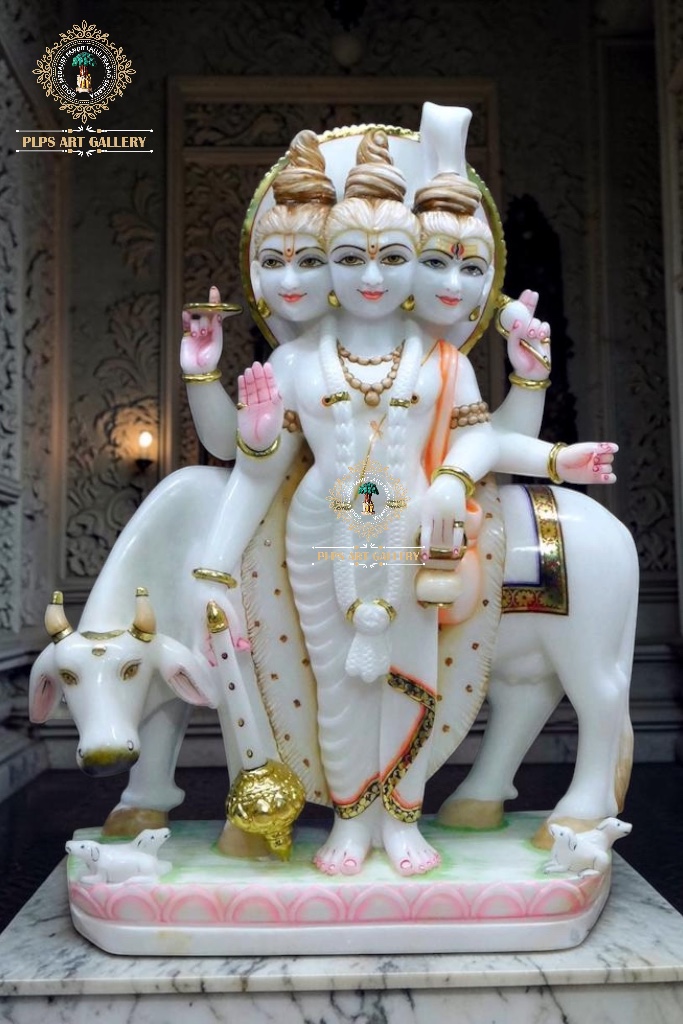
Made-to-Order Only
Our dattbhagwan statue are crafted exclusively on commission. Share your size, marble type and iconography — our fourth-generation artisans will begin your piece at our Chandpole Bazaar workshop, Jaipur.
Start a Commission