
Disha Dev
Disha Devi — also invoked as Disha Maa or Disha Ki Ma — is a folk kul-devi (clan goddess) revered by specific Sindhi Hindu lineages and by certain Rajasthani families whose ancestral records name her as their household Shakti. Unlike pan-Indian forms such as Durga or Laxmi, her worship is community-particular: passed through generations, invoked at weddings, mundan, gruha-pravesh and Cheti Chand or Navratri sthapana. After 1947 many Sindhi families carried her worship from pre-Partition Sindh to Ulhasnagar, Mumbai, the Gulf, the UK and North America, where a marble kul-devi murti anchors the diaspora mandir.
Carving a lesser-known regional Devi is a different discipline from carving a widely-documented deity. At PLPS Art Gallery, four generations of Jaipur Shilpis since 1950 — the workshop founded by Late Pandit Lallu Prasad Sharma, Shilp Guru and Presidential Awardee (1991) — treat every kul-devi commission as a family consultation. Because iconography varies between clans, we ask the family for their oral tradition, ancestral temple photograph or elder-generation sketch before Shila Pariksha. Makrana marble, prized for its shukla-varna radiance, is the traditional choice for benevolent Devi forms.
Disha Devi is depicted as a maternal Shakti with a serene smiling face, seated or standing on a lion vahana in most traditions, holding trishul, khadag, kamandal and the abhaya mudra across four arms — though certain lineages record two-arm or eight-arm variants. Vastu convention places the kul-devi murti in the Ishaan Kon (North-East corner) of the home mandir, facing East, on a raised chowki with a jyot at daily aarti. Sindhi households often install her adjacent to Jhulelal Sahib; Rajasthani families place her within the wider kul-devta shrine.
PLPS carves Disha Devi from 9-inch shrine murtis to 4-foot ancestral-hall installations, with 12 to 18 inches most popular for household altars. Mineral pigments render the saree colour prescribed by the family — sindoori red, kesari orange or the softer gulabi certain clans specify — with Swarna Karya gold-leaf on the mukut, haar and weapons. The base accepts custom inscription in Devanagari, Sindhi (Perso-Arabic or Devanagari), Gurmukhi or Roman script, carrying the family gotra, clan surname or a shloka in bas-relief.
For Sindhi families in Ulhasnagar, Mumbai, London, Dubai or New Jersey — and Rajasthani households across Marwar, Mewar and Shekhawati — seeking an heirloom Disha Devi murti carved to your community's tradition, speak with PLPS Art Gallery. Custom orders take 45 to 90 days with worldwide shipping.

Frequently Asked Questions
Disha Devi — also called Disha Maa or Disha Ki Ma — is a folk kul-devi (clan goddess) revered by specific Sindhi Hindu lineages and by certain Rajasthani families whose ancestral records name her as their household Shakti. She is not a pan-Indian form like Durga or Laxmi; her worship is passed within the clan and often known only inside the extended family. In most traditions she is a maternal, benevolent Devi with a serene face, four arms bearing protective attributes, and a lion vahana. The name disha means direction — she is the goddess who guides the family's path.
Kul-devi worship differs meaningfully between the two communities, and PLPS respects both. Sindhi families — many of whom carried their worship from pre-1947 Sindh to Ulhasnagar, Mumbai, the Gulf and the wider diaspora — typically install Disha Devi alongside Jhulelal Sahib, invoke her at Cheti Chand, weddings and gruha-pravesh, and offer coconut, misri and akhand jyot. Rajasthani lineages integrate her within the wider kul-devta shrine, honour her at Navratri and Akshaya Tritiya, and observe clan customs at birth, mundan and marriage. In both traditions the kul-devi murti is the family's living ancestral presence, not a decorative image.
In Sindhi and Rajasthani households a kul-devi is not one deity among many but the specific Shakti who protects the lineage. She is invoked before other deities at every family sanskar, and her displeasure is traditionally held responsible for generational misfortune — hence the emphasis on continuous worship. A Disha Devi murti belongs in the Ishaan Kon (North-East corner) of the home mandir, facing East, on a raised chowki with a jyot at daily aarti. Pran-pratishtha by the family purohit is essential before worship begins; the murti should never sit at floor level or in a bedroom.
Makrana marble is the traditional choice for benevolent Devi forms — its pure calcium composition gives the shukla-varna (radiant white) reading Shakta iconography prescribes and accepts the fine carving a serene maternal face demands. Vietnam White renders the crispest small-scale detail and suits 9 to 12 inch shrine pieces. Bhainslana, with its deep dark tone, suits families who intend heavy Swarna Karya gold-leaf on the mukut and jewellery. Saree colour is hand-applied in mineral pigment per family tradition — sindoori red, kesari orange or the softer gulabi certain clans specify — and sealed with a natural fixative stable for decades.
Yes — this is the heart of a kul-devi commission at PLPS. Because Disha Devi's iconography varies between clans (arm-count, vahana, attributes, saree colour, seated or standing posture), we ask the family to share an oral description, a photograph of the ancestral temple deity, an old family murti or a sketch from the elder generation. Our Shilpis translate that tradition into Rekhankan (the sacred marking stage) so every element is community-correct. The base accepts custom inscription in Devanagari, Sindhi (Perso-Arabic or Devanagari), Gurmukhi or Roman script — carrying the family gotra, clan surname or a shloka in permanent bas-relief.
Disha Devi receives special worship at Cheti Chand (the Sindhi new year in Chaitra), Navratri (both Chaitra and Sharad), Akshaya Tritiya and at every family sanskar — weddings, mundan, gruha-pravesh and childbirth — with daily aarti, jyot, coconut and misri prasad. For care, dust daily with a soft dry cloth; never use damp cloth on the painted saree or gold-leaf; avoid all citrus, vinegar or ammonia cleaners, which etch marble permanently. Custom orders take 45 to 90 days from family consultation through Shila Pariksha, Rekhankan, carving, Chikni polishing and Swarna Karya finishing, with insured worldwide shipping and moisture-safe diaspora crating.
Looking for a custom Disha Dev?
Every piece is hand-carved to order in our Chandpole Bazaar workshop, Jaipur. Share your size, marble type and iconography — our 4th-generation artisans will craft it for you.
Request a Quote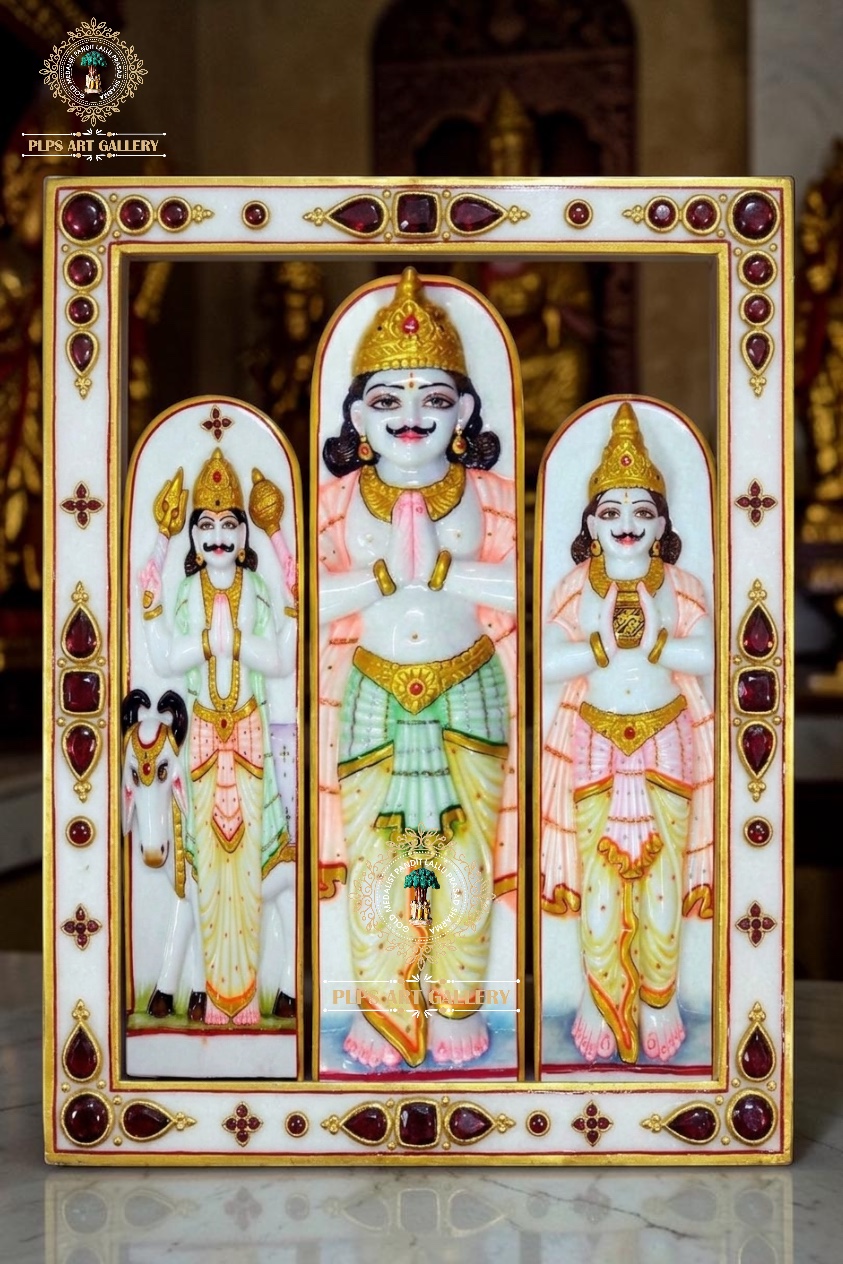
Made-to-Order Only
Our disha dev are crafted exclusively on commission. Share your size, marble type and iconography — our fourth-generation artisans will begin your piece at our Chandpole Bazaar workshop, Jaipur.
Start a Commission