
Gajanan Maharaj
Shri Gajanan Maharaj of Shegaon is among the most beloved saints of modern Maharashtra — a 19th-century avadhoot who first appeared at Shegaon on 23 February 1878 and took samadhi on 8 September 1910. Revered in different lineages as an incarnation of Ganesha, Datta and Shiva, he is the guru of Marathi households from Pune and Nagpur to Melbourne and Chicago. The Shri Sant Gajanan Maharaj Sansthan at Shegaon, established in 1908, remains the reference point every faithful Maharaj murti is measured against — and it is the Samadhi Mandir portrait, together with the surviving 19th-century photograph, that fixes his likeness for the sculptor.
Carving Gajanan Maharaj is portrait sculpture, not scriptural idealisation. Like Sai Baba, his form is fixed by photographic record — the tilt of the head, the sparseness of the beard, the exact fall of the matted hair over the shoulders, the folds of the kaupin (loincloth) knotted at the waist. Four generations of PLPS Shilpis, working under the lineage of Late Pandit Lallu Prasad Sharma — Shilp Guru and Presidential Awardee (1991) — have refined the human-portraiture discipline this commission demands. Makrana's dense grain holds facial expression at a fidelity coarser stones cannot approach, and Chikni polish lifts the serenity of the face while Rekhankan detailing carries the sinews of the ascetic frame.
Maharaj's iconography is fixed and non-negotiable: seated posture, naked upper body, kaupin at the waist, unkempt matted hair, sparse beard, and a serene half-smiling expression. The classical Shri Gajanan Vijay Granth depiction shows him with a chilam in hand — devotees who want the Granth-faithful form request it; families who prefer the meditative variant choose the chilam-omitted posture with hands resting on the knees or the right hand raised in benediction. Both are equally accepted at Shegaon. In the home mandir, place him in the North-East (Ishaan) corner facing East. As with all guru murtis, install him at eye level — never above head-height — mirroring the darshan relationship Marathi households have always kept with their guru.
PLPS carves Gajanan Maharaj from 8 inches to 6 feet. Home mandir sizes of 12 to 18 inches are most requested; dedicated Maharaj altars carry 18 to 24 inches; community mandirs and Shegaon Sansthan-scale replicas run 3 to 6 feet, including the raised stone platform. Custom finishes include mineral-pigment tinting for a warm ascetic skin tone, subtle painted separation of the beard and matted hair strands, hand-applied Swarna Karya gold leaf along the pedestal, and a base inscribed with Om or Gan Gan Ganat Bote — the mantra Maharaj himself was heard reciting.
From Pune drawing rooms to Marathi households in Melbourne, Chicago and Toronto, PLPS ships Maharaj installations aligned to Prakat Din, Guru Purnima and Rushi Punyatithi. Commission a piece that honours Shegaon — and the fourth generation of Chandpole Bazaar Shilpis who understand what this portrait asks of the stone.

Frequently Asked Questions
Shri Gajanan Maharaj is a 19th-century avadhoot saint who first appeared at Shegaon in Buldhana district, Maharashtra, on 23 February 1878 and took samadhi at the same place on 8 September 1910. Marathi devotees revere him as an incarnation of Ganesha, and in parallel traditions of Datta and Shiva. Shegaon matters because the Shri Sant Gajanan Maharaj Sansthan — established in 1908 — preserves the eternal dhuni, the Samadhi Mandir and the 19th-century photographic record that together fix his authentic likeness. Every faithful marble Maharaj murti is measured against this Shegaon reference, which is why we anchor our workshop's iconography to it rather than to generic saint imagery.
The authentic form is unmistakable and non-negotiable: seated posture, naked upper body, a kaupin (loincloth) knotted at the waist, unkempt matted hair falling loose over the shoulders, a sparse ascetic beard, and a serene, faintly smiling expression with eyes soft or half-closed. The classical Shri Gajanan Vijay Granth depiction — composed by Das Ganu Maharaj — shows him with a chilam in one hand; modern devotional variants either retain the chilam or omit it with hands resting on the knees or the right hand raised in benediction. Generic saint statues soften these markers, add heavier robes, or restyle the hair — a Shegaon-faithful murti keeps them exactly.
For a Maharashtrian home mandir, Makrana white is our first recommendation. It is the same marble the Taj Mahal is built from — dense, fine-grained, capable of holding a mirror-bright Chikni polish for generations, and warming beautifully in the light of a diya. Its grain holds the fine detail Maharaj's portrait demands: the matted hair, the sparse beard, the folds of the kaupin. Vietnam White is a fine alternative at accessible price points for smaller sizes up to 18 inches. Bhainslana's deep black tonality suits devotees who want an ashram-like gravitas across the ascetic frame — closer to the visual mood of a dhuni-lit Shegaon darshan than a bright white finish.
Scriptural deities like Ganesha or Krishna carry idealised iconography — proportions, mudras and ornaments defined in shilpa-shastra texts that the sculptor interprets. Gajanan Maharaj is portrait sculpture in the same discipline as Sai Baba: his likeness is fixed by a 19th-century photograph and the Shegaon Samadhi Mandir reference, and devotees recognise him instantly by specific facial features — the tilt of the head, the exact fall of the matted hair, the sparseness of the beard, the shape of the eyes. Four generations of PLPS Shilpis have refined human-portraiture skills for exactly this work. We ask commissioning devotees to share the Shegaon reference photograph they associate Maharaj with, and the piece is carved to that portrait.
Three days matter most in the Maharaj calendar. Prakat Din — the anniversary of his first appearance at Shegaon, celebrated on Magh Krishna Saptami (typically February; in 2026 it falls on 8 February) — is the largest festival at Shegaon Sansthan. Rushi Punyatithi on 8 September commemorates his samadhi. Guru Purnima (Ashadha, July) is universally observed by Maharaj devotees as the day of the guru, and every Thursday (Guruvar) carries additional weight. PLPS routinely aligns dispatch to arrive several days before Prakat Din, Guru Purnima or a specific Thursday chosen for prana pratishtha — please share the intended consecration date at order confirmation.
A 12 to 18 inch home-mandir Maharaj takes 3 to 5 weeks depending on the level of portrait detailing and finish; 24 to 36 inch commissions run 6 to 10 weeks; Shegaon Sansthan-scale replicas of 4 to 6 feet, including a carved raised platform base, take 12 to 20 weeks. Customisations include mineral-pigment tinting for a warm ascetic skin tone, painted separation of the matted hair and beard strands, Swarna Karya gold leaf along the pedestal, and — most requested by Marathi families — a base inscribed with Om, Shri Gajanan Maharaj Ki Jai, or the Gan Gan Ganat Bote mantra Maharaj himself was heard reciting, carved in Devanagari.
The matted hair and beard undercuts trap dust and — critically — moisture, so they must never be wiped with a damp cloth. Dust the hair, beard, and kaupin folds weekly with a soft dry natural-hair brush, moving in the direction the strands fall. The smooth surfaces of the face, torso and hands can be cleaned with a barely-damp muslin cloth, dried immediately with a second dry cloth. Avoid citrus, vinegar or any acidic cleaner — Makrana marble is calcite-based and etches on contact with acid. Once a year, a light coat of neutral marble wax on the smooth surfaces (never in the hair or beard undercuts) restores the Chikni polish.
Looking for a custom Gajanan Maharaj?
Every piece is hand-carved to order in our Chandpole Bazaar workshop, Jaipur. Share your size, marble type and iconography — our 4th-generation artisans will craft it for you.
Request a Quote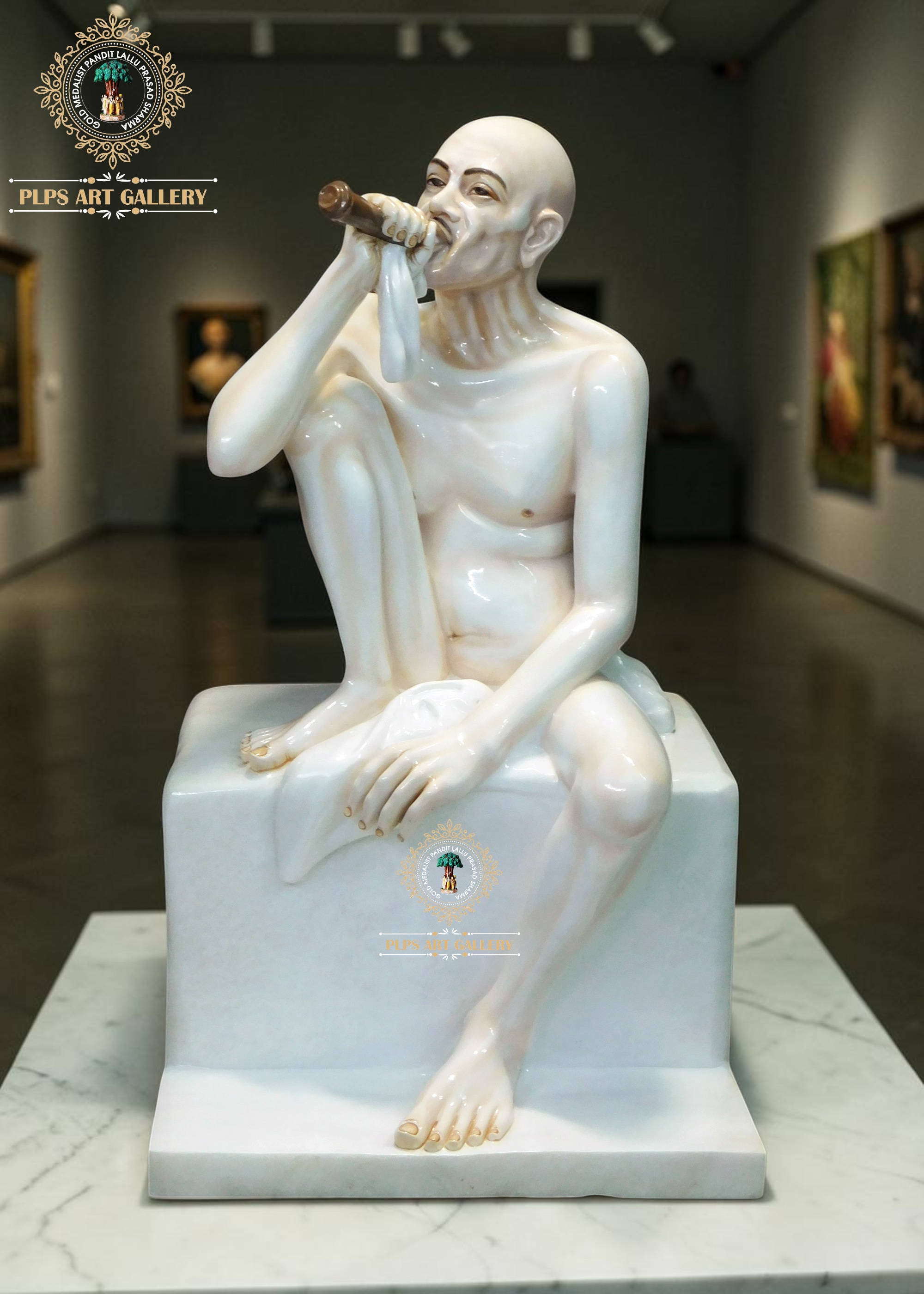
Made-to-Order Only
Our gajanan maharaj are crafted exclusively on commission. Share your size, marble type and iconography — our fourth-generation artisans will begin your piece at our Chandpole Bazaar workshop, Jaipur.
Start a Commission