
Ganesh Ji Statue
Lord Ganesha — Vighnaharta, remover of obstacles, and the first deity invoked before every Hindu ritual — commands a place in almost every Indian home. A marble Ganesh Ji statue endures where clay dissolves and metal tarnishes: its cool white stone carries the sattvic purity our shastras associate with permanent household worship. Hand-carved marble is chosen for daily puja precisely because it holds the deity's presence with the stillness the form deserves, growing more revered with every generation it passes through.
At PLPS Art Gallery, four generations of Jaipur sculptors — beginning with Late Pandit Lallu Prasad Sharma, Shilp Guru and Presidential Award (1991) recipient — have shaped Ganesha's most delicate features by hand: the curl of the trunk, the roundness of the modak, the intact and broken tusks, the folds of the dhoti, and the individually chiselled fingernails. We carve in dense Makrana marble (the traditional choice), softer Vietnam White where finer detail on jewellery is required, or deep-black Bhainslana. Optional Swarna Karya gold-leaf work brightens the crown, ornaments, and modak. No machine finishes the face; every eye is drawn by chisel and hand-polished in Chikni.
Ganesha appears in several classical forms — the seated Lambodara (calm, abundance), the standing form (readiness and progress), the dancing Nataraja pose (cosmic rhythm), and the reclining Sukhasana (comfort and prosperity). Trunk direction matters most: a left-curled Vamamukhi trunk brings householder prosperity and is the traditional recommendation for homes, while the right-curled Dakshinamukhi (Siddhi Vinayaka) form is spiritually intense and better suited to temples with strict daily ritual. Place the murti in the north-east Ishan Kona facing east or west; avoid the bedroom, bathroom, and south wall.
Our Ganesh Ji statues range from a 4-inch travel murti to full seven-foot temple installations. For a home mandir, 12–18 inches remains the most versatile choice; 6–12 inches suits an apartment shelf; 18 inches and above becomes truly ceremonial for Ganesh Chaturthi. We customise the seat (single lotus, double lotus, mushak vahana, or carved throne), paint the dhoti and shawl in mineral pigments, add gold-leaf detailing to crown and ornaments, and engrave family names or mantras on the pedestal on request.
Commissioning a Ganesh Ji statue takes 30 to 90 days depending on size and detail. For Ganesh Chaturthi 2026 (mid-September), please place custom orders by the first week of June. Contact our Chandpole Bazaar workshop to begin — worldwide insured shipping included.
Available Ganesh Ji Statue
Handcrafted marble sculptures — explore our collection.


Hand-Carved Marble Ganpati Idol

hand carved marble ganesha statue

Frequently Asked Questions
Traditionally, the left-curled trunk form — called Vamamukhi Ganesha — is recommended for the household. The left is linked with the lunar Ida nadi, feminine energy, and worldly prosperity; it is considered easier to appease with everyday puja and grants family harmony, wealth, and general auspiciousness. The right-curled form (Dakshinamukhi or Siddhi Vinayaka) is spiritually more powerful, associated with the solar Pingala nadi and Kundalini awakening, but it demands strict, unbroken daily ritual and is more suited to formal temples than to family mandirs. When in doubt, choose Vamamukhi.
The 12-to-18-inch range is the most widely recommended size for a permanent home mandir Ganesha — it is visible and dignified without dominating the room, and it fits comfortably on standard mandir shelves. For small apartments or wall-mounted mandirs, a 6-to-9-inch murti works well. Ganesh Chaturthi installations, where the deity becomes the centrepiece for ten days of ritual, can go 18–36 inches. Anything above three feet is usually commissioned for community pandals, temple garbhagrihas, or garden and courtyard installations rather than the daily home shrine — we make all three.
Ideally, place the marble Ganesha in the north-east corner of the home — the Ishan Kona, considered the most auspicious zone in Vastu Shastra — inside a dedicated puja room. The idol should face east or west so the worshipper faces west or east respectively. Never install Ganesha inside a bedroom, bathroom, kitchen, storeroom, or directly under a staircase; avoid placing him against a south wall or opposite the main entrance. Keep the surface elevated and clean, light a diya at dawn, and do not keep two Ganesha idols of the same posture in one room.
For a traditional home Ganesha, Makrana marble — the same stone used in the Taj Mahal — is the classic choice; it is denser, more translucent when polished, and ages beautifully across generations. Vietnam White is softer and permits finer detail on trunk curls, jewellery, and modak, making it popular for medium mid-detailed pieces. Bhainslana marble carries a dense black grain and suits collectors who want a striking non-white finish. All three take Swarna Karya gold-leaf work cleanly. Avoid painted plaster or resin claiming to be marble — real marble is cool to touch and rings faintly when tapped.
Machine-turned marble idols show perfectly symmetrical features — identical ear curves, mechanically uniform tool marks under the arms, and a slightly flat, glassy finish where the CNC cutter passed. A hand-carved Ganesha carries subtle asymmetry in the ear fan, individually chiselled fingernails, natural depth in the eye sockets from Rekhankan line-work, and the soft Chikni polish only wet-sanding by hand produces. Ask the seller for in-progress photos of the same idol at the Shila Pariksha (stone selection), rough-out, and finish stages — a genuine hand-carved commission can always share them; a factory-imported piece cannot.
No — a marble Ganesha is meant for permanent Pran Pratishtha installation and daily worship, never for Visarjan (immersion), which is reserved for temporary unfired clay eco-murtis. Many families keep a permanent marble Ganesha for daily puja and add a small clay murti for the tenth-day immersion. For care, wipe the marble weekly with a soft dry cotton cloth; for deeper cleaning, use a lightly damp cloth followed by immediate drying. Never use chemical polishes, abrasive scrubs, or acidic cleaners; keep painted or gold-leafed pieces out of direct sunlight to preserve pigment.
Looking for a custom Ganesh Ji Statue?
Every piece is hand-carved to order in our Chandpole Bazaar workshop, Jaipur. Share your size, marble type and iconography — our 4th-generation artisans will craft it for you.
Request a Quote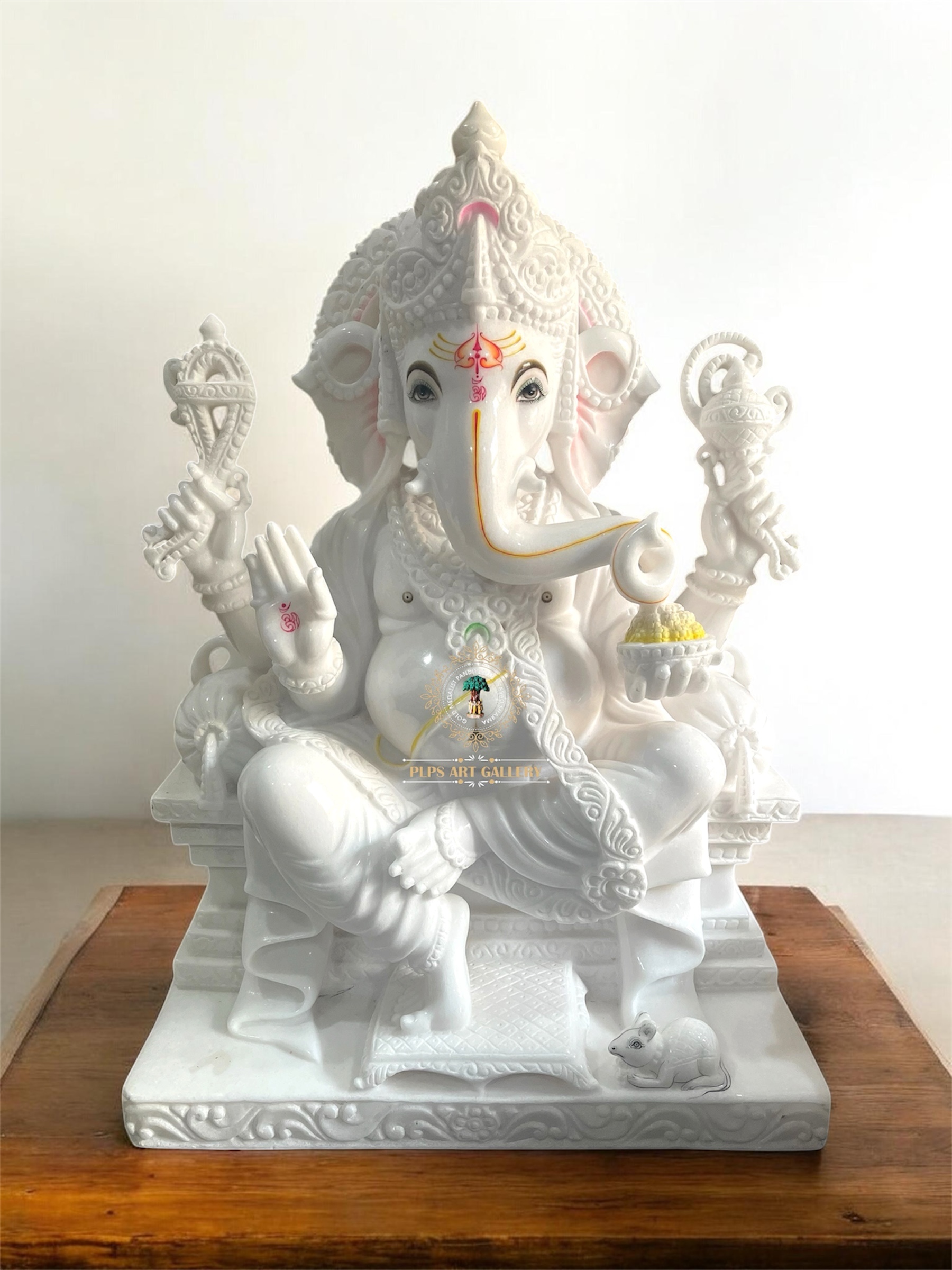
Browse Ganesh Ji Statue
Explore our current collection of handcrafted ganesh ji statue in Makrana, Vietnam White & deep-black Bhainslana marble.
View All Products