
Gayatri Mata murti
Maa Gayatri stands unique in Sanatan Dharma — she is not the deity of a mantra but the mantra itself given form. The 24 syllables of the Gayatri Mantra, revealed to Rishi Vishwamitra and considered the most sacred verse in the entire Vedic corpus, are personified as a Panchamukhi (five-faced) ten-armed goddess whose five faces represent the five elements and whose four subsidiary faces embody the four Vedas — Rig, Yajur, Sama, Atharva. Called Veda Mata, mother of the Vedas, she has been worshipped in Brahmin households, Vedic pathshalas and Arya Samaj mandirs at every Sandhya Vandana for millennia.
Carving five faces and ten arms from a single marble block is the most technically exacting commission our workshop undertakes. The faces must emerge in perfect radial symmetry — identical proportion, matched serene expression — while ten arms fan out holding the four Vedas as books, a lotus, shankha, chakra, akshamala and kalash of amrit, each attribute crisply released without weakening the marble bridge to the body. PLPS artisans at Chandpole Bazaar, in the tradition founded by Shilp Guru Late Pandit Lallu Prasad Sharma (Presidential Award, 1991), reserve Makrana for Panchamukhi commissions — only its dense translucent grain holds this fineness across five faces without hairline fracture.
Traditional Panchamukhi iconography assigns each face a distinct varna: pearl-white for wisdom, coral-red for creativity, gold for prosperity, deep blue for infinite space and bright white for purity — together representing consciousness working through the five elements. Gayatri rides Hamsa, the swan of discernment, or is seated on a fully-opened white lotus. Vastu Shastra places her in the Ishaan (north-east) corner of a dedicated Vedic study room or the home mandir, always facing east so the morning Gayatri Sandhya is offered directly toward the rising sun.
Sizes range from a 9-inch personal Sandhya piece for a Brahmachari's puja shelf, through 15–24 inch murtis for family Vedic study rooms and Arya Samaj household mandirs, up to 3–5 foot commissions for Gayatri Parivar centres and community havan halls. Customisation includes 22-carat Swarna Karya gold leaf on the four Vedas books, the full 24-syllable Gayatri Mantra hand-engraved in Devanagari along the pedestal in the traditional three-line pada format, and mineral-pigment application on the five faces to preserve the scriptural varna scheme without staining the marble body.
For a Brahmin household observing daily Sandhya, a Vedic scholar's private study, an Arya Samaj mandir where Gayatri holds primacy, or a Gayatri Parivar centre planning a Gayatri Jayanti (Jyeshtha Purnima) Pran Pratishtha, share your size, face-colour scheme and mantra-engraving requirements with our Chandpole Bazaar workshop — we handle stone selection, five-face carving, pigment work, gold leaf and insured worldwide delivery.

Frequently Asked Questions
Panchamukhi Gayatri is the classical form of Maa Gayatri with five faces and ten arms. The central face represents pure consciousness and the transcendent syllable Om; the four surrounding faces embody the four Vedas — Rig, Yajur, Sama, Atharva — from which all Vedic knowledge flows. In a parallel scriptural reading, the five faces stand for the five elements — prithvi, jal, agni, vayu and akash — that constitute all creation. Traditional iconography paints each face a distinct varna: pearl-white, coral-red, gold, deep blue and bright white, together representing consciousness expressing itself through matter.
The Gayatri Murti is uniquely a mantra given visible form. The 24 syllables of the Gayatri Mantra — Tat Savitur Varenyam / Bhargo Devasya Dheemahi / Dhiyo Yo Nah Prachodayat — are personified as this five-faced goddess, so the statue is not a symbol of the mantra but its dhyana-rupa (meditative form). When a devotee sits in daily Sandhya Vandana and offers the mantra, the murti provides the visual anchor for concentration. This is why serious upasakas prefer a statue with the full mantra engraved on the pedestal, so recitation and darshan reinforce one another at every Sandhya.
Makrana white is the traditional and correct choice for Gayatri, and the practical one — Panchamukhi carving cannot be executed cleanly on softer stone. Five faces released from a single block need the tight, low-porosity grain of Makrana to hold identical detail without micro-fractures at the neck bridges, and the same grain lets Devanagari mantra engraving on the pedestal read crisply for decades. For a Vedic scholar's study or a Brahmin household mandir where the murti will remain for a lifetime of daily Sandhya, only Makrana justifies the commission. Vietnam white is an acceptable lower-cost alternative for smaller pieces.
We offer three engraving formats. The first is the traditional three-line pada format — Om Bhur Bhuvah Svah / Tat Savitur Varenyam Bhargo Devasya Dheemahi / Dhiyo Yo Nah Prachodayat — hand-cut in Devanagari across the front and side faces of the pedestal. The second is the shortened Om Bhur Bhuvah Svah on the front alone, for smaller statues where line thickness matters. The third is the full 24-syllable mantra encircling a lotus base in a continuous ring. All Devanagari is chiselled by hand, not sandblasted, so each akshara carries correct stroke weight, and can be finished with 22-carat Swarna Karya gold leaf on request.
Gayatri Jayanti falls on Jyeshtha Shukla Purnima — the full moon of the Jyeshtha month, generally late May to mid-June — and is the most auspicious day of the year to install or reconsecrate a Gayatri murti. Gayatri Parivar centres, Arya Samaj mandirs and devout households commonly plan Pran Pratishtha around it. Panchamukhi Gayatri is our slowest carving commission: five faces and ten arms take four to six weeks of workshop time alone. For a Gayatri Jayanti installation we recommend placing the order 75 to 90 days in advance, so carving, mantra engraving, pigment work and insured shipping all complete comfortably.
The five faces and ten arms concentrate more fine detail than almost any other murti we carve, so cleaning must be gentle and disciplined. Dust weekly with a soft dry natural-hair artist's brush — squirrel or sable — working outward from each face and along each arm; cloth will catch on the attributes and can chip a shankha or an akshamala. For deeper cleaning use a barely damp cotton bud along seams; never use soap, marble cleaner or lemon, whose acid dulls Makrana and eats gold leaf. Always lift the murti by the pedestal or lotus base with both hands, never by an arm or face.
They are distinct in form, function and worship tradition. Saraswati is single-faced and four-armed, seated with a hamsa and holding veena, pustaka, sphatik-mala and kamandalu — she presides over arts, music, learning and creative expression. Gayatri is five-faced and ten-armed, the personified form of the Gayatri Mantra itself and Veda Mata from whom all Vedic knowledge originates. Saraswati is worshipped by students, artists and musicians on Vasant Panchami; Gayatri is worshipped by Brahmins and Vedic scholars at daily Sandhya Vandana and formally on Gayatri Jayanti. In an Arya Samaj mandir Gayatri holds primacy; in a music school, Saraswati does.
Looking for a custom Gayatri Mata murti?
Every piece is hand-carved to order in our Chandpole Bazaar workshop, Jaipur. Share your size, marble type and iconography — our 4th-generation artisans will craft it for you.
Request a Quote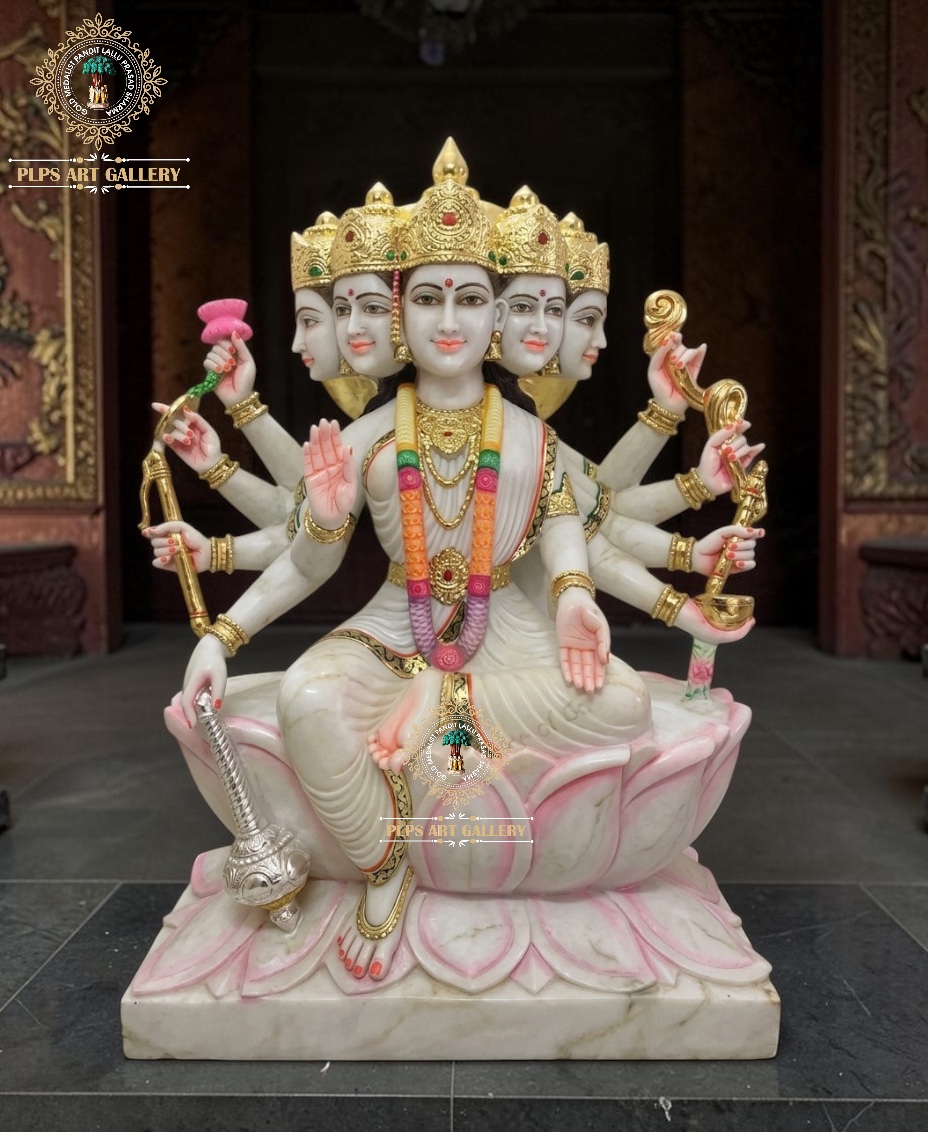
Made-to-Order Only
Our gayatri mata murti are crafted exclusively on commission. Share your size, marble type and iconography — our fourth-generation artisans will begin your piece at our Chandpole Bazaar workshop, Jaipur.
Start a Commission