
Guru Nanak Ji
Guru Nanak Dev Ji (1469-1539), the first of the Ten Sikh Gurus and the founder of Sikhi, taught a radiant monotheism that rejected ritual and idol worship. The eternal Guru of Sikhs is the Guru Granth Sahib, and inside the Darbar Sahib of every Gurudwara that scripture alone presides. It is important, then, to be clear about what a marble portrait of Guru Nanak Dev Ji is — and what it is not. These are reverent portrait sculptures, akin to the framed Sobha Singh paintings hung in Sikh households the world over. They belong in the home, in the langar-hall antechamber, in community centres and diaspora cultural halls — as visual reminders of the founder's presence. They are not, and cannot be, substitutes for the Guru Granth Sahib in the sanctum.
With that framing, portrait sculpture of Guru Nanak Dev Ji becomes a specific artisanal discipline — closer in nature to the marble portrait of Shirdi Sai Baba than to a deity idol. There is no scriptural idealisation to work from. The universally recognised likeness of Guru Nanak — serene half-smile, luminous eyes, white beard flowing to the chest, full dastar wound high on the head, right hand raised in blessing — was established for the modern era by the Punjabi painter Sobha Singh (1901-1986), whose canonical portraits are the visual reference every credible sculptor in India returns to. PLPS carves from that tradition. Makrana marble, dense and fine-grained, is our first recommendation: it holds the fine detail of the beard, catches soft light on the cheekbones, and photographs beautifully in the ivory-and-blue tonality most Sikh families expect. Four generations of Shilpis in Chandpole Bazaar have refined the portrait-carving discipline this work demands — the Chikni polish that lifts the meditative expression, the Rekhankan detailing along the folds of the chola.
The seated cross-legged form with the right hand raised in blessing is by far the most requested. Larger commissions often add Bhai Mardana — the Muslim rabab-player who was Guru Nanak's lifelong musical companion on his udasis — and Bhai Bala holding a chaur, together telling the interfaith story at the heart of the early Sikh sangat. Standing forms with staff and japamala are chosen for taller pedestals. In the household, place the portrait in a dedicated clean, well-lit space — many Sikh families keep it in a Guru Granth Sahib room antechamber, in the drawing-room or in a personal reflection corner, at eye level or slightly above, never in a bedroom or a walk-through passage.
Sizes range from an 8-inch desk piece to 5-foot commissions. Home portraits of 15 to 24 inches are the sweet spot; community-hall and diaspora installations run 30 to 60 inches. Customisation is where this category truly opens up: mineral-pigment tinting of the dastar in traditional deep blue, saffron or ivory; hand-applied Swarna Karya gold leaf on the chola border; Ik Onkar (ੴ), Khanda or Waheguru in Gurmukhi engraved on the base. For families commissioning a piece for a Sikh community hall or a Nagar Kirtan procession, we replicate elements referencing the Golden Temple's pearl-white marble idiom.
Every Guru Nanak Gurpurab (Kartik Purnima, November), PLPS ships commissions to Sikh families in Punjab, Delhi, Toronto, Vancouver, Brampton, Southall, Birmingham, New York and California. The order of scale, the reverence of the framing and the Chandpole-workshop provenance are ours. Commission a portrait that carries the founder's presence into your home — with all the respect his message demands.

Frequently Asked Questions
This is the most important question to address honestly. Sikhi, as taught by Guru Nanak Dev Ji, rejects murti puja — the only object of worship is Ik Onkar / Waheguru, and the eternal Guru is the Guru Granth Sahib. A marble portrait is therefore not offered as an idol for worship. It is a reverent portrait sculpture, akin to the Sobha Singh paintings and framed prints already present in most Sikh homes as visual reminders of the founder. It belongs in the household, drawing room, community hall or Gurudwara antechamber — never in the Darbar Sahib itself, and never as a substitute for reading and honouring the Guru Granth Sahib. Families uncomfortable with any three-dimensional depiction should not commission the piece; both positions are theologically valid within the Panth.
The near-universal modern likeness of Guru Nanak Dev Ji — serene half-smile, luminous eyes, white beard flowing to the chest, full dastar, right hand raised in blessing — was established by the Punjabi painter Sobha Singh (1901-1986), whose canonical portraits hang in Sikh homes across the world. PLPS carves from that documented visual tradition, cross-referenced with older janamsakhi manuscript imagery. Portrait sculpture is a different discipline from deity idealisation: there is no scriptural template, so the exact tilt of the head, the softness of the eyes, the length and separation of the beard, and the drape of the chola all have to be resolved from painting to stone. Makrana marble, dense and fine-grained, is our first choice because it holds facial expression at a level coarser stones cannot. Reference images are welcomed at commissioning.
Place the portrait in a dedicated, clean and well-lit space that a family already treats as reflective — the drawing-room shrine, a personal reflection corner, or the antechamber to a Guru Granth Sahib room if one exists in the household. Eye level or slightly above is ideal. Avoid bedrooms, walls shared with bathrooms, walk-through passages and cluttered surfaces. Cover the head when in the immediate presence of the piece, as families would in a Gurudwara. Fresh flowers and a lit diya on Gurpurab and other significant Sikh days are appropriate; formal murti-puja rituals are not the tradition. The intent throughout is reverence, remembrance and inspiration — not deity worship.
Makrana — the same marble used in the Taj Mahal and in much of the Golden Temple's white cladding — is dense, fine-grained, warm-white in tone, and holds a mirror polish for generations. For a Guru Nanak portrait, those qualities matter more than in any other commission: the beard requires fine undercutting the coarser stones cannot support, and the meditative facial expression only reads clearly when the polish is even. Vietnam White is a fine alternative at smaller sizes and accessible price points and photographs almost identically. Bhainslana, our deep-black marble, is chosen occasionally when a family wants a striking sandstone-like tonality, especially in Punjab where warm-toned interiors are common. For most Sikh households commissioning a household or community-hall portrait, Makrana remains the first choice.
Yes — the dastar is the most requested customisation surface on any Guru Nanak commission. PLPS applies mineral-pigment tinting in the three traditional palette choices: deep blue (referencing the Nihang and Sant Sipahi tradition), saffron (kesari, associated with sacrifice and celebration), or ivory-white (the tone Sobha Singh most often depicted). We can also hand-apply Swarna Karya gold leaf along the chola border and the dastar edge for a more ceremonial finish. Base engraving options include Ik Onkar (ੴ) in Gurmukhi, the Khanda, or the word Waheguru in flowing Gurmukhi script. For three-figure ensembles we add Bhai Mardana with rabab and Bhai Bala with chaur, quoted separately at commissioning.
The beard and the folds of the chola are the two areas most vulnerable to careless cleaning. Dust the beard, moustache and robe folds weekly with a soft dry natural-hair brush — a clean shaving brush works well. Never wipe these undercuts with a damp cloth; trapped moisture dulls the polish over time and can stain the mineral pigment on the dastar. The smooth surfaces of the face, hands and base can be wiped with a barely damp muslin cloth and dried immediately. Keep the piece out of direct harsh sunlight if the dastar is pigmented, as UV exposure will slowly fade mineral tints. Avoid all citrus, vinegar and household chemical cleaners — a paste of Multani mitti with water, applied lightly and rinsed, is the traditional remedy for stubborn dust.
Guru Nanak Gurpurab, celebrated on Kartik Purnima in November, is by far the peak commissioning window for Sikh families and community halls in Punjab and across the diaspora. Standard sizes of 12 to 24 inches in Makrana, without heavy customisation, require six to eight weeks from confirmed order to delivery within India. Larger commissions of 30 to 60 inches, three-figure ensembles with Bhai Bala and Bhai Mardana, or pieces with heavy mineral-pigment work and gold-leaf detailing need ten to fourteen weeks. International shipping to Canada, the UK, USA and Australia adds three to four weeks for sea freight and about ten days for air freight. For a Gurpurab arrival, we recommend confirming your order by early August; PLPS shares a Chandpole-workshop production calendar with all commissions.
Looking for a custom Guru Nanak Ji?
Every piece is hand-carved to order in our Chandpole Bazaar workshop, Jaipur. Share your size, marble type and iconography — our 4th-generation artisans will craft it for you.
Request a Quote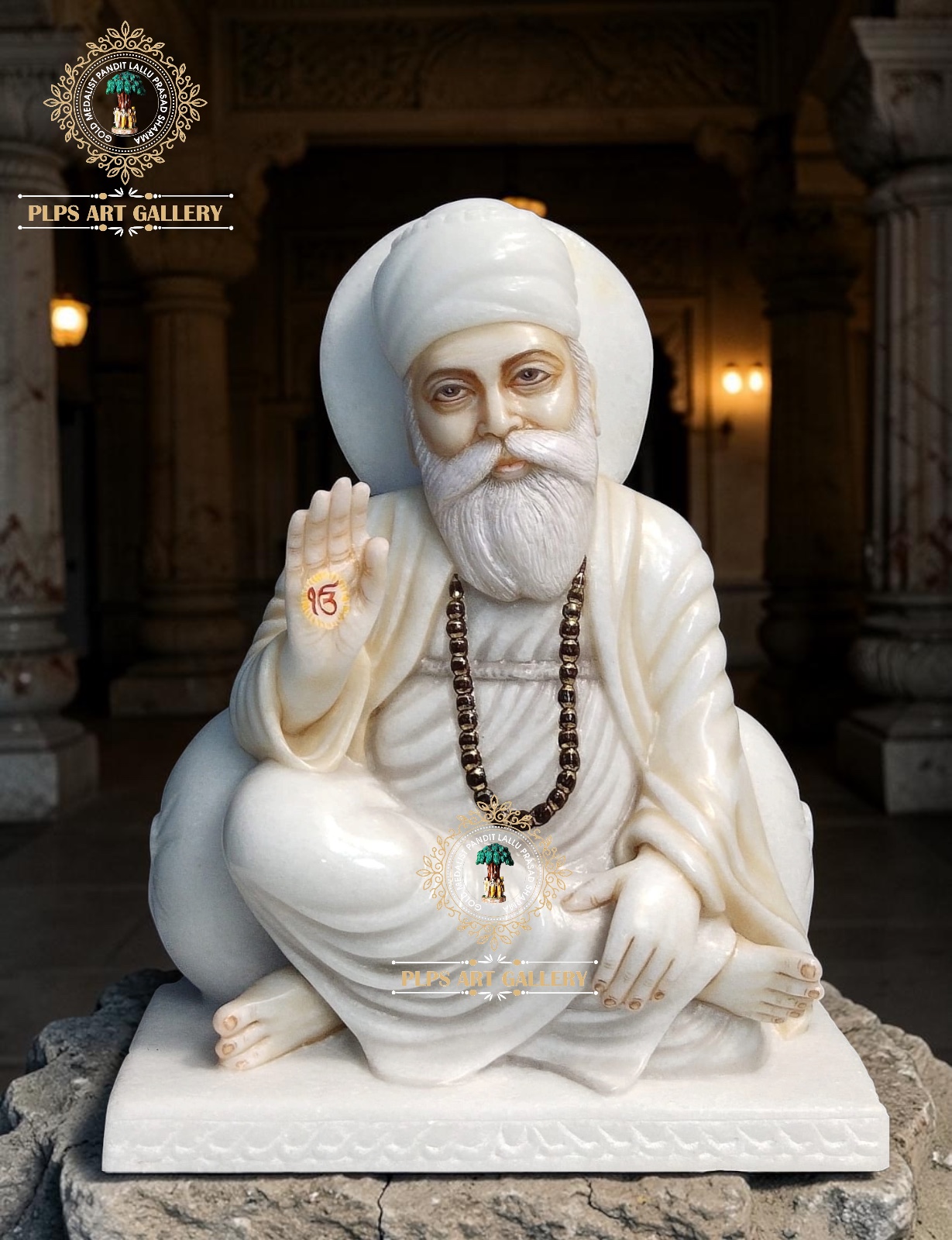
Made-to-Order Only
Our guru nanak ji are crafted exclusively on commission. Share your size, marble type and iconography — our fourth-generation artisans will begin your piece at our Chandpole Bazaar workshop, Jaipur.
Start a Commission