
Hindu Saint Statue
A Hindu Saint Statue in this category is a marble portrait sculpture of a realised acharya, bhakti poet, avadhoot or yogic master whose life continues as living tradition — the sants outside the dedicated pages for Sai Baba, Gajanan Maharaj and other categories on this site. PLPS commissions span the sampradaya spectrum: Adi Shankaracharya and Ramana Maharshi in the Advaita tradition; Ramanujacharya, Madhvacharya, Chaitanya Mahaprabhu, Meerabai, Sant Tukaram and Tulsidas in Vaishnav-Bhakti lineages; Ramakrishna Paramahamsa, Sri Aurobindo and Anandamayi Maa in the modern renunciate stream; Kabir and Guru Ravidas in Nirguna Bhakti. Each is portrait sculpture rather than deity idealisation — the likeness is fixed by photographic record, painted miniature or sampradaya-preserved reference, not by shilpa-shastra proportion.
Under the four-generation lineage of Late Pandit Lallu Prasad Sharma — Shilp Guru and Presidential Awardee (1991) — our Chandpole Bazaar Shilpis treat sant murti as a distinct craft discipline. An Adi Shankaracharya must show the youthful sannyasi with ekadanda and shikha; a Ramakrishna carries the fine bengali beard and the bhava-uplifted gaze of Dakshineshwar; a Ramana Maharshi is bare-torsoed in his kaupin, seated as at Ramanashramam. Every commission begins with a sampradaya consultation — the reference photograph or painted miniature your parampara trusts, the mudra your acharya fixes, and the marks (rudraksha, tulsi mala, urdhva pundra, tripundra, tridandi staff) that identify the lineage — before rekhankan is drawn on the stone.
Sampradaya iconography is precise and non-transferable. Adi Shankaracharya is carved seated in chinmudra with the ekadanda; Ramakrishna in the Dakshineshwar posture; Ramana Maharshi on the stone couch of Sri Ramanashramam; Sri Aurobindo in the meditative Pondicherry darshan pose; Anandamayi Maa in her white sari with an open, tender gaze; Tulsidas seated with the Ramcharitmanas on his lap; Chaitanya Mahaprabhu standing with arms raised in kirtan; Ramanujacharya in tridandi with the twelve urdhva pundra marks; Meerabai standing with the ektara. In an ashram or math, install on the guru-peetha at the position the tradition already keeps. In a home mandir, place in the Ishaan (North-East) corner facing East — always at eye level, because the guru-shishya darshan of a sant murti never rises above head-height as a scriptural deity may.
PLPS carves Hindu saint statues from 12 inches to 6 feet. Home shrines cluster between 12 and 24 inches; a dedicated family saint niche or guru corner carries 24 to 36 inches; ashram main-hall installations and lineage samadhi mandirs run 3 to 6 feet including pedestal, sized to the darshan hall's viewing distance. Custom finishes include mineral-pigment tinting for a warm ascetic skin tone true to the saint's own complexion, hand-painted separation of beard, matted hair or shikha, delicate marking of the sampradaya tilak (urdhva pundra, tripundra or chandrachitta), and Swarna Karya gold leaf kept deliberately minimal — most of these saints lived in absolute renunciation, and heavy gilding contradicts that testimony. Every base can carry a Devanagari inscription — the saint's mool-mantra, a signature line from a bhashya or abhang, or the sampradaya's guru-vandana — carved to your ashram's or family's specification.
For ashrams, maths, sampradaya-lineage households and spiritual centres commissioning a portrait-accurate marble murti of an acharya, bhakti sant or realised master, PLPS carries the fourth-generation Chandpole workshop discipline this category demands. Share the reference and the sampradaya at the outset — we consult, draft, and carve to your lineage's standard.

Frequently Asked Questions
Across ashrams and households the most-requested commissions cluster in three streams. From the Advaita tradition, Adi Shankaracharya (the young sannyasi with ekadanda and shikha) and Ramana Maharshi (bare-torsoed on the stone couch of Ramanashramam) are the two most-carved. From modern renunciate lineages, Ramakrishna Paramahamsa, Sri Aurobindo and Anandamayi Maa dominate — often installed together in centres tied to the Ramakrishna Mission or the Sri Aurobindo Ashram. From the bhakti stream, Tulsidas with the Ramcharitmanas, Meerabai with her ektara, Sant Tukaram in kirtan and Chaitanya Mahaprabhu with arms raised in ecstatic dance are steady favourites; Ramanujacharya, Madhvacharya, Kabir and Guru Ravidas are commissioned by sampradaya-lineage households.
We treat a saint's face as a portrait, not an interpretation. At the start of every commission you share the exact reference the sampradaya, ashram or family recognises — nineteenth-century photographs for Ramakrishna and Ramana Maharshi, the well-known darshan photographs of Sri Aurobindo and Anandamayi Maa, painted miniature and mural traditions for older acharyas like Shankaracharya, Ramanuja and Madhva, and the classical bhakti-tradition paintings of Meerabai, Tulsidas and Chaitanya Mahaprabhu. Our Shilpis then draft the head, features and gaze against that reference at the rekhankan stage, share in-progress photographs, and only proceed to Chikni polish once your acharya or ashram trustee has approved the likeness.
A sant's iconography is inseparable from his or her parampara, and markers are non-interchangeable. Ramanujacharya is shown in tridandi with the twelve urdhva pundra marks of Sri Vaishnavism — a Shaiva tripundra on that same figure would be a grave error. Adi Shankaracharya's Dashanami ekadanda differs from a Vaishnav sannyasi's tridandi; Chaitanya Mahaprabhu's ecstatic kirtan-mudra is not interchangeable with a formal acharya's chinmudra; Anandamayi Maa's flowing hair and open gaze cannot be softened into a generic goddess pose. We confirm the sampradaya at order confirmation so every mark, mudra, robe knot and posture is executed to the tradition your ashram or family stands in.
Sizing follows the darshan the space is built for. In a home mandir, 12 to 18 inches sits well on a chowki within the pooja room; a dedicated family saint niche or guru corner carries 18 to 24 inches at eye level. In an ashram or spiritual centre, sizing is set by the hall itself — a dedicated saint shrine within a larger complex typically runs 24 to 36 inches on a raised peetha, and the main guru murti of a lineage samadhi mandir or sampradaya seat carries 3 to 6 feet including pedestal, sized so devotees have full-body darshan from the seating rows. Share the room dimensions and viewing distance and we will advise the exact height.
For portrait fidelity Makrana white (Sangemarmar) is our first recommendation — its dense, fine grain holds facial expression, beard strands and matted-hair undercuts across generations, and its Chikni polish carries the serenity of the saint's face at a fidelity coarser stones cannot approach. Vietnam White is a fine option for smaller home-mandir sizes up to 18 inches where the price point matters, its slightly finer surface suiting delicate facial modelling. Bhainslana's deep black tonality suits ashram commissions of ascetic figures like Ramana Maharshi, Sri Aurobindo or Tulsidas — the earthiness of the stone reads truer to a dhuni-lit sannyasa mood than a bright white finish.
A 12 to 18 inch home-shrine sant murti takes 3 to 6 weeks depending on portrait detailing; 24 to 36 inch ashram-scale murtis run 8 to 14 weeks; 4 to 6 foot main-hall installations, including a carved raised peetha, take 4 to 6 months. For care, dust the matted hair, beard, shikha, tulsi mala, rudraksha strand and manuscript folds weekly with a soft dry natural-hair brush — never damp, as trapped moisture will dull Makrana over time. Wipe smooth surfaces of the face, hands and dhoti with a barely-damp muslin cloth and dry immediately. Avoid citrus or acidic cleaner; a light neutral marble wax once a year restores the Chikni polish on smooth surfaces.
Looking for a custom Hindu Saint Statue?
Every piece is hand-carved to order in our Chandpole Bazaar workshop, Jaipur. Share your size, marble type and iconography — our 4th-generation artisans will craft it for you.
Request a Quote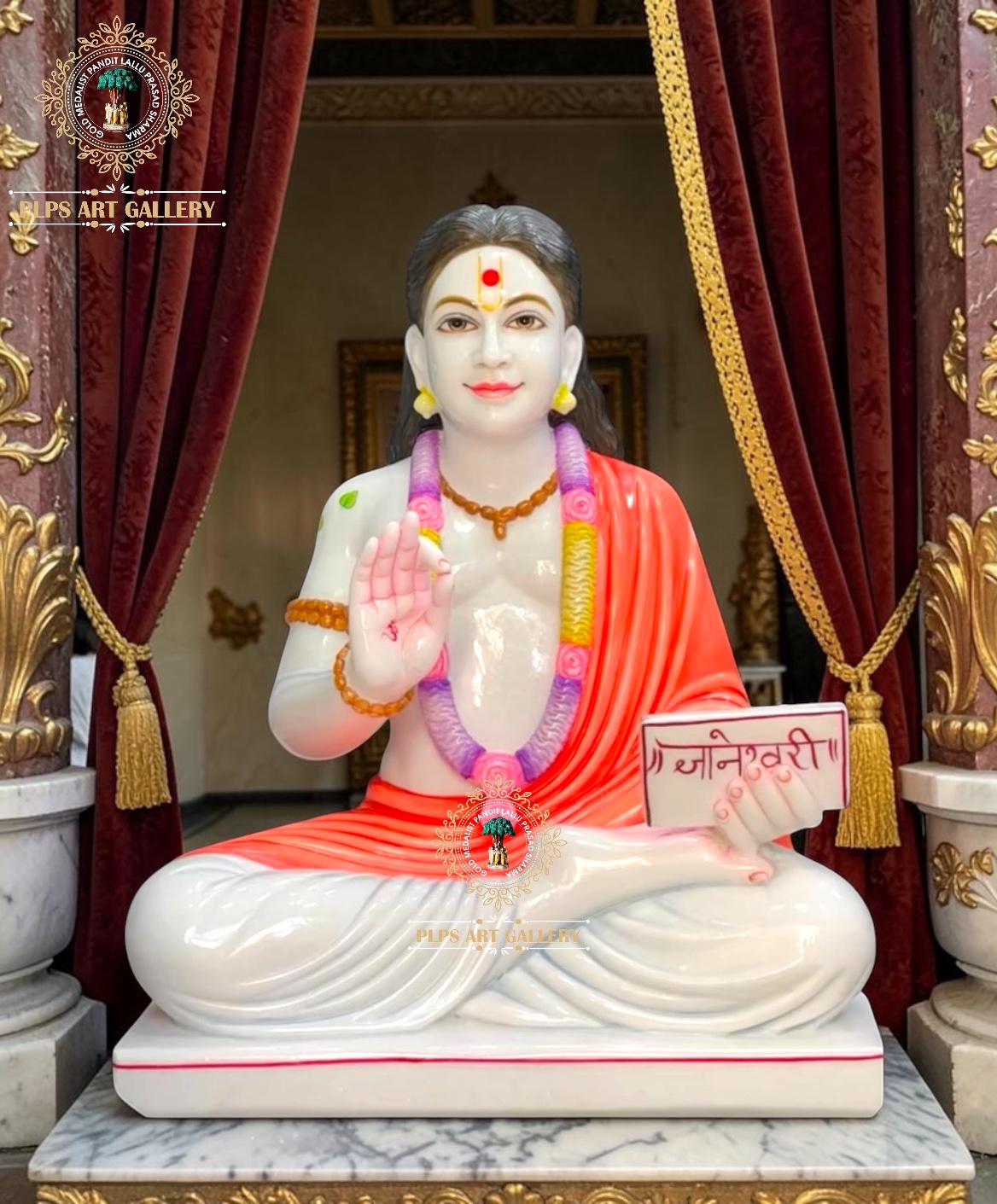
Made-to-Order Only
Our hindu saint statue are crafted exclusively on commission. Share your size, marble type and iconography — our fourth-generation artisans will begin your piece at our Chandpole Bazaar workshop, Jaipur.
Start a Commission