
Jain Murti
A Jain Murti is a marble image of a Tirthankara — one of the twenty-four Jinas of this cosmic half-cycle who conquered attachment, taught the path of liberation, and are today the object of Jain darshan and pratishtha. The line begins with Rishabhanatha (Adinath), the first Tirthankara, and closes with Mahavira, the twenty-fourth. Every image in between belongs to this same silent order: perfectly still, seated in padmasana or standing in kayotsarga, unadorned by any worldly gesture, because a Jina has already crossed. Marble — most traditionally Makrana Sangemarmar from Rajasthan — is the preferred stone because its cool, luminous whiteness reads as ascetic purity, and because it can hold the razor-fine surface polish that Jain iconography demands. Where Hindu murtis wear jewellery, weapons and dynamic mudras, a Tirthankara is defined by what has been renounced. The stone has to carry that renunciation.
At our Chandpole Bazaar workshop, the first craft principle for any Jain commission is that the lanchan — the identifying emblem carved on the pedestal directly beneath the Tirthankara's seat or feet — is not a decorative afterthought. It is the sole way a devotee tells one silent, near-identical Tirthankara from another. Rishabhanatha has the bull, Ajitanatha the elephant, Sambhavanatha the horse, Chandraprabha the crescent moon, Shantinatha the deer, Neminatha the conch, Parshvanatha the serpent, Mahavira the lion. Parshvanath is additionally shown with a seven-hooded serpent canopy of Dharanendra above the head; Suparshvanath, whose lanchan is the swastika, is identified by a five-hooded canopy — hood counts a trained eye reads before it drops to the base. Across every Tirthankara sits the Shrivatsa, a diamond-like mark at the centre of the chest, one of the Ashtamangala, which our Shilpis carve identically on every image as an authenticity signature. In the Digambar tradition the figure is nude and eyes are downcast in inward contemplation — meaning the entire darshan rests on the flawless proportion of the body itself, with no cloth or ornament to hide a mis-line. PLPS has served Jain sanghs, mandirs and families since 1950, and this particular discipline — an ornament-free surface where nothing can hide — is the reason those relationships have carried across four generations.
Iconographically we hold to the two canonical postures only. Padmasana — cross-legged in deep meditation, hands cupped in the lap in dhyana mudra — is the seated form used for most home-mandir and temple main-deity commissions. Kayotsarga — standing erect, arms straight down alongside the body, feet slightly apart — is a posture unique to Jainism and literally translates as 'dismissing the body'; it is preferred for larger temple installations and for Bahubali, whose kayotsarga is the archetype. Ears are carved elongated, remembering the heavy royal earrings worn before renunciation. For Vastu, the Jain home mandir is best located in the North-East (Ishanya) quadrant of the home, on a raised chowki, with the Tirthankara facing East or North. Cleanliness is paramount — Jain worship is deeply tied to ahimsa and purity, so the space must be kept free of leather, food traces and outdoor footwear.
Sizes range from a 6-inch personal-shrine piece to 6-foot temple installations. The most requested home-mandir sizes are 9 to 18 inches; Jain temple pratishthas typically call for 2 to 6 feet. We commission individual Tirthankaras, mool-nayak (principal deity) pieces with full parikar (throne-back with attendant figures, chhatra and chauri-bearers), and complete Chaubisi sets of all twenty-four Tirthankaras for temple installations. Both Digambar (nude, unadorned, downcast eyes) and Shvetambara (loin-cloth, sometimes bejewelled, with inlaid glass eyes) treatments are executed strictly per sampradaya. Gold leaf (Swarna Karya) is kept deliberately minimal or omitted altogether — the ascetic brief calls for restraint. Materials include Makrana white, finer Vietnam White for facial modelling, and deep black Bhainslana on request; black marble is available for select Digambar pieces where the community prefers it.
PLPS serves Jain families, sanghs and mandirs across India and the global diaspora — the United States, United Kingdom, Belgium, East Africa, Singapore and beyond. Speak with our team to commission a Tirthankara murti, a mool-nayak with full parikar, or a complete twenty-four Chaubisi set for your mandir, carved to your sampradaya's exact iconographic standard.

Frequently Asked Questions
The definitive identifier is the lanchan — a small emblem carved on the pedestal directly beneath the Tirthankara's seat or feet. Rishabhanatha (Adinath) carries a bull, Ajitanatha an elephant, Sambhavanatha a horse, Chandraprabha a crescent moon, Shantinatha a deer, Neminatha a conch, Parshvanatha a serpent, and Mahavira a lion. Two Tirthankaras carry a second visual cue above the head: Parshvanath has a seven-hooded serpent canopy of Dharanendra, and Suparshvanath a five-hooded canopy. Every PLPS piece is carved with the correct lanchan for the Tirthankara you have specified — this is non-negotiable in our workshop.
The difference is doctrinal and shows plainly in the stone. In the Digambar (sky-clad) tradition the Tirthankara is depicted nude, entirely unadorned, with eyes downcast in inward meditative absorption — a pure image of complete renunciation. In the Shvetambara tradition the figure wears a carved loin-cloth, is often bejewelled with a crown, necklace and earrings, and traditionally has open eyes inlaid with glass or enamel. Both are correct within their own sampradaya. When you commission a Jain Murti with PLPS we confirm your tradition at the outset and execute every detail strictly to that iconographic code.
Three Tirthankaras dominate home-mandir commissions across almost every Jain family we work with. Mahavira, the twenty-fourth and last Tirthankara, is the most widely worshipped and often the principal image in a household mandir. Parshvanath, the twenty-third, is enormously popular — his seven-hooded Dharanendra canopy is unmistakable and he is associated with protection and the removal of obstacles. Adinath (Rishabhanatha), the first Tirthankara, is chosen by families with deep ties to the primordial dharma-founder tradition. Many mandirs pair Mahavir and Parshvanath, or install all three, with a central mool-nayak and two flanking Tirthankaras.
Yes — this is a discipline we treat with unusual seriousness. Before carving begins we confirm three details in writing with you or your acharya: the specific Tirthankara, the sampradaya (Digambar or Shvetambara), and the posture (padmasana or kayotsarga). The correct lanchan is then drafted onto the pedestal at the rekhankan stage, along with the Shrivatsa mark on the chest and, where applicable, the serpent canopy hood-count. We share in-progress photographs at drawing, rough-carving and finishing stages, so your community's iconographic reviewer can sign off before final polishing begins.
Individual Tirthankara statues in the 2-to-4-foot range typically take 60 to 120 days from confirmed drawings to shipping. A mool-nayak with a full parikar (throne-back with attendant chauri-bearers, chhatra and celestial figures) runs 4 to 8 months, depending on scale. A complete Chaubisi — all twenty-four Tirthankaras carved to consistent proportion, matched marble grain and identical lanchan discipline — is a multi-year commission that we plan in coordinated batches over 12 to 24 months. We have executed such sets for Jain sanghs in India and abroad and welcome pratishtha-timeline planning conversations.
On a Digambar image the entire darshan lives in the smooth, uninterrupted flow of the polished surface, so care is genuinely important. Dust every two or three days with a soft, dry cotton or muslin cloth — never a rough or coloured fabric. For weekly cleaning use a barely-damp muslin wipe and dry the piece immediately with a second dry cloth; standing moisture will over months take the polish down. Do not use any citrus, vinegar, hard-water spray, agarbatti-ash residue solvent or commercial cleaner. Keep the murti away from direct incense smoke and from leather objects. Every three to four years the polish can be professionally refreshed if needed.
Yes — a Chaubisi commission is one of the highest-value pieces of work our workshop takes on. The critical discipline is consistency: all twenty-four Tirthankaras must share identical body proportion, seated height, throne treatment, Shrivatsa position and polish quality, differing only in their individual lanchans and (for Parshvanath and Suparshvanath) their serpent canopies. We reserve marble from a single Makrana quarry cut so grain and tone match across the set, carve in coordinated batches, and treat the whole Chaubisi as one composition. Community and acharya review is scheduled at each batch milestone before the next begins.
Looking for a custom Jain Murti?
Every piece is hand-carved to order in our Chandpole Bazaar workshop, Jaipur. Share your size, marble type and iconography — our 4th-generation artisans will craft it for you.
Request a Quote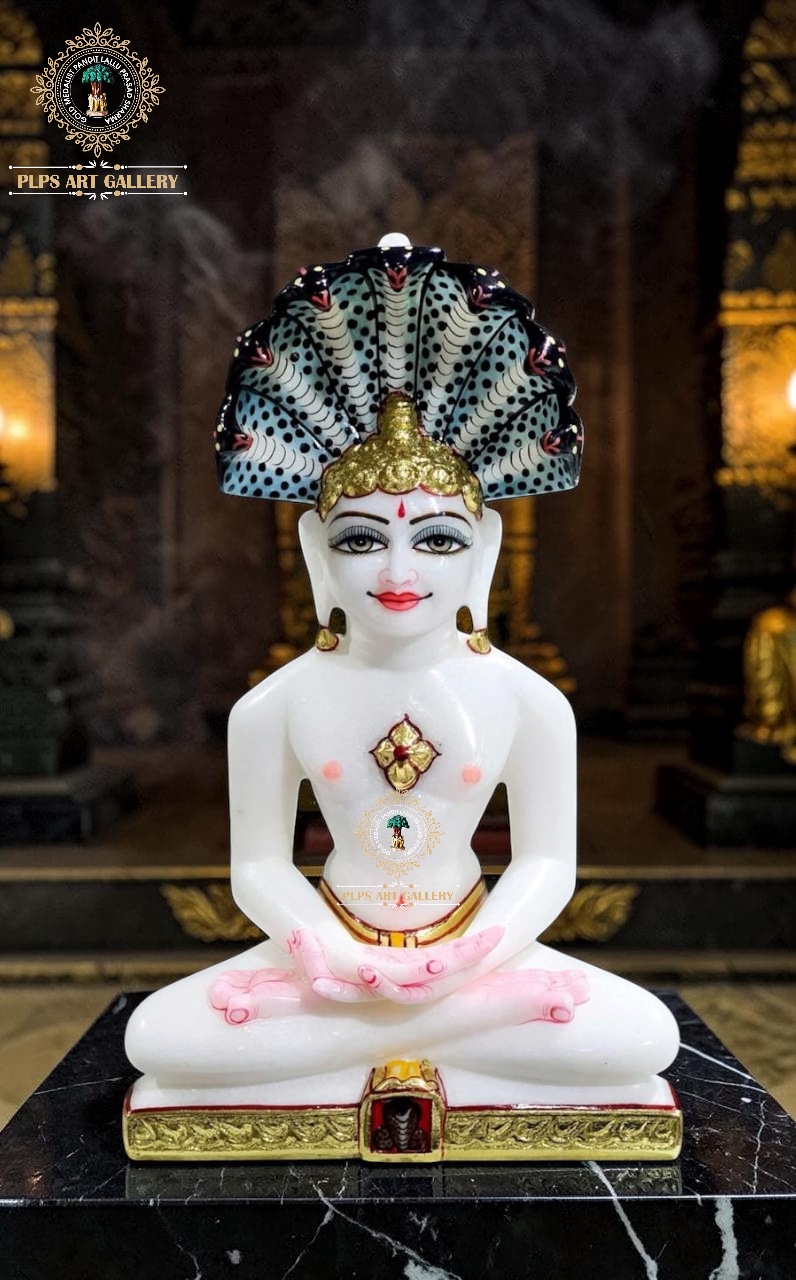
Made-to-Order Only
Our jain murti are crafted exclusively on commission. Share your size, marble type and iconography — our fourth-generation artisans will begin your piece at our Chandpole Bazaar workshop, Jaipur.
Start a Commission