
Khodiyar Mata
Maa Khodiyar is the beloved kul-devi of countless Gujarati families — the folk-goddess of Saurashtra and Kathiawad, born to Mamad Charan and Deval Bai in Rohisala many centuries ago and enshrined at her principal temple at Rajpara in Bhavnagar district. Unlike Puranic Devis who ride lions or tigers, Khodiyar Ma rides a makar (crocodile) — a vahana genuinely unique in Hindu sculpture. She is worshipped as protector-goddess and kul-devi by Kathi, Charan, Rajput, Rabari and Ahir communities across Gujarat and the diaspora.
Carving Khodiyar Mata at PLPS is doubly demanding. Her regal form must radiate the calm benevolence of a Charan folk-mother, and beneath her the crocodile — muscular, scaled, tail curling around the base — must be shaped from an anatomy almost never encountered in Hindu iconography. Four generations of Jaipur artisans since 1950, from the Shilp Guru lineage of Late Pandit Lallu Prasad Sharma (Presidential Awardee 1991), execute the makar in Makrana, Vietnam White or the deep-black Bhainslana marble that Gujarati families favour for its dramatic dark base beneath the painted saree.
Traditional Khodiyar iconography shows the goddess four-armed (chatur-bhuja) — bearing trishul, khadag, damaru and sankha, right hand raised in abhaya mudra — or in temple commissions eight-armed with the full array of Devi weapons. The makar always sits prominently below, tail wrapped along the pedestal. She wears the traditional Kathiawadi red or gulabi pink saree with a gold-edged border, an ornate mukut and nath. Vastu places her in the North-East (Ishaan Kon) of the Gujarati home mandir, facing East, with an akhand jyot beside her during Navratri sthapana.
Khodiyar Mata murtis range from 6-inch personal shrine pieces to 5-foot Rajpara-scale temple installations, with 12 to 24 inch sizes most requested for Kathiawadi household mandirs. Every commission is customisable — the saree shaded to deep sindoori red for classical Rajpara iconography or the softer gulabi pink favoured by younger households, mukut and haar receiving full Swarna Karya gold-leaf, and the makar base enlarged so the crocodile reads as a defining sculptural feature. Wedding-gift sets pair a 9-inch Khodiyar with a wooden mandir.
For Kathi, Charan and Rajput families in Rajkot, Bhavnagar and Ahmedabad, and the Gujarati diaspora in Leicester, Wembley, Kampala, Nairobi and New Jersey seeking a heirloom Khodiyar Mata murti for Navratri sthapana or Khodiyar Jayanti (Maha Sud Aatham), contact PLPS Art Gallery at Chandpole Bazaar, Jaipur. Custom orders take 30 to 90 days with insured worldwide shipping and moisture-safe crating for the painted saree and gold-leaf.

Frequently Asked Questions
Maa Khodiyar is a beloved folk-goddess and kul-devi of Saurashtra and Kathiawad. Born to Mamad Charan and Deval Bai in Rohisala village, she is worshipped as clan-protector by countless Kathi, Charan, Rajput, Rabari and Ahir families. Legend recounts how she journeyed to the serpent realm to fetch amrit and revive her brother Merakh, returning with a slight limp — which gave her the name Khodiyar, from the Gujarati khodangvun (to limp). Her principal temple sits at Rajpara in Bhavnagar district on the sacred Tataniya dhara.
Khodiyar Mata's makar (crocodile) vahana is genuinely rare in Hindu iconography — Ganga is the only major deity who shares it, and hers is a slender river-form very different from Khodiyar's grounded, muscular mount. Tradition holds that as she journeyed to the naga-lok to save her brother, the crocodile carried her across water and became her steadfast companion. The makar symbolises fearless command over hidden currents and the ability to move safely through danger — qualities Kathi and Rajput families invoke when they install her as their clan's protector.
Gujarat's great goddesses look immediately different in marble. Ambaji is enshrined at Banaskantha as a Shakti Peetha and rides a lion or tiger — a maternal, radiant Devi in red-pink saree. Bahuchara Mata of Becharaji rides a rooster (kukdo) and is often shown holding a sword. Khodiyar Mata alone rides the makar, a crocodile — a folk-Devi rather than a Puranic one, born to a Charan family and worshipped as kul-devi rather than universal Mother. Her iconography feels more Kathiawadi and earthbound, with the vahana as the sculptural signature that identifies her instantly.
White Makrana marble is the heritage-grade base for a formal Khodiyar shringar; Vietnam White gives a softer bright finish; and deep black Bhainslana provides a dramatic contrast base for the traditional red saree pigment favoured by Kathiawadi families. The saree is applied over the finished marble in fine layered mineral pigment — deep sindoori red for classical Rajpara iconography, or the gulabi pink increasingly chosen by younger Gujarati households. The border, mukut, nath and haar are gilded with Swarna Karya gold-leaf, and the makar can be tinted pale grey or left in stone-white.
Khodiyar Jayanti falls on Maha Sud Aatham (the eighth day of Maha Shukla Paksha, usually late January or February), and Navratri sthapana falls in late September or early October. For either occasion, commission at least four to five months ahead. A custom Khodiyar Mata murti moves through Shila Pariksha stone selection, Rekhankan sacred marking, main carving of both the Devi and her makar, Chikni polishing, mineral pigment saree painting, and Swarna Karya gold-leaf finishing — 30 to 90 days depending on scale. Add 10 to 15 days for domestic shipping, up to 4 weeks by sea for diaspora deliveries.
Yes — devotees regularly commission Rajpara-form Khodiyar Mata murtis, where the Devi is shown seated in the calm, benedictory posture familiar from the Rajpara sanctum, one hand raised in abhaya mudra with the makar carved prominently across the pedestal. We work from reference imagery you provide or from our archive of Rajpara studies. For care, dust the murti with a soft dry cloth and reach into the crocodile's scales, teeth and tail undercuts with a soft natural-hair brush weekly. Never use a damp cloth on the painted saree or Swarna Karya gold-leaf; wipe only exposed marble with plain water.
Looking for a custom Khodiyar Mata?
Every piece is hand-carved to order in our Chandpole Bazaar workshop, Jaipur. Share your size, marble type and iconography — our 4th-generation artisans will craft it for you.
Request a Quote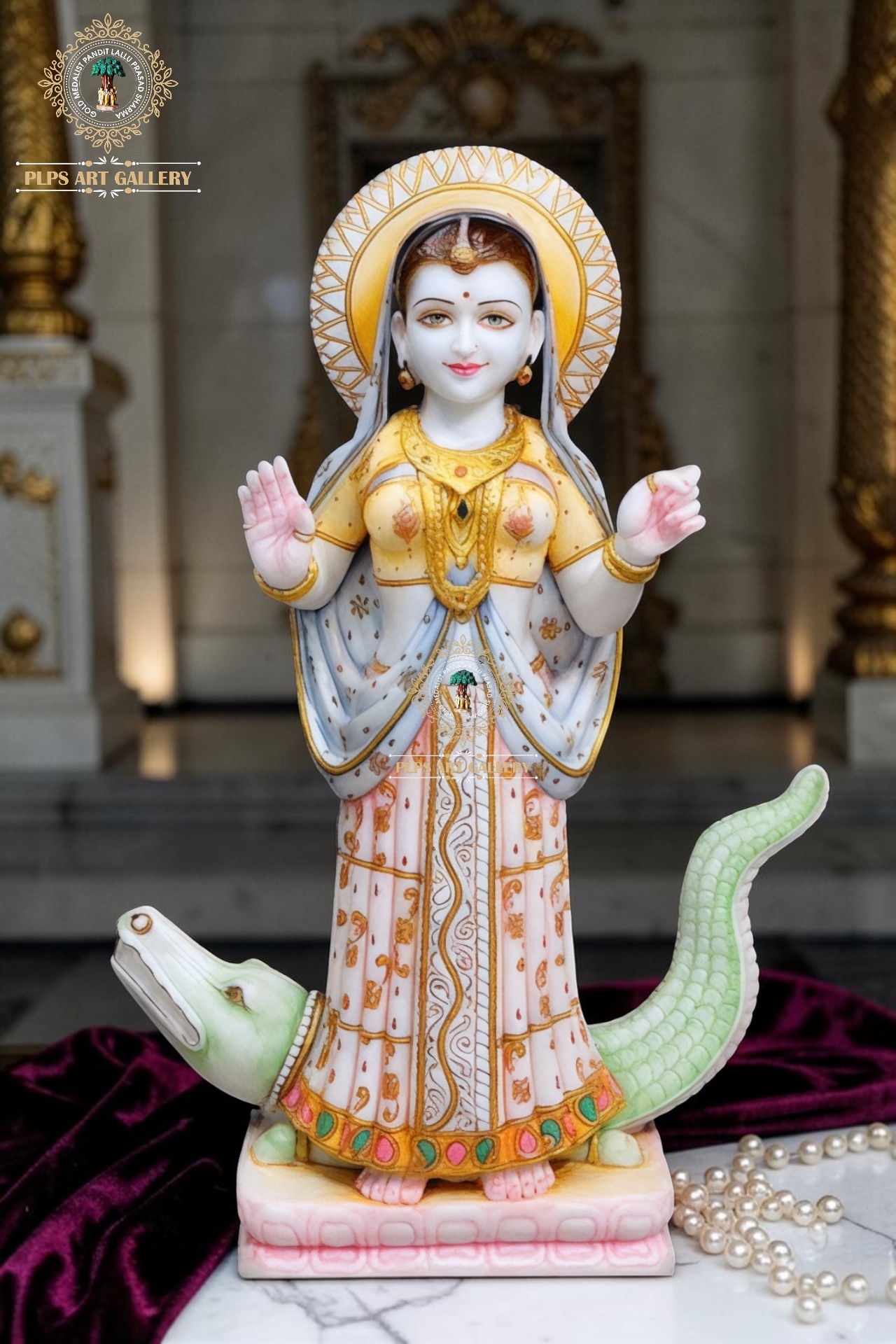
Made-to-Order Only
Our khodiyar mata are crafted exclusively on commission. Share your size, marble type and iconography — our fourth-generation artisans will begin your piece at our Chandpole Bazaar workshop, Jaipur.
Start a Commission