
Krishna Murlidhar
Krishna Murlidhar is the beloved flute-playing form of Lord Krishna, captured in the classical tribhanga stance with one foot crossed gracefully behind the other and the bansuri raised to his lips. This depiction embodies the cosmic musician whose melody draws devotees toward bhakti — the very sound that once summoned the gopis to Vrindavan. Marble suits this form perfectly: its smooth translucence lets the serene expression, slender flute, and peacock feather crown emerge with a luminous stillness no other medium achieves. At PLPS Art Gallery, four generations of Jaipur artisans have carved Krishna Murlidhar since 1950 — a lineage upholding the standards of our founder, Late Pandit Lallu Prasad Sharma, Shilp Guru and Presidential Awardee (1991). The standing crossed-leg pose is among the most demanding forms to shape: the balance point rests behind a single ankle, and the horizontal bansuri must emerge from one continuous block without joins. We carve in dense Makrana, softer Vietnam White, and deep-black Bhainslana, each stone selected through Shila Pariksha before Rekhankan sacred marking begins. Traditional iconography defines Murlidhar with precision. The tribhanga posture bends the body at three points — neck, waist, and knee — while the right leg crosses over the left at the shin. The bansuri is held horizontally with fingers placed on visible holes; the peacock feather (mor-pankh) rises from a jewelled crown; and the gaze rests softly forward. Vastu Shastra recommends placement in the North-East corner (Ishaan Kon) of the home, with the murti facing East to receive sunrise blessings. Eye-level or chest-height positioning on a raised pedestal is preferred over floor placement. Our Krishna Murlidhar sculptures range from 6-inch personal shrine pieces to 6-foot temple installations, with 12 to 24 inch sizes most popular for home mandirs. Every element accepts customisation: Swarna Karya gold-leaf on the bansuri, dhoti and crown; hand-painted peacock feather in natural pigments; scalloped or lotus-base pedestals; and optional gau (cow) or Radha companion figures. Face, jewellery, and stance can be tuned to family tradition. Each piece receives multi-day Chikni hand polishing that gives Makrana its signature glow. Custom orders take 30 to 90 days depending on size and detail, ship pan-India and worldwide with full insurance. Contact PLPS Art Gallery at Chandpole Bazaar, Jaipur to commission your Krishna Murlidhar.

Frequently Asked Questions
For most home mandirs, a 12 to 24 inch Krishna Murlidhar sits at ideal viewing height when placed on a raised pedestal. Shelf altars and personal puja niches work best with 6 to 9 inch pieces, while dedicated temple rooms suit 24 inches and above. As a working rule the deity's face should reach roughly chest height when you are seated for prayer, and the total footprint — flute tip to peacock feather crown — should leave breathing space on all sides. Larger sizes give the tribhanga stance its proper visual grandeur and let the bansuri detail read clearly.
According to Vastu Shastra, place Krishna Murlidhar in the North-East corner (Ishaan Kon), with the murti itself facing East so the deity receives the rising sun. If East is not possible, a West-facing orientation is an acceptable alternative. Avoid South-facing placement, and never position the murti with its back to the main door or inside a bedroom. Keep the flute-side line of sight unobstructed — the bansuri's melody symbolically travels outward, so a clear space in front of the murti is preferred over cramped shelves or immediate walls.
Makrana is the classical choice — dense, calcite-rich, and famed for the Taj Mahal — giving the most enduring translucence and finest detail retention, but at a higher price point. Vietnam White is softer to carve and more affordable, ideal for larger sizes or first-time buyers who want a bright modern white. Bhainslana carries a deep black tonality that contrasts strikingly with wooden mandirs and gold-leaf shringar. For a heritage-grade Murlidhar meant to pass through generations, Makrana remains the traditional recommendation at PLPS; Vietnam White balances beauty with value for most modern homes.
Genuine hand-carved marble carries small deliberate asymmetries. Each finger on the bansuri will be sculpted individually, the peacock feather barbs will show irregular hand-cut spacing, and the tilt of Krishna's head will bear subtle chisel signatures no two artisans repeat identically. Machine work produces perfectly repeating patterns, symmetric undercuts, and often rotary tool marks inside the crown or between fingers. Ask any maker for in-process photos of Rekhankan marking and Chikni polishing stages. At PLPS, every Krishna Murlidhar carries a signed maker plaque and documentation of the artisan lineage that carved it.
The bansuri can be left in plain carved marble, painted with fine gold detail on the finger holes, or fully covered in real Swarna Karya gold-leaf — the last is the traditional choice for temple-grade pieces. The peacock feather (mor-pankh) can stay pure white, receive natural-pigment hand-painting in blues and greens, or use gold-leaf accenting on the eye. Additional shringar options include a jewelled crown, yellow-pigmented dhoti with engraved waistband, painted vaijayanti mala, and kohl-lined eyes. Pedestals can be plain, lotus-form, or carved with gopi and cow motifs.
Dust the murti daily with a soft, dry microfibre cloth, paying particular attention to the flute holes, peacock feather barbs, and crevices between the fingers where dust settles most. For a weekly clean, use a lightly damp cloth with plain water — never lemon, vinegar, or acidic cleaners, which etch marble permanently. Avoid direct sunlight on painted or gold-leaf areas, as natural pigments fade over time. For abhishekam, use plain water or milk followed by a gentle dry wipe. Every two to three years, PLPS clients can send the piece back for professional Chikni re-polishing.
Looking for a custom Krishna Murlidhar?
Every piece is hand-carved to order in our Chandpole Bazaar workshop, Jaipur. Share your size, marble type and iconography — our 4th-generation artisans will craft it for you.
Request a Quote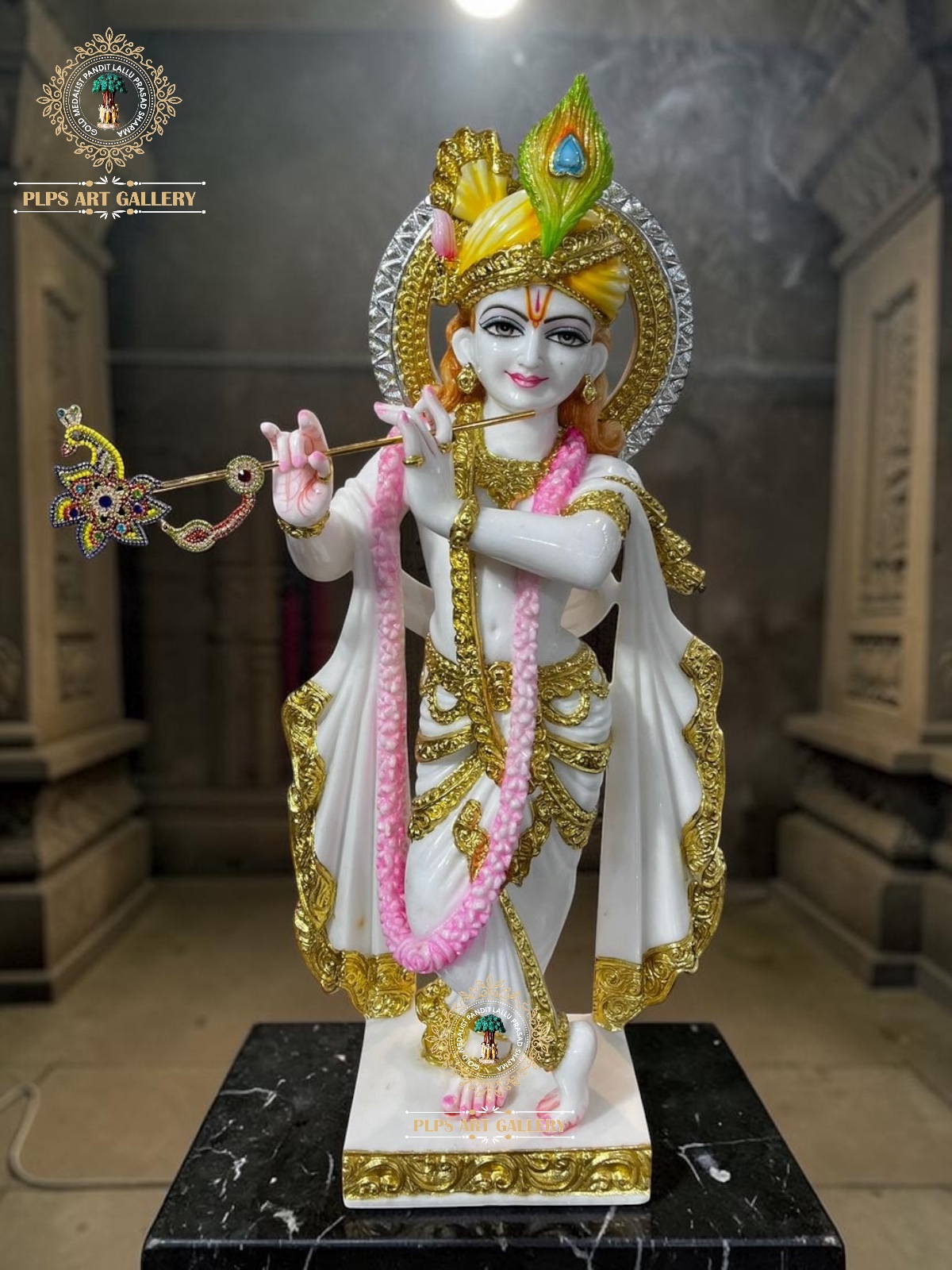
Made-to-Order Only
Our krishna murlidhar are crafted exclusively on commission. Share your size, marble type and iconography — our fourth-generation artisans will begin your piece at our Chandpole Bazaar workshop, Jaipur.
Start a Commission