
Maa Laxmi Ji Statue
Maa Laxmi, the goddess of wealth, abundance, and auspicious beginnings, presides over every Hindu home where prosperity is invited to dwell. Diwali and every Friday centre her worship — the lamps lit, the lotus offered, the first coins placed at her feet. Marble carries her energy with unmatched grace: cool, luminous, and enduring, it holds the still, seated presence Laxmi is meant to embody as she blesses the space she inhabits.
At PLPS Art Gallery, four generations of Chandpole Bazaar carvers — trained in the lineage of Late Pandit Lallu Prasad Sharma, Shilp Guru and 1991 Presidential Awardee — approach Laxmi with the reverence her form demands. The flowing sari folds, the tiered lotus petals of her asana, the balanced kalash, and the eight expressive hands of an Ashta Lakshmi commission are all dressed with our traditional Rekhankan detailing and Chikni polish. Bhainslana black marble, associated with grounding and protective energy, is a favoured stone; Swarna Karya gold leaf is applied to jewellery and kalash on request.
Most home altars feature Padmasana Laxmi — seated on a full-bloomed lotus, four arms holding lotus buds above and offering abhaya (protection) and varada (boon-granting, with coins streaming from the palm) mudras below. Gaja Lakshmi adds two flanking elephants lustrating her with water, a motif tied to rain, fertility, and royal fortune. Vastu places her in the north or north-east zone of the home, facing east, on a raised platform at heart level. Avoid walls shared with a bathroom, kitchen, or the space beneath a staircase.
We carve Laxmi Ji from 6-inch desktop murtis suitable for office cabinets and Diwali gifting up to 5–6 foot temple installations. The 12–18 inch seated Padmasana in Makrana white or Bhainslana black is the most requested home size, often paired with a matching Ganesh on her left for Diwali altars. Ashta Lakshmi can be commissioned as a set of eight individual murtis or a single carved composite panel. Custom lotus bases, an engraved Sri Yantra beneath the asana, gold-leaf detailing, and family-name inscriptions are all workshop options.
Diwali 2026 orders are lead-time critical — a 12-inch Laxmi needs 30–45 days from confirmation, and an Ashta Lakshmi set or gold-leaf commission up to 90. Reach the workshop early to secure your Lakshmi Puja delivery.

Frequently Asked Questions
Both are seated Laxmi forms, but Gaja Lakshmi includes two elephants (gaja) flanking the goddess, raising their trunks to pour water over her from decorated pots. The elephants symbolise rain, agricultural fertility, and royal power, so Gaja Lakshmi is preferred by families praying for expansive, worldly abundance and business growth. Padmasana Laxmi — seated alone on a full lotus with four arms in mudra — is the simpler daily-puja form suited to smaller altars. Both are equally valid iconographically; the choice is aesthetic and devotional preference.
Diwali 2026 falls in early November, and Lakshmi Puja is the peak installation moment for a new murti. A standard 12–18 inch Padmasana Laxmi from our workshop takes 30–45 days from confirmed measurements, marble selection, and advance. Ashta Lakshmi sets, Gaja Lakshmi with detailed elephant work, or any Swarna Karya gold-leaf commission runs 60–90 days. For international shipping in time, we ask clients to place Diwali orders no later than August so packing, freight, and any customs delay are absorbed comfortably.
Position Maa Laxmi in the north or north-east zone of your home — these are the wealth-flow quadrants in Vastu — with the murti facing east so the morning light falls on her. Place her on a raised wooden or stone chowki at heart level, never directly on the floor. Keep the wall behind her clean and unshared with any bathroom, kitchen, or space beneath a staircase. If pairing with Ganesh for Diwali, seat Ganesh to Laxmi's left (the viewer's right) so both face the same auspicious direction.
Makrana white is the classical, luminous choice — the same marble used in the Taj Mahal — ideal for a serene, temple-grade Laxmi that pairs with white or coloured altar lighting. Bhainslana black, quarried in Rajasthan, has natural deep-black grain that many families associate with prosperity energy and choose specifically for Laxmi and Kubera murtis. Bhainslana also carries Swarna Karya gold leaf beautifully because its base tone already reads as gold. Both are Vastu-auspicious for Laxmi; the decision is aesthetic and how the murti will be lit.
Ashta Lakshmi are the eight aspects of Laxmi, each granting a specific form of abundance. They are Adi Lakshmi (primordial existence), Dhana Lakshmi (monetary wealth), Dhanya Lakshmi (harvest and food), Gaja Lakshmi (royal prosperity and rain), Santana Lakshmi (progeny), Veera or Dhairya Lakshmi (courage), Vijaya Lakshmi (victory), and Vidya Lakshmi (knowledge). Devotees commission the full eight as separate murtis for a dedicated altar wall, as a single carved composite panel with all eight in composition, or as a smaller framing set flanking a central Padmasana Laxmi. Our workshop delivers any of the three formats.
Swarna Karya gold leaf is a delicate finish and should be dusted, never scrubbed. Use a soft dry brush or clean cotton cloth once a week, working outward from the ornaments and kalash. Avoid water, chemical polishes, incense residue landing directly on the leaf, and any abrasive cleaner — these lift the leaf over time. Keep the murti out of direct harsh sunlight and away from windows that receive monsoon spray. With this gentle routine, the gold-leaf jewellery on a PLPS Laxmi holds its lustre for decades and can be re-leafed by our workshop if ever needed.
Looking for a custom Maa Laxmi Ji Statue?
Every piece is hand-carved to order in our Chandpole Bazaar workshop, Jaipur. Share your size, marble type and iconography — our 4th-generation artisans will craft it for you.
Request a Quote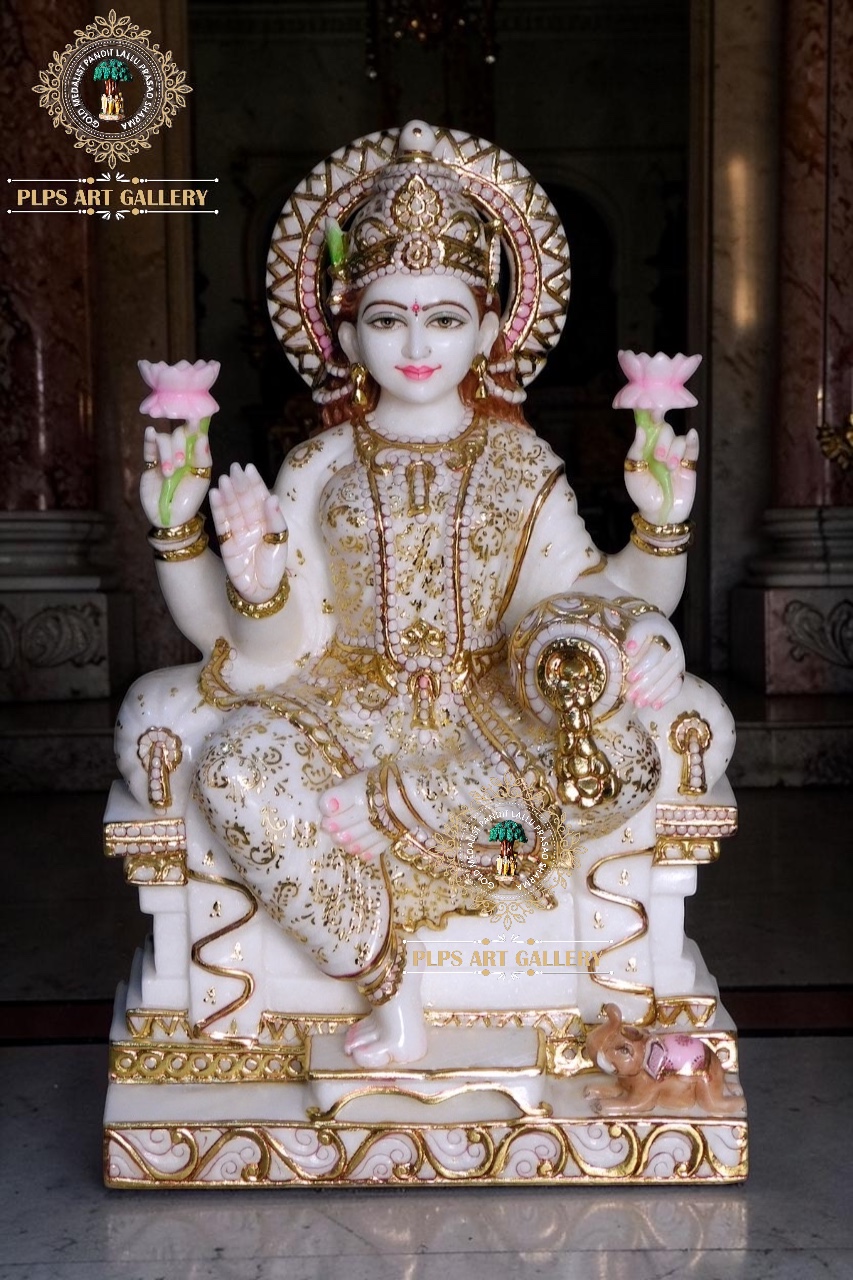
Made-to-Order Only
Our maa laxmi ji statue are crafted exclusively on commission. Share your size, marble type and iconography — our fourth-generation artisans will begin your piece at our Chandpole Bazaar workshop, Jaipur.
Start a Commission