
Lord Ganesha Vietnam
Vietnam White marble Ganesha statues carry the same iconography that Jaipur artisans have carved for centuries — trunk, modak, mushak, mudras and all — rendered in a different marble variety. Unlike Makrana's dense, creamy white with its fine grey mineral veining, Vietnam White is a brighter, chalkier white with a faintly translucent skin that catches diya-light softly and reads clean, uniform and contemporary. Buyers reach for it for three honest reasons: the price sits meaningfully below Makrana without abandoning the marble aesthetic; the surface takes a smoother polish that suits modern mandir interiors; and the softer grain permits larger statues at scales where Makrana would become prohibitive to source, carve and ship. This is a material choice, not an iconographic one — the same Vinayaka, in a lighter, more affordable stone.
At PLPS Art Gallery in Chandpole Bazaar, we approach Vietnam White with a different hand than Makrana. The softer grain lets our fourth-generation artisans — trained in the workshop of Late Pandit Lallu Prasad Sharma, Shilp Guru and 1991 Presidential Awardee — push crisper detail on the face, dhoti folds and jewellery scrollwork, since the chisel bites cleanly where dense Makrana would demand slower, blunter passes. But we also work with more restraint around load-bearing points: trunk curves, raised arms and standing-pose ankles are proportioned with slightly thicker cross-section to compensate for the lower density, so the murti still endures decades of daily aarti. Every Vietnam White block we accept is ethically sourced from Southeast Asian quarries and put through traditional Shila Pariksha — the same sound-and-water block test our workshop has used for generations — before a single Rekhankan line is drawn.
The iconography does not change with the marble. Seated Ganesha in padmasana on a lotus is the household default; standing Ganesha suits taller mandirs and entrance foyers; dancing Nritya Ganesha carries celebratory energy; Bal and Panchmukhi Vinayaka are equally at home in Vietnam White. Trunk direction still matters — a left-curving trunk (Vamamukhi) is the standard grihastha choice, welcoming prosperity and calm, while a right-curving trunk (Dakshinamukhi) is more austere and traditionally reserved for temples with strict daily ritual. Vastu placement follows the same rules across marbles: the Ishaan (north-east) corner of the home mandir, elevated on a chowki, ideally facing East to receive morning light. Avoid bedrooms, bathrooms, staircases, spots under beams, and any direct placement on the floor.
Vietnam White's affordability changes what is realistic to commission. Our sizes range from 12-inch home-mandir figures through 2 to 3 foot statement pieces to full 5 and 6 foot statues suitable for entrance foyers, community temples and covered outdoor pavilions — scales that would demand substantially heavier budgets in Makrana. Surface finishing takes wet-polish and Chikni burnishing beautifully. Colour work behaves differently on the softer stone: mineral-pigment paint and kohl detailing sit crisply on the smooth surface, while Swarna Karya gold leaf is applied more selectively, because the softer grain bonds gold less tenaciously than Makrana — we reserve it for crown, jewellery and dhoti border rather than broad gilded panels. Custom bases include round lotus, square carved chowki, engraved mushak plinth and pillared masand, cut from matched Vietnam White or contrasted with dense black Bhainslana marble.
Compared to Makrana, the differences are real but not disqualifying. Density is the headline: Makrana runs harder and denser, Vietnam softer and lighter. Both, cared for well, cross the hundred-year threshold — museum-grade Vietnam marble idols from the mid-twentieth century remain in worship today. Cost sits meaningfully below Makrana at every size, without being a downgrade in intent or craftsmanship. Aesthetically, Makrana reads creamy, mineral-veined and warm; Vietnam reads chalkier, more uniformly snow-white, with a faint edge translucency. Choose Makrana for heritage tone and micro-detail precision; choose Vietnam for scale, budget and a brighter modern white.
For buyers who want the sacred presence of a white marble Ganesha at a gentler cost — or who need larger scale than Makrana budgets allow — Vietnam White is an honest, well-made choice. Speak with our Chandpole Bazaar workshop to commission yours.

Frequently Asked Questions
Makrana and Vietnam White are both white marbles used for Ganesha idols, but they differ in almost every physical property. Makrana is denser — roughly 98 percent calcium carbonate — harder, lower in water absorption, and creamier white with fine grey mineral veining; it is the heritage stone that built the Taj Mahal and has served Indian temples for centuries. Vietnam White is softer, less dense, and a brighter, chalkier white with a faintly translucent surface and minimal veining. For a Ganesha specifically, that means Makrana holds micro-detail like fingernails, eyelids and kohl edges more crisply and endures rougher handling; Vietnam takes a smoother polish, reads more modern, and permits larger sizes at a meaningfully gentler price. Neither is inherently better — the honest question is what the buyer values most.
Three factors compound to make Vietnam White more affordable, and none of them reflect a compromise in the finished murti. First, quarrying: Vietnam's marble reserves are large and less constrained than Makrana's protected Rajasthan seams, so the raw-block cost is lower at source. Second, carving time — the softer grain lets our artisans move faster on a given size, so a two-foot Ganesha that would take weeks longer in Makrana completes sooner in Vietnam White, and that labour saving passes to the client. Third, transport: Vietnam White arrives at Indian ports in commodity volume, whereas the finest Makrana grades are increasingly rationed and priced at a premium. The price gap reflects supply, workability and market scale, not craftsmanship.
Both, treated well, are genuinely multi-generational objects. Makrana's density and very low water absorption make it the more forgiving stone — it tolerates humidity, occasional splashes and years of ghee-lamp soot with less visible wear, and antique Makrana idols regularly cross two or three centuries in continuous temple use. Vietnam White is softer, so it is more susceptible to edge chipping if knocked, to staining from prolonged moisture contact, and to gradual dulling of polish if neglected. With sensible care — dry dusting, protection from standing water, an annual application of natural marble wax — a Vietnam White Ganesha will comfortably serve a hundred years and beyond. The longevity gap is real, but it is often overstated by sellers pushing Makrana upsells.
Match the marble to the intent, not to received wisdom. Choose Makrana if you want small-scale high-detail work — statues under twelve inches with intricate jewellery — or if you need maximum longevity, heritage authenticity, outdoor placement, or a high-humidity coastal environment. Choose Vietnam White if you want a larger statue, roughly two feet upward, or a life-size foyer or community-temple murti, without moving into Makrana's premium bracket; if you prefer a brighter, more uniformly snow-white aesthetic over Makrana's creamier warmth; or if the marble look is non-negotiable but budget is genuinely constrained. Many of our clients commission both — a Makrana desk Ganesha for the daily mandir and a Vietnam White standing piece for the entrance foyer.
Vietnam White presents a colder, brighter white than Makrana. The surface is more uniform — the grey vein patterns that give Makrana its earthy, mineral character are largely absent — and the polished skin has a faint translucency, so morning light and diya flame skim across it in a softer, glassier way. In photographs the Vietnam variety looks noticeably whiter and more modern; in person it reads clean and contemporary rather than warm and antique. Some traditional buyers prefer Makrana's mineral character precisely because it feels lived-in and sacred; contemporary interiors and modern mandir designs often prefer Vietnam's crispness against wood or marble flooring. Neither is wrong — it is a taste question worth resolving honestly before you commission a statue you will keep for decades.
Yes, Vietnam White needs a gentler hand than Makrana. Because the stone is softer and slightly more porous, both physical and chemical damage happen faster if you are careless. Dust the murti twice weekly with a soft dry cotton or microfibre cloth, moving in the direction of the carving; never use a stiff brush. For occasional wet cleaning, use plain water or a single drop of pH-neutral marble soap on a barely damp cloth — never vinegar, lemon, citrus cleaner, or any acidic household product, all of which etch the surface permanently and quickly. Wipe up spills of oil, ghee, kumkum or turmeric immediately rather than letting them settle. A yearly application of natural marble wax preserves polish and slows moisture ingress. Keep the statue out of prolonged direct sunlight and standing water.
Standard Vietnam White commissions run 30 to 60 days from confirmed design to workshop dispatch, depending on size and detail complexity. A 12 to 18 inch home-mandir Ganesha typically completes in 30 to 45 days; 2 to 3 foot statement pieces in 45 to 75 days; and 4 to 6 foot standing or seated statues in 75 to 120 days, since block selection, Shila Pariksha testing, Rekhankan drawing, carving, Chikni polish and any Swarna Karya gold-leaf detailing all extend in duration with scale. Add roughly 10 to 15 days if gold-leaf ornamentation is specified, and 15 to 30 days for insured worldwide shipping and customs clearance after workshop completion. We share progress photographs at the Rekhankan, rough-cut and final-finish stages so clients follow their commission end to end.
Looking for a custom Lord Ganesha Vietnam?
Every piece is hand-carved to order in our Chandpole Bazaar workshop, Jaipur. Share your size, marble type and iconography — our 4th-generation artisans will craft it for you.
Request a Quote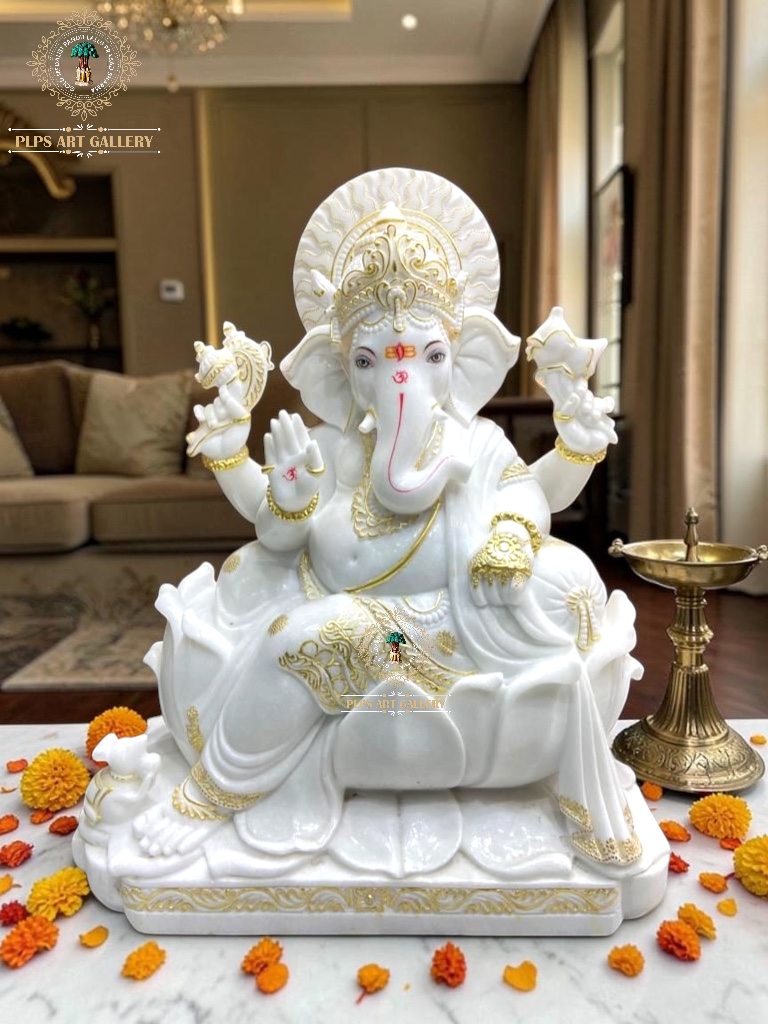
Made-to-Order Only
Our lord ganesha vietnam are crafted exclusively on commission. Share your size, marble type and iconography — our fourth-generation artisans will begin your piece at our Chandpole Bazaar workshop, Jaipur.
Start a Commission