
Mahakali Statue
Mahakali stands as the ultimate protective force in Sanatan Dharma — not a warrior goddess, but the cosmic destroyer of evil beyond form and time. Where Durga rides her lion to slay demons, Mahakali dissolves the very illusion that gives rise to them. Her dark complexion, protruding tongue, and garland of skulls unsettle those who only glance; devotees who look deeper find the fiercest mother, the one families install for absolute protection, serious sadhana, and the removal of every obstacle rooted in fear.
Carving Mahakali is among the most demanding assignments in our Chandpole Bazaar workshop. Her fierce expression must convey compassion beneath the terror, the extended tongue cannot appear grotesque, and each of the fifty-one skulls in her mundamala is chiseled individually so no two faces repeat. Once the marble is complete, we apply mineral pigments in patient layers to achieve her scripturally accurate dark blue-black complexion — a painting tradition our family has preserved across four generations, refusing the shortcuts our founder Late Shri Lallu Prasad Sharma (Shilp Guru, Presidential Awardee 1991) warned would strip a murti of its shastric integrity.
The four-armed Dakshina Kali is our most requested form — right foot forward on Shiva's chest, sword and severed head in her left hands (knowledge cutting through ego), abhaya and varada mudras in her right (fearlessness and liberation). The mundamala's fifty-one skulls represent the letters of the Sanskrit alphabet, marking Kali as Shabda Brahman — reality itself as sound. For placement, we advise a dedicated puja room or sadhana space rather than a casual living area; her intensity deserves reverent surroundings, a daily lamp, and unbroken cleanliness.
Our Mahakali murtis range from twelve-inch personal shrine pieces to five-foot temple installations, with two finishing traditions to choose from. Bengali households and Tantra practitioners typically request the fully painted version — dark blue-black skin, crimson tongue, gold ornaments — matching Kalighat and Dakshineswar aesthetics. North Indian and Western families sometimes prefer unpainted white Makrana marble for a calmer visual register. Bases can be customised with Shiva in shava-asana beneath her, cremation-ground motifs, or a plain lotus platform.
Because Mahakali worship carries specific ritual weight, we encourage a short consultation before you finalise the order — our team can guide you on form, finish, and whether your household tradition calls for painted or white marble.

Frequently Asked Questions
Both are supreme forms of Devi, but they operate at different levels. Durga is the warrior queen who rides a lion and defeats specific demons like Mahishasura — her battles have beginnings and ends. Mahakali is beyond battle; she is Kaal itself, time as devourer, born from Durga's own forehead when even Durga's warrior fury could not stop Raktabija's blood-born army. Durga restores dharma to the world; Mahakali dissolves the illusion that produces adharma. Iconographically, Durga is radiant and armoured; Mahakali is dark, largely unadorned, and stands on Shiva.
Absolutely — this is a widespread misconception born from her fierce iconography. Bengali, Assamese, and Odia families have kept Dakshina Kali in home mandirs for centuries; she is considered the most benevolent form of the goddess toward sincere devotees. What matters is placement and discipline. Install her in a dedicated puja room or sadhana space, not a casual living or entertainment area. Offer a daily lamp, maintain unbroken cleanliness around the murti, and if possible receive a mantra of installation from a qualified guru before beginning regular worship.
Two readings coexist and both are correct. The folk narrative describes Kali losing herself in battle rage until she stepped on her husband Shiva and bit her tongue in sudden recognition — the extended tongue is her embarrassment. The Tantric reading interprets it as spanda, the primal creative pulse of consciousness from which all speech and the universe emerged. The protruding tongue became canonical in Bengali imagery from around the sixteenth century onward. We carve it carefully — expressive enough to convey the meaning, restrained enough to preserve the devotional atmosphere of a home mandir.
This is a personal and traditional decision. Bengali households almost always prefer the painted form — dark blue-black skin, red tongue, golden ornaments — because scripture and Kalighat tradition describe her that way, and puja aesthetics are inseparable from her colour. North Indian, South Indian, and some diaspora families choose unpainted Makrana or Vietnam white marble for a calmer visual register that harmonises with an existing white-marble mandir. Neither is spiritually inferior; the painted version follows shastra literally, the white version emphasises the underlying purity of the stone.
Mundamala carving is done last, after the torso and arms are fully shaped, so vibration during earlier chiseling cannot chip a finished skull. Each of the fifty-one skulls is worked individually with progressively finer tools, then polished by hand with our Chikni technique using natural abrasives. For painted statues we seal the marble with a breathable primer before pigment application so that the skull cavities do not accumulate dust-trapping paint. At home, dust the garland weekly with a soft dry brush and avoid wet cloths on painted areas.
A standard Dakshina Kali in white marble, up to three feet, ships in about thirty days from a confirmed order. Painted versions add ten to fifteen days because pigment layering, controlled drying, and fine ornament detailing cannot be rushed without compromising longevity. Larger installations of four to five feet, or custom bases showing Shiva in shava-asana with cremation-ground detailing, require sixty to ninety days. We share photographs at three stages — rough carving, finished stone, and post-painting — so overseas devotees can approve every detail before packing and international shipping.
Looking for a custom Mahakali Statue?
Every piece is hand-carved to order in our Chandpole Bazaar workshop, Jaipur. Share your size, marble type and iconography — our 4th-generation artisans will craft it for you.
Request a Quote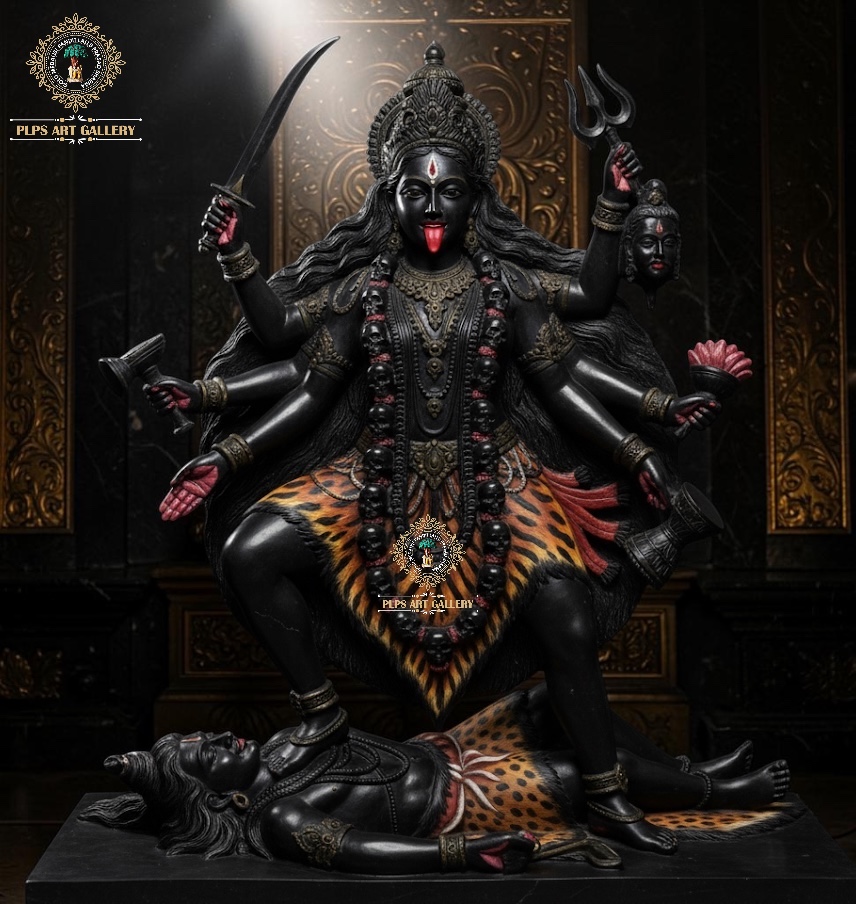
Made-to-Order Only
Our mahakali statue are crafted exclusively on commission. Share your size, marble type and iconography — our fourth-generation artisans will begin your piece at our Chandpole Bazaar workshop, Jaipur.
Start a Commission