
Mahatma Gandhi statue
Few figures of the modern age are as universally recognised as Mohandas Karamchand Gandhi (1869-1948) — the freedom-movement leader Rabindranath Tagore honoured as 'Mahatma' and India came to call 'Bapu'. Remembered every 2 October — marked since 2007 by the United Nations as the International Day of Non-Violence — and on Martyrs' Day (30 January), his marble busts endure across schools, government secretariats, high court foyers, embassies, NGO headquarters and Gandhi study centres from Sabarmati to South Africa.
Sculpting Gandhi is portrait work, not deity idealisation — and it tests our workshop the way Sai Baba portraits do. Every reference photograph shows the same features: a fully receded hairline, thin lips in a knowing half-smile, deep-set eyes behind round wire-frame steel spectacles, ears set slightly forward, a jaw softened by age. Makrana marble's fine grain holds these subtleties in a way coarser stones cannot. Four generations of PLPS Shilpis — descendants of Shilp Guru Late Pandit Lallu Prasad Sharma (Presidential Award, 1991) — bring Chikni polish to the cheekbones and Rekhankan precision to the eye-glass hinges and the fold of the khadi shawl.
The bust format focuses everything on the face and shoulders — the glasses, the bare crown, the shawl rendered in absolute simplicity. Gandhi's iconography is defined by its austerity: no jewellery, no ornamentation. The spectacles themselves demand the most exacting work — thin round frames carved from the same marble block, never fitted separately, without weakening the temples or nose bridge. Placement is a civic decision, not a religious one: school assembly halls, principals' chambers, government entrances, embassy receptions, court atriums, memorial gardens. A simple plinth carries the dates 1869-1948 or a single carved quotation.
PLPS carves Gandhi busts from twelve inches to six feet. Desk busts of 8 to 15 inches suit principals' offices and NGO conference rooms. Foyer and assembly-hall busts of 24 to 36 inches are the most requested institutional size. Standing figures of 5 to 6 feet reproduce familiar poses — the striding Dandi March walk with staff, or seated Bapu with charkha. Bases can be engraved in Devanagari with 'Ahimsa Paramo Dharma' or a line from Gandhi's beloved bhajan 'Vaishnav Jana To', with English translations for embassies. Plain Makrana without gilding is our default for institutional dignity.
Each year PLPS ships Gandhi installations for Gandhi Jayanti and Martyrs' Day to schools, government offices, NGOs and Indian centres from Delhi to Durban. Please confirm any Gandhi Jayanti commission eight to twelve weeks in advance so the bust reaches you before the garlanding on 2 October.

Frequently Asked Questions
For most schools, government offices, embassy foyers and NGO reception areas, a bust is the correct choice — it focuses attention on Gandhi's face and the wire-frame glasses that made him instantly recognisable, and it fits comfortably on a plinth against a wall or in a corner niche. Full-figure standing statues of 5 to 6 feet are reserved for outdoor memorial gardens, dedicated Gandhi study centres, and large hall settings where the striding Dandi March pose or the seated charkha-spinning figure can be viewed from a distance. Below the 24-inch mark, a bust reads with dignity where a shrunken full body would look diminished.
The round wire-frame spectacles are the single most technically demanding element of a Gandhi bust. At PLPS we carve them from the same block of Makrana as the face — never fitted separately — using Rekhankan detailing tools to hollow the lens area to shallow relief and shape the temple arms as thin unbroken filaments running back to the ears. The bridge across the nose is the fragile point; our Shilpis work it last, once the surrounding mass has been safely established. On busts under 12 inches, the glasses are indicated as shallow relief rather than free-standing, to protect the piece over decades of dusting and institutional handling.
For classroom display cabinets and library alcoves, 8 to 12 inches sits comfortably beside framed photographs and a small plaque. Principals' offices and senior civil-service chambers commission 15 to 18 inches as a desk or credenza bust. School assembly-hall foyers, government-building entrances and embassy reception rooms carry 24 to 36 inches on a matching stone plinth — our most requested institutional size. Memorial gardens, Gandhi study centres and outdoor grounds justify a 5 to 6-foot standing figure — either the Dandi March striding pose with walking stick or the seated Bapu with charkha modelled on the Sabarmati Ashram references.
Institutional Gandhi busts should read as dignified, timeless and unadorned — and Makrana marble is unmatched for that character. The same stone the Taj Mahal is built from, Makrana is dense, fine-grained, and holds a mirror polish for generations without yellowing under artificial lighting. Its bright, cool white suits the moral clarity Gandhi is remembered for, and it takes the Chikni polish that lifts the cheekbones and catches light on the wire-frame lenses. For institutions that want a warmer, ashram-like tonality across the khadi shawl, PLPS's Bhainslana black marble is a considered alternative; Vietnam White is offered for smaller desk busts at accessible price points.
Every year we receive a surge of Gandhi Jayanti and Martyrs' Day commissions from schools, secretariats, NGOs and Indian embassies. For a bust of 12 to 24 inches carved in Makrana with a plain plinth, please confirm the order at least eight weeks in advance. For 36 inches with Devanagari base engraving, allow ten weeks; a 5 to 6-foot standing memorial with detailed dhoti drape and walking stick requires twelve to sixteen weeks. Institutional orders placed by mid-July are comfortably delivered before the garlanding ceremony on 2 October, including protective wooden-crate packaging and international shipping to embassies and Gandhi centres abroad.
Yes — plinth engraving in Devanagari, English or a regional script is included in institutional commissions. The two most-requested inscriptions are 'Ahimsa Paramo Dharma' (non-violence is the highest duty) and a line from Gandhi's beloved bhajan 'Vaishnav Jana To'; the dates 1869-1948 and the institution's name of unveiling are commonly carved below. For care, dust the shoulders and crown weekly with a soft dry natural-hair brush and clean the face with a barely damp muslin cloth, dried immediately. The wire-frame glasses and the undercuts around the ears should never be wiped with a wet cloth; a light conservation polish once every five years keeps the marble luminous for generations.
Looking for a custom Mahatma Gandhi statue?
Every piece is hand-carved to order in our Chandpole Bazaar workshop, Jaipur. Share your size, marble type and iconography — our 4th-generation artisans will craft it for you.
Request a Quote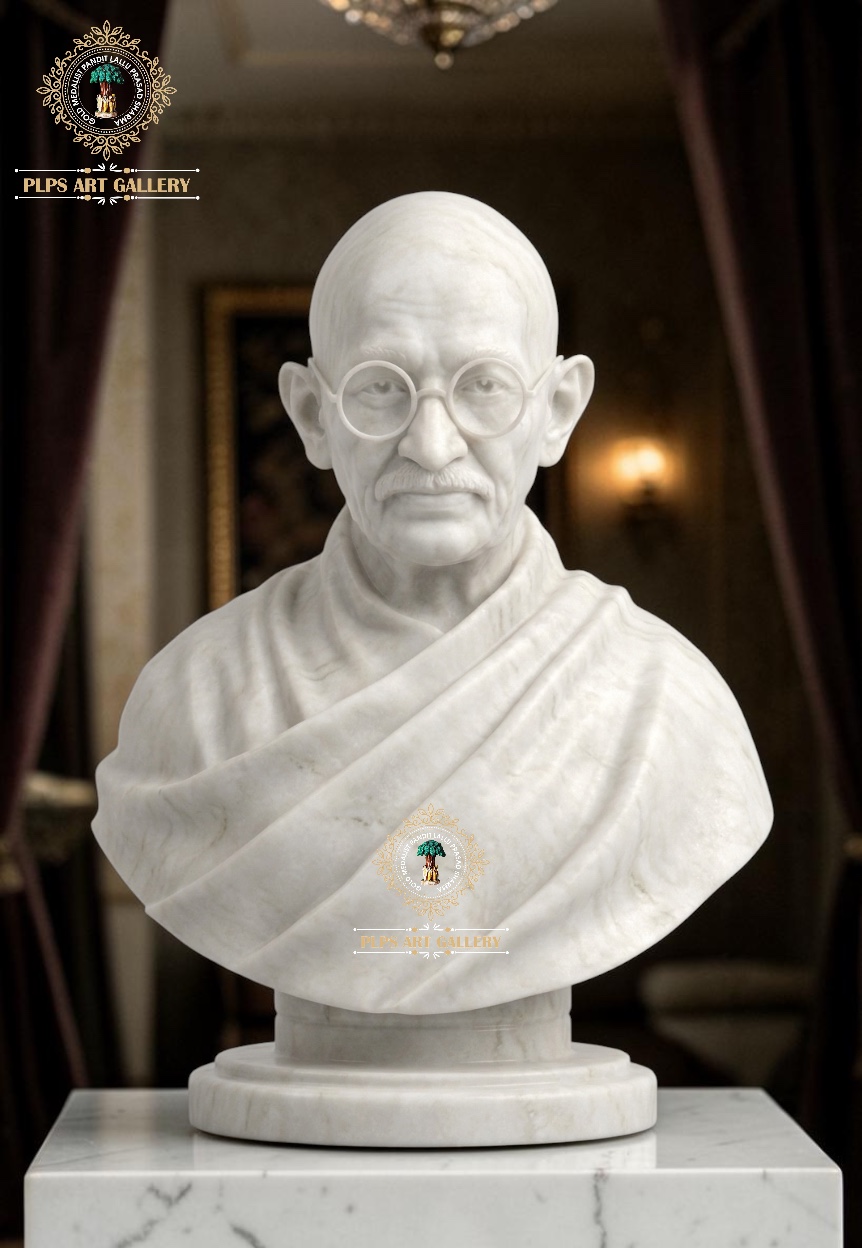
Made-to-Order Only
Our mahatma gandhi statue are crafted exclusively on commission. Share your size, marble type and iconography — our fourth-generation artisans will begin your piece at our Chandpole Bazaar workshop, Jaipur.
Start a Commission