
Mahavir Swami
Bhagwan Mahavir Swami is the 24th and last Tirthankara of the current cosmic age (599-527 BCE) and, in the reckoning of most historians, the founder of the Jain monastic tradition as it is practised today. A Mahavir Swami statue is unlike almost any other devotional carve in the Indian tradition. There are no weapons, no consorts, no ornament, no crown of jewels; only the lion emblem (lanchana) at the base of the pedestal, the Shrivatsa mark on the chest, and a face composed in absolute meditative stillness. Within Jainism itself, two great traditions have carried this image forward: the Digambara sect, in which the Tirthankara is depicted sky-clad and entirely unadorned — nothing worn, nothing owned, symbolising complete renunciation — and the Shvetambara sect, in which he wears a katisutra waistband and a fine loincloth, sometimes with a crown, painted lips and inlaid eyes to render a lifelike gaze. Pure white marble suits both traditions because its unbroken tone reads instantly as ascetic purity, the single visual quality on which the entire Tirthankara aesthetic rests.
At our Chandpole Bazaar workshop, a Mahavir Swami commission is treated as the discipline of subtraction. On a Ganesha, a Krishna or a Durga, an artisan can compensate for a slightly imperfect proportion with a curl of hair, a fold of drapery, a mudra, a mount, a garland. On a Mahavir there is nothing to hide behind. Every millimetre of the shoulders, the crossed legs of Padmasana, the vertical drop of the arms in Kayotsarga, the profile of the jaw and the closed contemplative eyes — all must be exact, because the eye of a Jain devotee is trained on precisely those proportions. Shila Pariksha is unusually strict for a Mahavir: we hand-select a Makrana block for absolute uniformity of tone, since a single grey vein across the chest or face is disqualifying in a way that would be forgivable on an ornamented deity. Rekhankan (proportioning) follows the classical Jain shilpa texts. Chikni polishing is taken to a higher grade than usual — the naked marble body has to read as luminous even under temple lamp-light. Swarna Karya (gold work) is deliberately restrained; on a Digambara Mahavir it is often omitted entirely. What we always carve with complete precision are the two canonical identifiers: a clearly modelled Simha (lion) lanchana at the front of the pedestal, and the Shrivatsa symbol at the centre of the chest.
Iconography is fixed by tradition and we honour it strictly. A Tirthankara is depicted in only two postures: Padmasana, the lotus seat with hands resting in dhyana mudra on the lap, chosen most often for home mandirs and meditation altars; or Kayotsarga, literally 'dismissing the body' — standing perfectly straight, feet parallel about ten centimetres apart, arms hanging free without touching the thighs — reserved usually for temple pratishtha and taller commissions. The lion always sits below. The Shrivatsa always sits on the chest. A serpent-hood is never carved above a Mahavir — that belongs to Parshvanath, the 23rd Tirthankara, and is a common attribution error we help buyers avoid. For placement, the Jain home mandir is traditionally installed in the Ishan (northeast) corner of the home, with the murti facing East, kept at least six inches from any wall, and surrounded by scrupulous cleanliness — no leather, no non-vegetarian food, no clutter in the vicinity of the statue.
We carve Mahavir Swami from six inches for a personal meditation altar up to six feet and beyond for community Jain temple installations, with the 12-inch to 24-inch range being the most requested for home mandirs and 30-inch to 48-inch typical for domestic temple deras. At the point of order we ask each client which tradition to honour — Digambara (fully unclothed, plain, downcast contemplative eyes) or Shvetambara (with kachhota loincloth, optional crown, painted or inlaid eyes) — and carve accordingly. Makrana pure white remains the classical choice; Vietnam White is offered for finer facial modelling on smaller pieces. Custom pedestals with a boldly rendered lion emblem, Ashtamangala symbols in relief, or a padma (lotus) throne are all available; we generally advise against heavy gold leaf on a Mahavir, since the ornament works against the ascetic ideal that gives the form its power.
PLPS has served the Jain communities of Jaipur, Ahmedabad, Mumbai, Karnataka, and the diaspora in the United States, United Kingdom, Belgium, Kenya and Singapore for four generations. If you are commissioning a Mahavir Swami for a home mandir, a family dera, a Mahavir Jayanti gift, or a full Panch Kalyanaka Pratishtha at a new Jain temple anywhere in the world, speak with our team early — larger pieces require ninety to a hundred and fifty days from block selection to crated dispatch.

Frequently Asked Questions
Every Tirthankara has a unique lanchana — a small emblem carved on the pedestal directly beneath the feet — and this is the primary and definitive identifier. Mahavir's lanchana is the Simha, the lion. If you see an unornamented seated or standing Tirthankara with a clearly carved lion on the front of the pedestal, that is Mahavir Swami. Two other markers help confirm: the Shrivatsa symbol on the chest (present on all Tirthankaras but always carefully rendered on a good Mahavir), and the absence of any serpent-hood over the head (the naga belongs to Parshvanath, the 23rd Tirthankara, and is often confused with Mahavir by lay viewers).
The difference is doctrinal and shows directly in the carving. A Digambara Mahavir is depicted sky-clad — completely unclothed, entirely plain, with no ornament, no crown, and downcast contemplative eyes. This reflects the Digambara understanding that a Tirthankara has renounced all possessions including clothing after Diksha. A Shvetambara Mahavir is depicted wearing a katisutra (waistband) and a kachhota (fine loincloth pleats), and is often given a crown, jewelled ornaments, red painted lips, and inlaid glass or crystal eyes for a lifelike gaze. Both are canonically correct within their own traditions. At PLPS we ask every client at the point of order which tradition to honour, and carve accordingly — the two versions are not interchangeable.
These are the only two postures in which a Tirthankara is ever depicted, and the choice is driven by use-case rather than preference. Padmasana — the classical lotus seat with hands folded in dhyana mudra on the lap — is chosen for home mandirs, personal meditation altars and smaller compositions where the eye rests on the face and folded hands. Kayotsarga — literally 'dismissing the body', standing perfectly straight with feet parallel about ten centimetres apart and arms hanging free without touching the thighs — is reserved usually for taller commissions and Jain temple pratishtha installations, where the vertical composition reads across a large hall. For a home mandir under three feet, we almost always recommend Padmasana.
Because the entire aesthetic of a Tirthankara image is built on ascetic renunciation, and heavy ornament works against the meaning of the form. Mahavir walked away from a kingdom, gave up clothing and every attachment, and attained kevala jnana in absolute silence. A Digambara Mahavir with gold leaf on the shoulders reads, to a knowing devotee, as a small doctrinal contradiction — you have re-clothed the sky-clad one. Shvetambara icons do carry limited ornament and painted features by tradition, and we honour that; but even there we advise restraint over exuberance. The luminous white surface of well-polished Makrana marble, an exact facial expression, and a cleanly carved lion emblem carry more weight than any amount of gold.
The Jain home mandir is traditionally installed in the Ishan corner — the northeast — of the house, which is considered the most auspicious zone. The Mahavir murti itself should face East (or North if East is not possible), and should be set at least six inches away from any wall so that circumambulation and darshan are unobstructed. Cleanliness around the mandir is not a decorative preference but a doctrinal requirement: no leather items, no non-vegetarian food, no shoes, and no clutter in the surrounding space. Ideally the mandir room is used only for worship and meditation. A separate lamp and a small offering plate for pure flowers or dried rice are the customary accompaniments.
Yes, and that is precisely the point — the discipline of daily care is itself part of the devotional practice. Dust the entire surface every morning with a soft, dry natural-hair brush; a clean shaving brush works perfectly for the fine grooves around the lion emblem and the Shrivatsa mark. Once a week, wipe the smooth planes of the body and face with a barely-damp muslin cloth and immediately dry with a second soft cloth. Never use citrus, vinegar, dishwash liquid or any acidic cleaner — they etch Makrana permanently. On abhishek or ceremonial bathing (customary in some Shvetambara households), use only pure water and dry the statue completely afterward; standing moisture will dull the polish over time.
For a home mandir piece between 12 and 24 inches in Padmasana, plan on 30 to 45 days from confirmation of drawings to crated dispatch, plus international freight time. For a 30-inch to 48-inch temple dera piece, allow 60 to 90 days. For a full temple pratishtha installation between 4 and 6 feet — typically carved in Kayotsarga — plan on 120 to 150 days, and speak with us at least six months before the intended Panch Kalyanaka Pratishtha Mahotsava date. Mahavir Jayanti falls in April, so commissions intended as Mahavir Jayanti gifts or new installations should be initiated no later than the preceding November. We share in-progress photographs at every stage and ship worldwide with full export documentation.
Looking for a custom Mahavir Swami?
Every piece is hand-carved to order in our Chandpole Bazaar workshop, Jaipur. Share your size, marble type and iconography — our 4th-generation artisans will craft it for you.
Request a Quote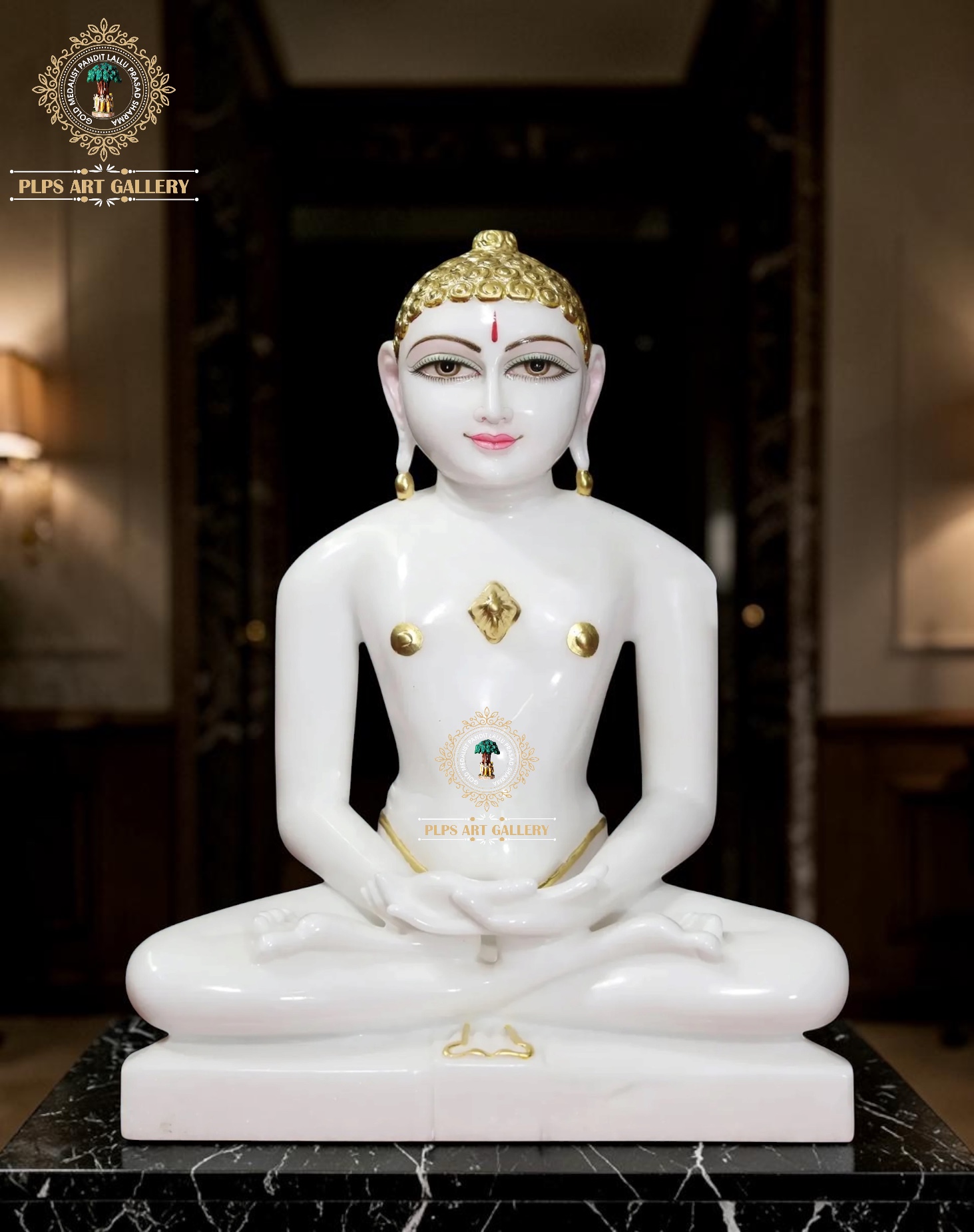
Made-to-Order Only
Our mahavir swami are crafted exclusively on commission. Share your size, marble type and iconography — our fourth-generation artisans will begin your piece at our Chandpole Bazaar workshop, Jaipur.
Start a Commission