
Marble Bust statue
The marble bust — a head-and-shoulders portrait carved in stone — belongs to a sculptural tradition that reached India through the 19th-century colonial art academies, tracing its lineage to Greco-Roman antiquity. Unlike the full-body deity murtis Indian workshops have carved for millennia, the bust is strictly a portrait: it honours an individual rather than idealising a divine archetype. Today, marble busts anchor university foyers, corporate boardrooms, memorial halls and family libraries across India — commemorating founders, freedom fighters, scholars, saints and beloved ancestors.
Sculpting a marble bust is among the most exacting commissions our workshop undertakes. There is no ornament, no vahana, no scriptural attribute to carry the work — the entire sculpture rests on the accuracy of a single face. Makrana marble, the fine-grained white stone of the Taj Mahal, holds facial expression at a level coarser stones cannot match. The tilt of the head, the set of the jaw, the softness around the eyes — these are what our Shilpis train a lifetime to render. Late Pandit Lallu Prasad Sharma's Shilp Guru lineage brought portrait discipline into a workshop rooted in deity iconography, and four generations have refined it through Vivekananda, Gandhi and saint commissions.
The bust is a vertical composition. The head crowns the sculpture, the shoulders anchor it, and a plinth lifts the whole to eye level. Subtle drapery — a jacket lapel, a shawl fold, the pleat of a dhoti or the pallu of a saree — grounds the portrait in the subject's era. The shoulder line can be rounded (softer, for family portraits and spiritual figures) or cut squared for institutional gravitas. The plinth is treated as part of the work, often engraved with name, dates and a short inscription. Institutional foyers, boardrooms and library reading rooms are the traditional homes for marble busts; eye-level placement invites the viewer to meet the subject's gaze.
PLPS carves busts from eight inches to four feet. Desk and mantel sizes of 10 to 16 inches suit private studies and family shelves; lobby and reception busts range 18 to 30 inches; institutional and memorial-hall commissions run 36 to 48 inches. Makrana is the classical choice for institutional dignity and generational polish; Vietnam White is a budget-conscious alternative that still reads brilliantly under gallery lighting. Custom pedestals in matching marble, black granite or teak are fitted with cast brass or engraved plaques; likeness is worked from high-resolution photographs, with a clay maquette shared for approval before the block is cut.
Universities, alumni associations, corporate founders' offices, memorial trusts, ashrams and families commemorating a parent or grandparent have commissioned PLPS busts across four generations. Whether the piece is a boardroom founder tribute, a memorial-hall centrepiece or a private family portrait in stone, our Chandpole Bazaar workshop would be honoured to sculpt it.

Frequently Asked Questions
A bust is chosen when the subject's face and presence carry the tribute — most commonly for founders, scholars, freedom fighters, spiritual teachers and beloved family elders where recognisable likeness is the point. Full-body statues are appropriate when posture, gesture or attributes — a book, a walking stick, a folded flag — tell part of the story, and where the site can accommodate a taller installation. Busts also suit smaller footprints: a corner of a foyer, a boardroom credenza, a home library where a full statue would overwhelm the space. Site sightlines and budget usually decide.
For an institutional foyer, alumni hall or corporate reception, a bust of 24 to 36 inches on a 36 to 48 inch pedestal reads correctly from a ten-to-fifteen-foot viewing distance. Memorial-hall centrepieces are commonly 36 to 48 inches. For a desk, private study or family mantel, a 10 to 16 inch bust is proportionate; below 10 inches, facial modelling begins to lose fidelity and portrait accuracy suffers. Pedestal height is set so the subject's eyes meet the standing viewer at eye level. We prepare scale drawings on request and recommend a mock silhouette placed on site before final approval.
Portrait busts demand a stone that holds fine facial detail — the corner of a mouth, the curve of an earlobe, the transition from cheek to jaw — without chipping or graining out. Makrana marble, quarried in Rajasthan for over a thousand years and the stone of the Taj Mahal, has an exceptionally dense, calcite-rich grain. It takes the mirror-smooth Chikni polish that renders skin convincingly, and it does not yellow across decades of gallery exposure. For institutional busts intended to stand a hundred years, Makrana is the classical choice; Vietnam White is a competent alternative for smaller commissions.
The ideal reference set includes a sharp, well-lit front-facing photograph, both three-quarter profiles (left and right), a strict left and right side profile, and one taken slightly above to capture the crown of the head. Resolution matters more than colour — sharp black-and-white historical photographs work well. Where possible, share images taken at different ages so our Shilpis can settle on the most representative period. A written note describing the subject's characteristic expression — reflective, warm, stern, half-smiling — helps beyond what any still image conveys. We prepare a clay maquette for your approval before carving the marble block begins.
A standard commission takes 45 to 90 days from confirmed reference photographs to workshop dispatch. The first two weeks go to photograph study, proportion drawings and a clay maquette shared with you for facial-accuracy approval — the critical veto point before the block is cut. Roughing the marble, Rekhankan line-drawing on stone and primary carving occupy the next four to six weeks. Chikni polish, plinth fitting and plaque engraving close the schedule. Memorial-hall pieces or commissions requiring multiple review rounds may extend to 120 days. Confirm your installation date at commissioning so dispatch aligns to it.
The pedestal is designed alongside the bust, not treated as an add-on. Matching-marble pedestals give visual continuity; black granite adds institutional gravitas under a white bust; teak or rosewood suit warmer interiors. Cast brass or engraved marble plaques carry name, dates and inscription, and institutional crests can be incorporated. For care, dust the face weekly with a soft dry natural-hair brush, working outwards from the nose and eyes. Wipe the smooth cheek and forehead planes only with a barely damp muslin cloth, drying immediately. Avoid all citrus and acidic cleaners, and reapply neutral marble wax every two to three years.
Looking for a custom Marble Bust statue?
Every piece is hand-carved to order in our Chandpole Bazaar workshop, Jaipur. Share your size, marble type and iconography — our 4th-generation artisans will craft it for you.
Request a Quote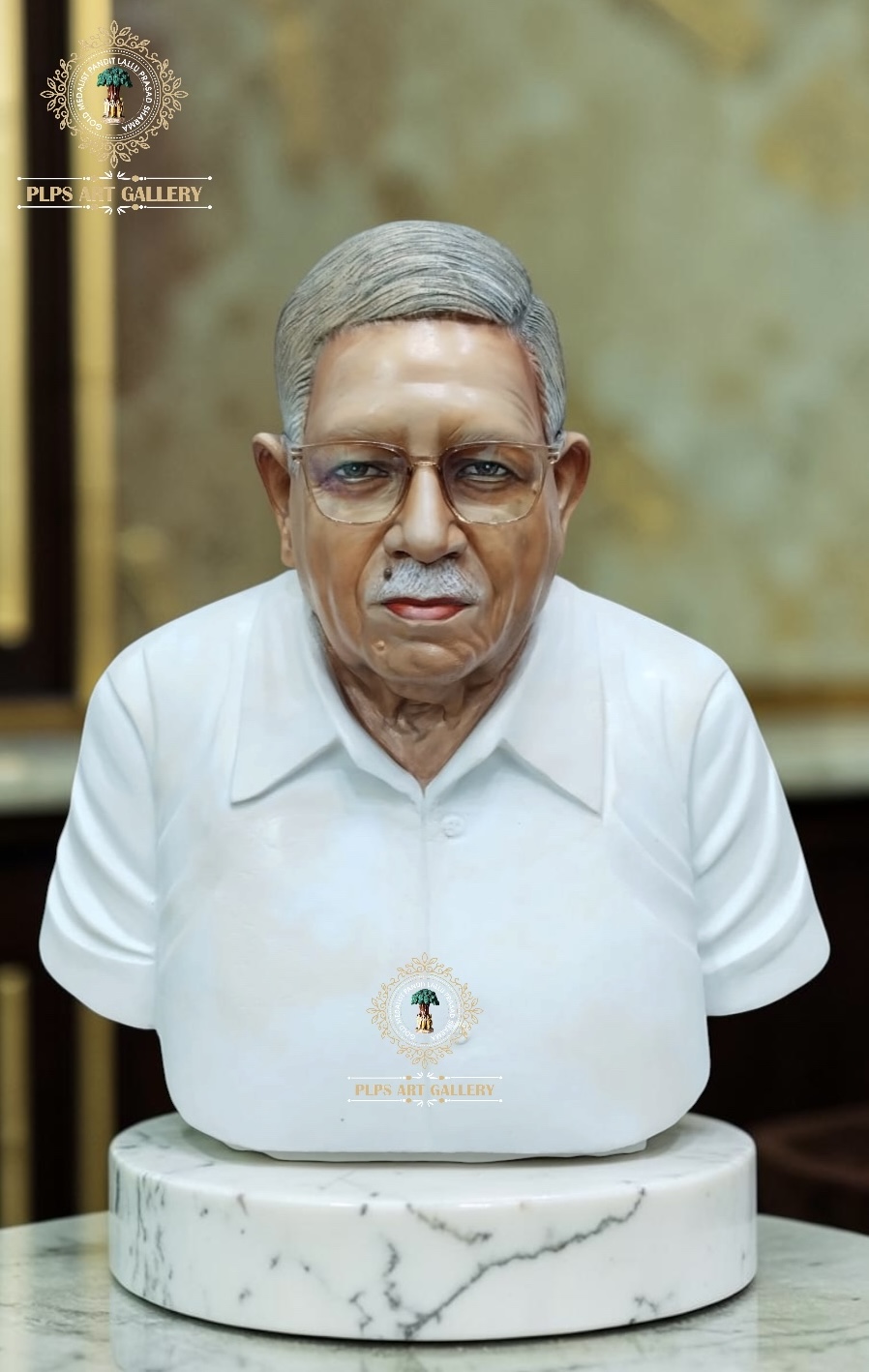
Made-to-Order Only
Our marble bust statue are crafted exclusively on commission. Share your size, marble type and iconography — our fourth-generation artisans will begin your piece at our Chandpole Bazaar workshop, Jaipur.
Start a Commission