
Marble Jali Work
Marble jali — the perforated lattice screen carved into a single marble slab — is one of the great architectural achievements of the Mughal and Rajasthani stone tradition. The jaali around Mumtaz Mahal's cenotaph at the Taj Mahal and the extraordinary screens at Sheikh Salim Chishti's tomb at Fatehpur Sikri remain the world's benchmark for what a hand-drilled marble panel can achieve. Jali was never ornamental alone — it solved the triple problem the tropics demand: passive air-flow through solid walls, softened diffused light instead of glare, and total visual privacy without closing the room. The same panels now return in luxury interiors, mandir walls, jharokha windows, and heritage restoration projects.
At PLPS Art Gallery, jali is the peak technical challenge of our craft. Each opening — often several thousand per panel — is chiselled and drilled by hand, worked from both faces of the marble to meet at the centre without cracking the surrounding lattice. Only a dense marble tolerates this: we work almost exclusively in Makrana, the same stone the original Taj Mahal jaali was carved from, because softer marbles fracture at the fine spans. Four generations under Late Pandit Lallu Prasad Sharma (Shilp Guru, Presidential Award 1991) keep the Taj-era geometric vocabulary and Rajasthani floral repertoire alive in our Chandpole Bazaar workshop.
We carve both great jali traditions. Geometric jali — hexagonal, six- and eight-pointed star, octagonal and interlaced arabesque grids — follows the Mughal pattern books and reads best on large spans. Floral jali — lotus, rose, entwined vine, paisley — is the softer Rajasthani style favoured for mandir walls and interior partitions. Panels are commissioned as jaali chambers around temple sanctums and home mandirs, jharokha window and door screens, luxury room-divider walls, and courtyard pergolas where the moving shadow across the floor is itself the design.
Panels range from a 12-inch mandir insert to architectural units of eight feet by four feet, joined on site into walls of any dimension. Every panel is built to an approved pattern — a Taj Mahal jaali replica traced from the original geometry, a Rajasthani jharokha bloom, a minimal modern grid, or a custom family motif. Optional Swarna Karya gold-leaf accents the frame, brass or stainless hardware handles mounting, and engineering certification is available for load-bearing architectural work.
Marble jali is the signature commission of heritage architects, luxury interior designers, temple trustees, and restoration specialists. Lead times run 60 to 120 days per major panel — jali cannot be hurried without risking the stone. Send us your drawings or reference photograph; we produce a hand-drawn pattern proof before any chisel touches marble, and ship worldwide with insured crating.

Frequently Asked Questions
Marble jali (or jaali) is a perforated lattice screen carved by hand from a single marble slab — the empty pattern matters as much as the surrounding stone. The technique reached its peak under Mughal patronage in the 16th and 17th centuries; the finest surviving examples are the octagonal marble jaali around the cenotaphs of Mumtaz Mahal and Shah Jahan inside the Taj Mahal, installed around 1642, and the extraordinarily delicate marble screens at Sheikh Salim Chishti's tomb at Fatehpur Sikri. Rajasthani craftsmen later absorbed the vocabulary into haveli, temple, and palace architecture across Jaipur, Jodhpur, and Udaipur.
Every opening in a PLPS jali is drilled and chiselled by hand, working from both faces of the marble to meet at the centre — the moment of highest risk, because the surrounding lattice is only a few millimetres thick and one wrong strike can crack the entire panel. This is why Makrana marble is non-negotiable: its dense calcite grain holds those fine spans without fracturing, where softer Vietnamese or resin-bonded stone would split. A single commission runs 60 to 120 days from Shila Pariksha (stone selection) through Rekhankan pattern-transfer, hand-drilling, and final Chikni hand-polish.
Yes. We produce faithful replicas of the Taj Mahal marble jaali — specifically the octagonal screen around the cenotaphs of Mumtaz Mahal and Shah Jahan, and the eight framed jali panels of the marble cenotaph chamber, both carved originally in Makrana marble in the 1640s. The pattern is traced geometrically from published architectural drawings and scaled to your opening. We also reproduce the finer Sheikh Salim Chishti (Fatehpur Sikri) six-pointed-star jali on request. Every replica commission includes a paper-scale proof so the grid matches the reference before any carving begins.
Geometric jali — hexagonal, six- or eight-pointed star, interlaced arabesque — is the classic Mughal architectural vocabulary. It scales beautifully, reads strongly from a distance, and works best for large partition walls, boundary screens, and formal temple enclosures. Floral jali — lotus, blooming rose, trailing vine, paisley — is the softer Rajasthani interior tradition, best suited to mandir walls, bedroom and study partitions, and pieces meant to be viewed at close range where the botanical detail rewards the eye. Many clients combine the two: a geometric border frame around a floral central medallion is a traditional Rajasthani haveli motif.
A jali solves three problems at once. It is a passive ventilator: as hot air passes through the small perforations it accelerates and cools slightly, drawing interior air out — historically this replaced curtains and shutters in Mughal palaces long before mechanical cooling. It is a light diffuser: direct sun becomes a soft patterned wash across the floor, controlling glare without darkening the room. And it is a privacy screen: from outside a jali reads as an almost-solid wall, while from inside the occupant sees out clearly — the reason zenana (women's) quarters were traditionally jali-fronted.
For a home mandir back wall or jaali chamber, panels of 24 to 48 inches high work well and give the sanctum its glow. Interior partition walls typically use six- to eight-foot panels joined into a continuous run. Traditional jharokha window screens follow the opening size — usually three to four feet wide by four to five feet high — recessed into the reveal. For care, dust the openings with a soft dry brush every few weeks, wipe the flat faces with a barely damp cloth, and never use chemical polishes or acidic cleaners, which will pit the Chikni finish.
Looking for a custom Marble Jali Work?
Every piece is hand-carved to order in our Chandpole Bazaar workshop, Jaipur. Share your size, marble type and iconography — our 4th-generation artisans will craft it for you.
Request a Quote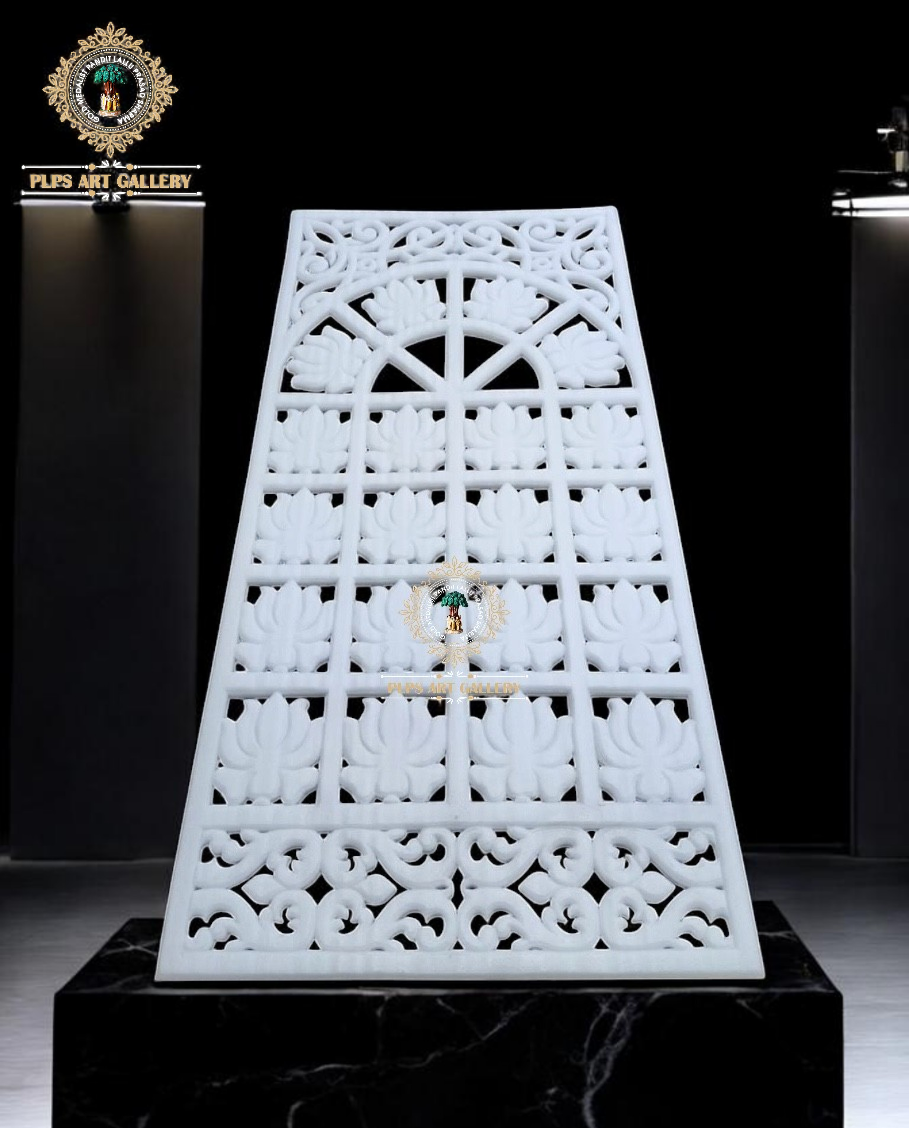
Made-to-Order Only
Our marble jali work are crafted exclusively on commission. Share your size, marble type and iconography — our fourth-generation artisans will begin your piece at our Chandpole Bazaar workshop, Jaipur.
Start a Commission