
Marble Panel
A marble panel is the wall-mounted counterpart to a freestanding sculpture — a flat, carved or inlaid slab that turns a plain wall into a piece of narrative or decorative art. It is the tradition of the temple sanctum wall that tells the Ramayana in a single frieze, of the Mughal floral inlay dado in the Diwan-i-Khas, of the Ganesha bas-relief above a family mandir, of the luxury foyer feature wall that greets a guest at the threshold. Unlike a Jali (a perforated lattice you see through) or a Pillar (a structural round), a panel is flat, is fixed to a wall, and is read frontally like a painting — but carved in stone with a depth and permanence no painted surface can match.
Bas-relief — the shallow-relief carving tradition that runs from the toranas of Sanchi through the wall friezes of Khajuraho, Halebidu and Konark — is a discipline distinct from round sculpture. A Ganesha in the round can be walked around; a Ganesha in bas-relief must project convincing three-dimensional presence into as little as one inch of physical relief through carefully graded planes, foreshortened limbs and undercuts that catch shadow under raking light. It is depth-perception carving, judged not by how much stone is removed but by how convincingly the eye reads three dimensions in two. Alongside this, PLPS carries the Pietra Dura tradition — Parchin Kari in India — the inlay technique brought to its apex on the Taj Mahal (1653), the Itmad-ud-Daulah (1628) and the Red Fort's Diwan-i-Khas, where floral panels of iris, tulip and poppy are rendered in malachite, lapis lazuli, carnelian and jasper set flush into white Makrana marble with hairline joints and no visible grout. Both disciplines have been worked in the Chandpole Bazaar atelier of Late Pandit Lallu Prasad Sharma (Shilp Guru, Presidential Award 1991) for four generations; optional gold-leaf borders (Swarna Karya) and mineral-pigment fills are offered for heritage and temple commissions.
The panels executed in this category fall across four broad families. Deity narrative panels tell a scriptural cycle in bas-relief — the Ramayana in seven or eleven scenes, the Mahabharata's key episodes, a Krishna Leela sequence from the Bhagavata Purana, or a Shiv Puran frieze. Floral, geometric and calligraphic decorative panels carry the Mughal-Rajasthani vocabulary of iris, tulip, mango boota, peacock, interlaced stars and Sanskrit shlokas. Pietra Dura inlay panels bring the Parchin Kari technique into the client's home or temple in floral, geometric or custom family-monogram designs. Architectural wall paneling is executed to site dimension for temple sanctum walls, home mandir back-walls, luxury foyers, boutique hotel reception walls and heritage restoration projects. Custom family-story panels — a private chapel, a memorial wall, a corporate lineage panel — are commissioned to a client's own script.
Panels range from 12-inch framed pieces for home puja walls up to 8-foot by 4-foot narrative murals, with multi-panel installations assembled from tessellated modules for larger walls. Thickness is typically 1.5 to 3 inches for bas-relief and 0.75 to 1.5 inches for inlay panels. Custom narrative commissions begin with a hand-drawn or CAD proof for approval, followed by client sign-off on the marble block (Makrana, Vietnam White or Bhainslana black), the Pietra Dura colour palette where relevant, and any gold-leaf border. Concealed French cleats, through-wall stud bolts or architectural anchors — sized and specified for the panel's weight with a 3x safety margin — are supplied with every piece, along with a written mounting specification and installation guidance.
PLPS supplies temple building committees commissioning sanctum wall panels, luxury home clients specifying puja-room dados and living-room feature walls, boutique hotels and restaurants installing heritage feature walls, institutional and corporate reception halls, heritage restoration projects working on historic temples and havelis, and private families commissioning memorial and chapel walls. Custom panel commissions take forty-five to ninety days depending on scale, relief depth and inlay complexity, with progress photographs shared at Rekhankan (line-drawing), roughing, detail and final polish stages. Panels ship worldwide in reinforced wooden crates with corner protection and shock-absorbing foam sized to the individual piece.

Frequently Asked Questions
A full round sculpture — a Ganesha you can walk around — is judged from every angle in true three dimensions. A bas-relief panel is judged from one frontal angle, but must still convince the eye that the figures are three-dimensional even though the physical relief may be as little as one inch deep. That illusion is achieved through depth-perception carving: graded planes, foreshortened limbs, undercuts that catch shadow, and carefully controlled overlap so a nearer figure clearly reads in front of a farther one. It is a distinct discipline from round carving — the Shilpi tradition that runs from Sanchi and Bharhut through Khajuraho, Halebidu and Konark — and it is judged not by how much stone is removed but by how convincingly two dimensions become three under raking light.
Pietra Dura — Italian for 'hard stone' and known in India as Parchin Kari — is the inlay technique of cutting matched recesses into a marble surface, shaping semi-precious stones (malachite, lapis lazuli, mother-of-pearl, carnelian, turquoise, jasper, agate) to fit those recesses with hairline joints, and setting them flush without visible grout. The tradition reached its Indian apex under Shah Jahan in the 17th century — the Taj Mahal (1653), the Itmad-ud-Daulah (1628) and the Red Fort's Diwan-i-Khas carry the finest surviving examples of floral panels in this technique. Jaipur ateliers preserved the practice through the Mughal decline, and PLPS's Shilpis carry it forward from the same Chandpole Bazaar where Silawat stone-carvers have worked since Maharaja Sawai Jai Singh II settled them in 1727.
For a home puja-room back-wall or a study feature wall, framed panels of 12 by 12 inches to 24 by 18 inches sit at reading distance and read comfortably at eye level. For a living-room or entry-foyer feature wall, a single panel of 3 by 2 feet up to 5 by 3 feet gives presence without dominating the room. For a home mandir back-wall behind an installed deity, a panel proportioned to the deity — typically 1.5 to 2 times the murti's height — is the traditional convention. For temple sanctum walls, mandap facades and heritage installations, narrative murals of 6 by 4 feet to 8 by 4 feet are executed as single slabs or as tessellated multi-panel installations sized to the wall itself. PLPS shares a scale drawing with the panel positioned against the actual wall dimensions before cutting begins.
Yes — custom narrative panels are among the most demanding and most requested commissions in this category. For a scriptural cycle (Ramayana, Mahabharata, Krishna Leela, Shiv Puran) we begin with the client's chosen episode set and reading sequence, prepare a hand-drawn Rekhankan layout showing scene divisions and figure placement, and share it for approval before touching stone. For a family or institutional story — a lineage panel, a memorial wall, a corporate heritage piece — the client supplies the script or the historical brief, and our design team drafts the composition, names the characters, sets the reading order and proposes the border treatment. Progress photographs are shared at line-drawing, roughing, detail and final polish stages. Lead time is forty-five to ninety days depending on scale and complexity.
The base marble is chosen for the panel's setting and intent. Makrana white (Sangemarmar) is our premium base for bas-relief and Pietra Dura — the same fine-grained stone the Taj Mahal is built from, unmatched for holding hairline inlay joints without micro-cracking and for showing the semi-precious stones at their truest colour. Vietnam White is our accessible alternative for framed home panels and volume orders. Bhainslana black — a PLPS specialty from quarries near our workshop — carries a dense grainy tone that suits temple sanctum panels and puja-room dados where a candle-lit warmth is desired. For inlay stones we use malachite (green), lapis lazuli (deep blue), mother-of-pearl (iridescent white), carnelian (red-orange), turquoise (sky blue), jasper (earth tones) and agate; contrast marbles in black, green and red are also inlaid where the design calls for larger colour zones. A hand-drawn or CAD proof with the exact palette is shared for client approval before cutting.
For bas-relief panels, dust weekly with a soft dry natural-hair brush that reaches into the carved recesses; wipe polished areas every few months with a barely damp muslin cloth, dried immediately. For Pietra Dura inlay panels the same rule applies — never let water pool in a recess and never use acidic cleaners (vinegar, ammonia, household polish) that would etch the calcitic marble and loosen the inlay's natural adhesive. Gold-leaf borders should be kept out of direct sunlight and cleaned only with a dry soft brush. For mounting, PLPS supplies hardware sized to the panel's weight with a 3x safety margin — concealed French cleats or heavy-duty picture-hangers for panels under 30 kg, through-wall stud bolts into masonry or wall plates for panels above 30 kg, and architectural anchors with epoxy for full wall-cladding installations — along with a written mounting specification and site-installation guidance.
Looking for a custom Marble Panel?
Every piece is hand-carved to order in our Chandpole Bazaar workshop, Jaipur. Share your size, marble type and iconography — our 4th-generation artisans will craft it for you.
Request a Quote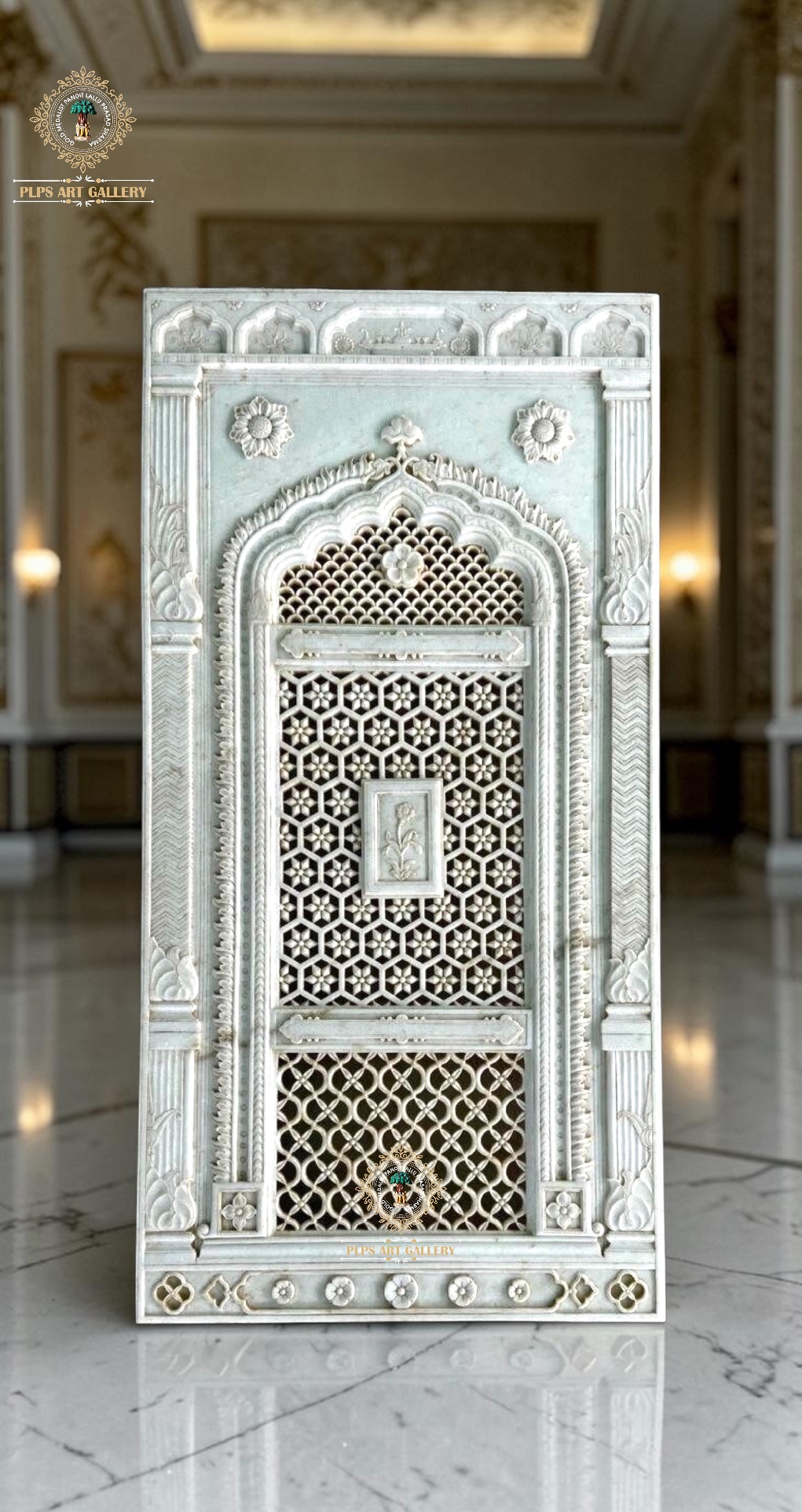
Made-to-Order Only
Our marble panel are crafted exclusively on commission. Share your size, marble type and iconography — our fourth-generation artisans will begin your piece at our Chandpole Bazaar workshop, Jaipur.
Start a Commission