
Marble Pillar
The marble pillar is architecture rather than sculpture — stone that carries weight and ornament in the same shaft. In Rajasthan the tradition reaches back through the Mughal jharokhas of Amber and the columned mandapas of Dilwara and Ranakpur to the haveli courtyards of old Jaipur, where every pillar was chiselled with a floral vine, a jaali screen or a cusped-arch capital. Today the same tradition serves wedding mandap installations, luxury home entrances and courtyards, garden gazebos and chhatris, temple architecture and heritage restoration.
Carving a load-bearing pillar is a discipline separate from figurative sculpture. A shaft that must stand for a century under a stone lintel or mandap beam has to be quarried from a block without hairline faults, cut on the vertical grain of the bed and turned true from every angle. PLPS reaches first for Makrana — the dense, low-porosity calcitic marble that carries the domes and colonnades of the Taj Mahal — for any structural pillar where the stone must hold both weight and detail for generations. Vietnam White is worked for smaller interior-only decorative columns; Bhainslana black serves as a dramatic dark accent stone. Four generations of Shilpis under Late Pandit Lallu Prasad Sharma (Shilp Guru, Presidential Award 1991) have resolved pillar sets at palace scale from the Chandpole Bazaar atelier.
Every traditional Indian pillar carries three carved sections. The base — an octagonal or square adhisthana set with turned mouldings and a lotus-kalash motif. The shaft — plain fluted, jaali-perforated, spirally twisted, or run with vines of lotus, paisley and mango-leaf; on Mughal-idiom pillars the shaft becomes an octagon with cusped-arch niches. The capital — the section that reads most from a distance — resolves as a Rajasthani jharokha bracket, a Mughal foliate crest, an inverted-lotus bell, or on temple commissions as small deity or dwarpal figures. PLPS carves the full range, from plain polished columns for restrained modern interiors to fully ornate ceremonial pillars.
Pillar sizes span from four-foot table-top decorative pieces through six to seven-foot interior columns up to architectural pillars of ten to twelve feet and beyond for temple mandapams, palace verandahs and mandap installations. Load-bearing pillars are engineered with structural certification against the intended lintel weight — a step most decorative competitors do not undertake. Wedding mandap sets are commissioned as coordinated four-pillar-plus-beam ensembles with matched carving, pair-matched veining, garland-hook brackets and pair-matched capitals; permanent temple mandaps carry deity iconography at the capital and dwarpal figures at the base. Design is fully custom — Rajasthani, Mughal, temple-classical or modern minimal — with optional Swarna Karya gold-leaf accents on capital detail.
Wedding planners commission mandap sets against fixed ceremony dates, luxury architects order entrance and courtyard columns for residences and boutique hotels, temple boards commission mandapam pillars against pran pratishtha unveilings, and heritage restoration teams commission matched replacement columns for havelis and forts under conservation. PLPS resolves each brief from Chandpole Bazaar in Jaipur and ships worldwide in wooden crates.

Frequently Asked Questions
The two are engineered differently from the block onwards. A decorative pillar — a table-top piece, an interior column that does not carry a lintel, or a garden accent — can be worked from a modest block for silhouette and ornament alone. A load-bearing structural pillar has to hold the weight of a stone lintel, a mandap beam or a temple mandapam roof; that block is selected fault-free from Makrana with the grain aligned vertically, quoted with structural certification against the intended load, and finished with an integrated base plinth. Please tell us upfront which category the pillar belongs to — the answer changes the block, the marble, the price and the lead time. Most competitors quote the two categories interchangeably; we do not.
A wedding mandap set is commissioned as a coordinated four-pillar-plus-beam ensemble, not four pillars purchased separately. Carving is matched shaft-for-shaft, jharokha-style capitals are carved in identical detail across all four, garland-hook brackets are integrated at the shaft, and marble veining is pair-matched where possible for visual coherence around the sacred fire. Some clients also commission a stepped stone base for each pillar and a decorative crossbeam or torana above. For permanent temple or family mandaps, deity iconography or dwarpal figures are added at the capital and base. Please share your ceremony date, mandap dimensions and any theme reference — Rajasthani jharokha, Mughal cusped-arch or temple-classical — at first enquiry so we can plan the carving depth accordingly.
For a residential entrance porch or portico, six to seven-foot pillars in pairs read at correct human scale and frame the doorway without dominating it. For an interior courtyard colonnade in a haveli, farmhouse or boutique hotel, seven to nine feet at consistent spacing is the classical Rajasthani proportion. For an outdoor gazebo or garden chhatri supporting a stone canopy, eight-foot pillars are typical. For a permanent temple mandapam or shrine architecture, ten to twelve feet — matched to the beam height and roof pitch — is standard, and taller pillars up to fifteen feet are executed for palace-scale verandahs. Table-top decorative pillars of four to five feet suit pedestal and console display in modern interiors.
For any structural or load-bearing pillar, Makrana white (Sangemarmar) is our first and usually only recommendation — the same fine, dense, low-porosity calcitic marble chosen for the Taj Mahal, the Victoria Memorial and the Dilwara temples, uniquely suited to holding weight, detail and mirror polish across centuries without micro-flaking under load. For smaller interior decorative pillars, table-top pieces and non-load-bearing accent columns, Vietnam White is a considered alternative at a more accessible price point. Bhainslana black — PLPS's own quarried Rajasthani stone — serves as a warm-toned accent pillar where the interior scheme calls for warmth rather than cool white. Mixed sets across marble types are possible but rarely visually successful and we would advise against them.
Yes — design is fully custom to your brief. Rajasthani iconography draws on jharokha-style projecting brackets at the capital, jaali-perforated shaft panels, floral vines of lotus and mango-leaf, and octagonal fluted shafts. Mughal iconography uses cusped-arch niches on the shaft, paisley scrollwork, foliate crests and inverted-bell capitals. Temple-classical mandapam pillars carry deity motifs at the capital and dwarpal figures at the base. Modern minimal is executed as a plain polished cylindrical or square-fluted shaft with a restrained capital. Optional Swarna Karya gold-leaf accents are applied to capital detail and jharokha frames. Share reference photographs, a hand sketch, or the palace, haveli or temple you want to echo — our Shilpis will interpret it faithfully to your site drawing.
Decorative table-top and interior pillars are typically delivered in forty-five to sixty days. A four-pillar wedding mandap set with matched carving and beam runs sixty to seventy-five days from confirmed brief. Load-bearing architectural pillars, temple mandapam commissions and full palace-verandah sets require seventy-five to ninety days and beyond depending on scale and detail — please plan accordingly for pran pratishtha or wedding-date unveilings and write to us ten to twelve weeks in advance. Once installed outdoors, Makrana ages beautifully but should be rinsed of monsoon dust and pollution deposits with clean water twice a year, dried with a soft cloth, and given a light conservation polish every three to five years. Never use acidic cleaners, vinegar or ammonia on any calcitic marble — they will etch the surface permanently.
Looking for a custom Marble Pillar?
Every piece is hand-carved to order in our Chandpole Bazaar workshop, Jaipur. Share your size, marble type and iconography — our 4th-generation artisans will craft it for you.
Request a Quote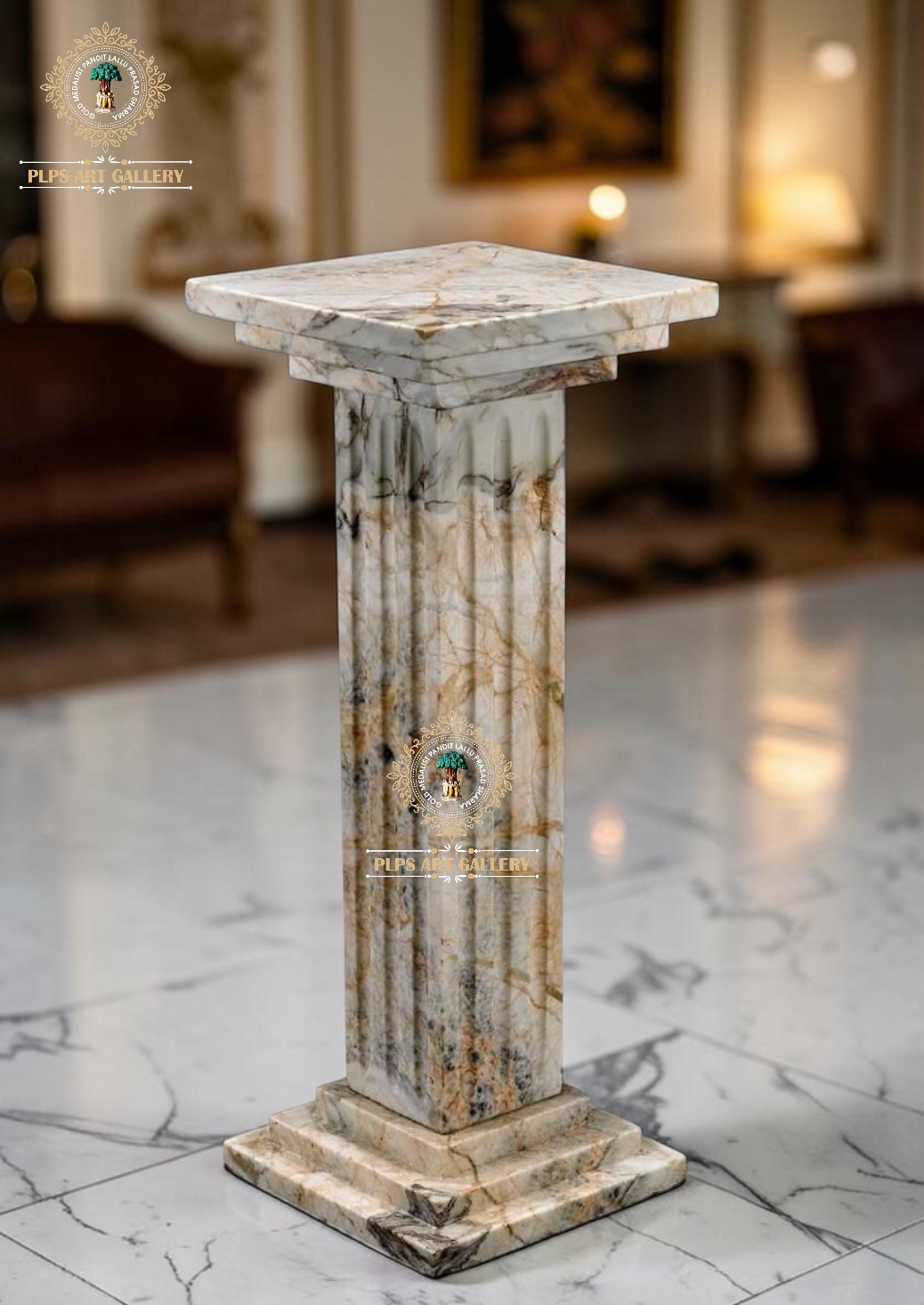
Made-to-Order Only
Our marble pillar are crafted exclusively on commission. Share your size, marble type and iconography — our fourth-generation artisans will begin your piece at our Chandpole Bazaar workshop, Jaipur.
Start a Commission