
Marble Singhasan
A singhasan is the ornate throne on which the deity idol is enthroned inside the mandir — the elevated seat that separates the murti from the mandir floor and confers the dignity of kingship on the divine form. It is not the mandir itself; the mandir is the temple structure that houses the deity, while the singhasan is the throne that sits within it. Hindu iconography treats the deity as sovereign, and the singhasan tradition carries centuries of Rajasthani royal-throne design vocabulary — pillared corners, jaali screens, cushioned seat, and the dome canopy of the durbar — recast for the puja room.
At PLPS, singhasan carving draws directly on four generations of Rajasthani throne craft from our Chandpole Bazaar workshop. Jaali (lattice) work on the flanks is our signature — each aperture hand-drilled from both faces so the pattern reads cleanly whether lit from within or backlit by the mandir's lamp. Floral vines, Rajasthani motifs, and the option of a domed chatra crowned with a marble kalash finial layer the piece with royal grammar. Swarna karya (gold-leaf) is applied only where tradition permits — floral bands, pillar caps, and the kalash — never on the seat surface. Every singhasan is sized to the specific deity that will occupy it, not built to stock dimensions.
Singhasans are carved in rectangular, octagonal, or square footprints, elevating the deity anywhere from 4 to 24 inches above the mandir floor depending on the murti's height and the eye-level rule (the deity's eyes should meet the seated devotee's gaze during aarti). Jaali on the three visible sides is traditionally functional — it lets the heat from ghee diyas and the smoke of dhoop dissipate rather than pool around the deity's feet. The optional chatra rises 8 to 18 inches above the seat, crowned by a kalash finial; it belongs on singhasans installed inside taller mandirs or on wall shelves with adequate clearance, and is omitted where the mandir ceiling sits close to the deity's crown.
Our singhasans range from 8-inch pedestal chowkis for pocket-size Bal Ganesha idols up to 6-foot pillared thrones for temple installations. We measure to the existing deity's base and add the traditional clearance ratio, then customise jaali patterns, gold accent placement, and the choice between cushion-style, pillared-throne, or pedestal-chowki silhouettes. Rajasthani floral bands, kirtimukha motifs, and edge scallops are specified per commission.
Commissioned for households upgrading a mandir with a dignified seat, temple installations replacing a worn platform, and devotees adding a proper throne to an heirloom deity. Custom builds 30 to 90 days from our Chandpole workshop; worldwide export.

Frequently Asked Questions
The mandir is the temple structure — the housing with pillars, jaali walls, and gopuram or shikhara tower that shelters the deities. The singhasan is the throne that sits inside the mandir on which a specific deity idol is enthroned. Think of the mandir as the palace and the singhasan as the throne within its darbar hall. Households often order a mandir and then realise the deity is sitting flat on the mandir floor; the singhasan is what elevates and dignifies the murti. You can install a singhasan inside an existing mandir, or on a wall shelf where no mandir structure is present.
Measure your deity's base at its widest point and share the murti's overall height with our workshop. The traditional clearance ratio adds roughly two to three inches on each side of the base and elevates the seat so the deity's eyes meet the seated devotee's gaze during aarti — usually 4 to 12 inches for smaller idols and up to 24 inches for larger murtis. If you plan a chatra, we also need the ceiling clearance above the deity's crown so the canopy fits. Send a photograph of the deity beside a measuring tape and we will draft a scaled design before carving begins.
Jaali on the flanks of a singhasan is traditionally functional, not merely decorative. Ghee diyas and dhoop burned during aarti generate heat and smoke; the perforated lattice allows both to dissipate outward rather than pool around the deity's feet, protecting the murti's polish from soot and thermal stress over decades. Jaali also lightens the visual weight of a tall seat and lets the mandir's internal lamp cast filtered light through the throne. At PLPS each aperture is hand-drilled from both faces of the stone so the pattern reads cleanly whether backlit or front-lit.
The chatra is the domed marble canopy above the seat, crowned by a kalash finial — a royalty motif signalling that the enthroned form is sovereign. It belongs on singhasans placed inside taller mandirs, on open wall shelves, or on temple installations with adequate vertical clearance; it typically adds 8 to 18 inches above the seat. Omit the chatra when the mandir ceiling sits close to the deity's crown, when the singhasan is a low pedestal chowki, or when the mandir already has its own internal dome. Share your mandir's internal height and we will advise whether a chatra fits before carving.
Makrana is our first recommendation for a load-bearing singhasan — it is the densest of the three stones we work, resists yellowing over decades, and takes a chikni polish that survives daily cleaning for a century. Vietnam White is softer and better suited to deep jaali relief on lighter singhasans; it needs sealing in humid coastal climates. Bhainslana, with its deep black tone, we reserve for pillar caps, kalash finials, and floral bands accenting a Makrana body. For temple installations bearing large murtis, always specify Makrana; for home singhasans under 24 inches, Vietnam White is fully adequate.
Dust daily with a soft dry brush — a natural-bristle paintbrush reaches into jaali apertures and floral undercuts where a cloth cannot. For weekly cleaning, wipe flat surfaces with a barely damp microfibre cloth and dry immediately; never let water sit inside jaali openings or carved recesses where it can seep and dull the polish. Avoid vinegar, lemon, and every acidic household cleaner — they permanently etch marble. For ghee splatter or diya oil, dab a paste of baking soda and water with a soft toothbrush, rinse gently, and dry. Reseal every 3 to 5 years with a marble-safe penetrating sealer.
Looking for a custom Marble Singhasan?
Every piece is hand-carved to order in our Chandpole Bazaar workshop, Jaipur. Share your size, marble type and iconography — our 4th-generation artisans will craft it for you.
Request a Quote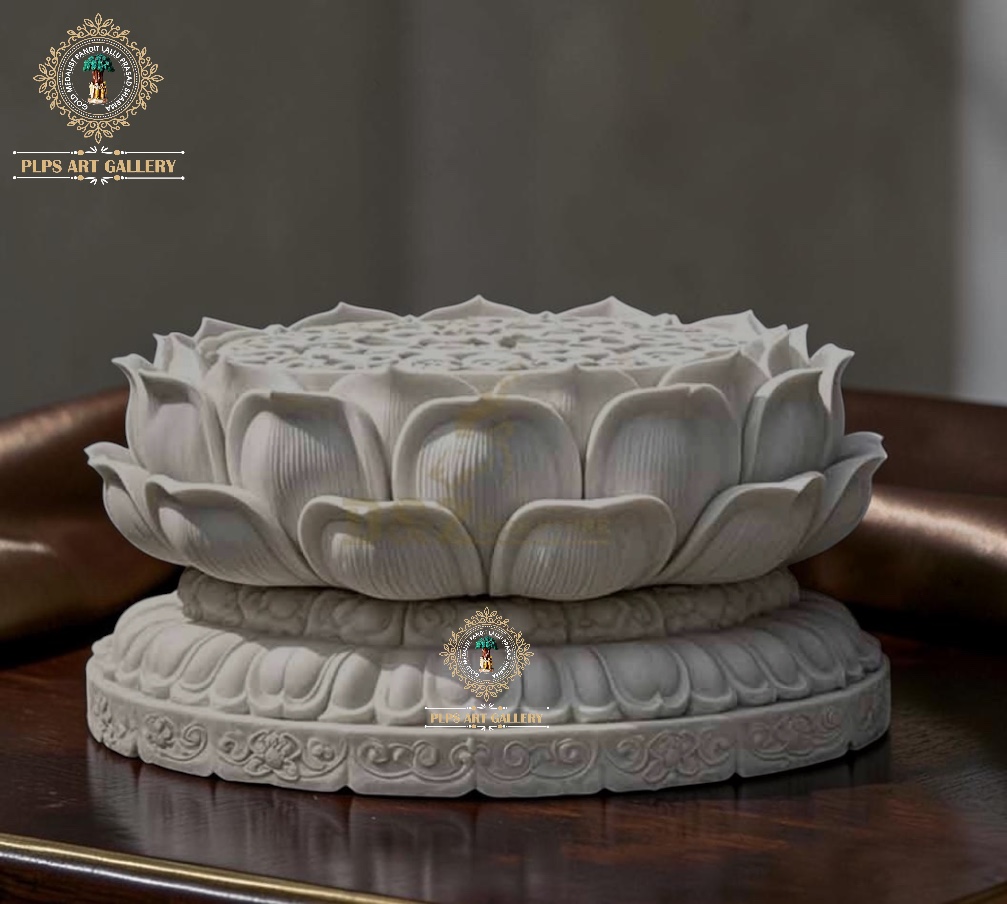
Made-to-Order Only
Our marble singhasan are crafted exclusively on commission. Share your size, marble type and iconography — our fourth-generation artisans will begin your piece at our Chandpole Bazaar workshop, Jaipur.
Start a Commission