
Marble Nandi Statue
Nandi is not the ornament outside the sanctum — he is the first darshan. Across every Shiva temple from Tanjore to Kashi, the devotee bows to the sacred bull before entering the garbhagriha, and it is Nandi who is believed to carry the whispered prayer to Mahadev's ear. As Shiva's vahana, gatekeeper of Kailash, chief of the ganas, and the jiva held in eternal focus toward the linga, Nandi receives worship in his own right. A marble Nandi murti in your mandir is not an accessory to the Shivling — it completes the darshan sequence that the agamic shastras prescribe, and honours a tradition that Chola and Vijayanagara sthapatis carved into stone a thousand years ago.
At PLPS Art Gallery, carving Nandi is a discipline of two sculptural languages spoken at once. The first is bovine anatomy — the taut dewlap folded at the throat, the muscular hump rising behind the neck, forelegs tucked precisely beneath a compact recumbent body, the hindquarters powered but at rest, the tail draping along a flank of controlled musculature. Unlike deity forms that follow fixed iconometric proportions, a convincing Nandi demands realism the eye can trust. The second language is ornament — a bell (ghanta) suspended from a beaded collar, a saddle cloth patterned with paisley, lotus or trishul motifs, ankle rings, garlands, and horns curled back and polished to the mirror-smooth Chikni finish that our workshop is known for. Four generations of the Sharma parivar, working from our Chandpole Bazaar karkhana under the legacy of Shilp Guru Late Pandit Lallu Prasad Sharma (Presidential Award, 1991), carry the Kamikagama proportions that codified the recumbent Nandi more than a millennium ago.
The iconography follows one non-negotiable rule: Nandi always faces the Shivling. Horns curve gracefully backward toward the hump, the head is raised in devotional attention, forelegs fold neatly, and the ears — sometimes slightly enlarged — honour the tradition of devotees whispering wishes into the right ear. In traditional mandir layout, Nandi sits on the central axis of the linga, at eye level with the yoni pitha, so the sight-line from bull to lingam is uninterrupted. Some agamic manuals place Nandi on the south side of the sanctum, but the facing rule always overrides the compass. In a home mandir, the same principle holds: install Nandi so his gaze rests directly on the Shivling, elevated on a clean stone or wooden pedestal.
Our Nandi murtis range from 6-inch mandir-scale bulls carved from a single Makrana block to full 6-foot temple installations quarried in Vietnam White for outdoor sanctums, where the denser stone weathers monsoon and sun without pitting. We offer paired Shivling-Nandi sets cut from the same marble batch and sized in shastric proportion — Nandi's shoulder height matched to the crown of the linga so the composition reads correctly in worship. Optional Swarna Karya applies 22-karat gold leaf to horns and the neck bell; mineral-pigment work in traditional Rajasthani palettes personalises the saddle cloth; and a Bhainslana black marble base delivers striking contrast beneath a white bull. Sanskrit shlokas and family names can be engraved on the plinth.
For temple pratishtha commissions, home Shivling installations, and gifted Shivling-Nandi pairs commemorating a Rudrabhishek, write to our Chandpole workshop with your mandir dimensions and the Shivling you already have (or would like matched). Every Nandi leaves Jaipur only after Shila Pariksha, hand-finishing, and pre-dispatch photographs — insured worldwide shipping included.

Frequently Asked Questions
Nandi is Shiva's vahana, but in Shaiva tradition he is also the first devotee — the jiva held in eternal darshan of the linga, and the messenger who carries whispered prayers to Mahadev. Agamic texts describe Shivling worship without a facing Nandi as incomplete darshan, which is why every Shiva temple installs the bull on the central axis of the sanctum. The pair completes the composition: the linga as the formless Shiva, and Nandi as the perpetual bhakta whose focus never wavers. A home Shivling shrine follows the same logic — install Nandi to complete it.
The direction rule for Nandi is simple and overrides ordinary compass Vastu: Nandi must always face the Shivling directly, with an uninterrupted sight-line. In a home mandir, install the Shivling first — typically on the north wall so the worshipper faces east — then place Nandi on the same axis, facing the linga. If you do not yet have a Shivling, Nandi may face east or the primary deity of the mandir, but once a Shivling is installed the bull must be realigned immediately. Elevate the murti on a clean pedestal, never directly on the floor.
Traditional shilpa shastra proportion suggests Nandi's shoulder height should roughly equal the crown of the Shivling, so the eyes of the bull naturally meet the top of the linga in the worshipper's line of sight. For a 9-inch home Shivling, a 6–8 inch recumbent Nandi is ideal; for a 2-foot temple Shivling, an 18–24 inch Nandi holds the composition; and for temple-scale 4-foot Shivlings, a 3-foot Nandi begins to look shastrically correct. PLPS supplies matched Shivling-Nandi pairs cut and polished from the same marble batch so tone, grain and vein remain consistent across the two pieces.
For outdoor sanctums exposed to sun, monsoon rain and pollution, we recommend Vietnam White marble — denser than most Indian marble, with lower porosity, which is why South Indian temple commissions have historically favoured it (and its regional cousins) for monumental Nandi installations. Makrana marble remains our preference for indoor mandir Nandis because of its warm ivory tone and centuries-proven longevity in the Indian climate. For a striking black bull placed opposite a white Shivling, Bhainslana black marble delivers a rich, dense finish that ages beautifully outdoors with minimal upkeep.
Yes — the saddle cloth, neck bell and horns are the three surfaces where we personalise every commissioned Nandi. We hand-paint the jhool (saddle cloth) using traditional mineral pigments in Rajasthani motifs such as paisley, lotus, trishul or damaru; apply 22-karat gold leaf (Swarna Karya) to the horns and the ghanta at the neck for a gilded finish; and can inscribe Sanskrit shlokas, family names or dedication dates along the base. Colour samples, motif references and in-progress photographs are shared for your approval before we finalise the piece for dispatch.
It is an old Shaiva devotional practice: worshippers cup their hand and whisper their wish softly into Nandi's right ear, believing that as Shiva's most trusted attendant, he will carry the prayer directly to Mahadev without distortion. The custom is especially visible at Chola-era South Indian temples and at the great monolithic Nandi shrines of Karnataka such as the Bull Temple in Bengaluru. A marble Nandi in your home mandir keeps this intimate ritual alive; several families ask us to slightly enlarge the ears at the carving stage specifically to honour and enable this practice.
Dust the Nandi weekly with a soft, dry muslin cloth — never use a wet cloth or any chemical polish on the gold-leafed horns and bell or on the mineral-pigment saddle work, both of which are surface-applied. For the plain marble body, a lightly damp cloth followed by immediate drying is safe; avoid soap, abrasive scrubs, turmeric-oil applications and acidic cleaners. Keep the murti out of prolonged direct sunlight to preserve pigment brilliance. If gold leaf on the horns or bell shows wear after many years of worship, PLPS offers refurbishment at the Chandpole Bazaar workshop.
Looking for a custom Marble Nandi Statue?
Every piece is hand-carved to order in our Chandpole Bazaar workshop, Jaipur. Share your size, marble type and iconography — our 4th-generation artisans will craft it for you.
Request a Quote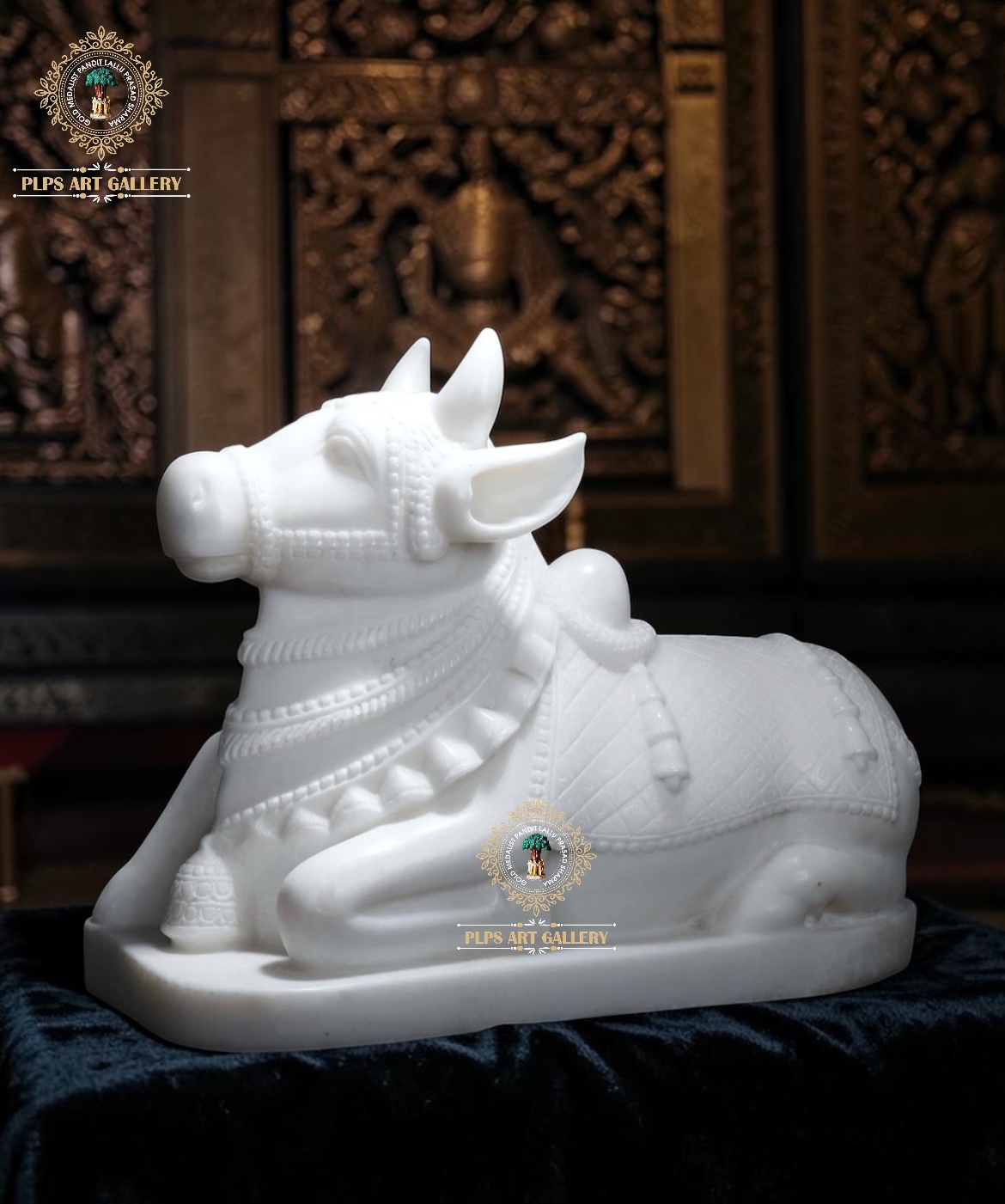
Made-to-Order Only
Our marble nandi statue are crafted exclusively on commission. Share your size, marble type and iconography — our fourth-generation artisans will begin your piece at our Chandpole Bazaar workshop, Jaipur.
Start a Commission