
Marble Parshuram Ji statue
Bhagwan Parshuram is the sixth of Vishnu's ten principal avatars — the warrior-sage born to Sage Jamadagni of the Bhrigu gotra and Mother Renuka, gifted the parashu (axe) by Shiva himself after severe tapas, and remembered in scripture for ridding the earth of unjust kshatriyas twenty-one times. He is one of the seven Chiranjivis, believed in the living tradition to still perform tapas on the Mahendragiri mountain, and — uniquely among the Vishnu avatars — is revered as the mool purush, the founder-ancestor, of the Bhumihar, Chitpavan, Niyogi, Daivadnya, Mohyal, Shukla, Awasthi, Tyagi, Anavil and Nambudiri Brahmin communities. In these households a Parshuram murti is not merely an avatar for the mandir; it is the kul-devta, the family's living ancestor. He is also the acknowledged martial-arts guru of Bhishma, Dronacharya and Karna in the Mahabharata, and his Jayanti falls on Vaishakh Shukla Tritiya — coinciding every year with Akshaya Tritiya, one of the most scripturally auspicious purchase days in the Hindu calendar.
Carving Parshuram is different from any other Vishnu avatar. Ram and Krishna are royal-regal, adorned in princely drapery; Narasimha is theriomorphic; Kurma and Matsya are zoomorphic. Parshuram alone is ascetic-warrior — a muscular tapasvi frame under nothing more than a kaupin (loincloth) at the waist, with the yajnopavita (sacred thread) draped visibly across the bare torso to hold both his Brahmin birth and his Kshatriya action in the same field of view. The face must carry raudra (fierce resolve) and daya (compassion) simultaneously — a paradox the sculptor resolves in the set of the jaw and the softness of the eyes. Four generations of PLPS Shilpis, working under the lineage of Late Pandit Lallu Prasad Sharma — Shilp Guru and Presidential Awardee (1991) — have refined the human anatomy discipline this figure demands. Shila Pariksha selects a Makrana block dense enough to hold the parashu blade edge without chipping (a projecting element that defeats many workshops); Rekhankan lays down the muscular ascetic frame and the coils of the jatamukuta; Chikni polish silks the skin surfaces while leaving the matted hair matte-textured; Swarna Karya applies gold leaf sparingly to the parashu edge and yajnopavita cord where the family sampradaya calls for it.
Iconography is fixed. Standing pose is canonical — with the parashu either raised in the right hand (the raudra warrior stance, most requested by martial-arts akharas and Bhumihar sabhas) or resting on the right shoulder (the contemplative sage-warrior variant preferred in home mandirs). The Vaishnavadhanus (Sharanga bow) can be added at the left side or held in the left hand. Two-armed depiction is the norm; the four-armed form described in the Bhagavata and Agni Purana — parashu, bow, arrow and tarjani mudra — is available for temple-scale commissions. The matted hair is coiled into a jatamukuta; the tripunda or urdhva-pundra forehead mark is carved per your family sampradaya; the scripturally described tamra-varna (red-copper) complexion is either applied in mineral pigment or, as most South Indian and plain-marble families prefer, left as the natural Makrana white. In the home mandir, place Parshuram in the North-East (Ishaan) corner facing East so the parashu catches the morning sun; unlike the guru murtis of Sai Baba or Gajanan Maharaj, he is installed at or slightly above chest level as a scriptural avatar. Never let the axe point at a sleeping family member's head or at the main entrance from inside.
PLPS carves Parshuram from 8 inches to 6 feet. Home mandir sweet spot is 15 to 24 inches; dedicated kul-devta altars in Bhumihar, Chitpavan and Mohyal households carry 24 to 36 inches; Kalaripayattu, Silambam and Gatka akharas commission 4 to 6 foot installations with a wave-carved base referencing the Konkan ocean-reclamation legend. Customisation includes mineral-pigment tamra-varna skin tone, hand-painted separation of the jata coils, Swarna Karya gold leaf on the parashu edge and yajnopavita, a carved bow across the base, and Devanagari inscription of the family gotra or the Parshuram gayatri on the pedestal.
For Brahmin households commissioning a kul-devta, for martial-arts akharas installing the archetypal shastra-guru, and for every family who wants a Parshuram delivered to arrive before Akshaya Tritiya, our workshop crafts each piece to the scriptural specification your sampradaya requires. Speak to our craftsmen — the fourth generation of Chandpole Bazaar Shilpis who understand what an ascetic-warrior asks of the stone.

Frequently Asked Questions
Bhagwan Parshuram is the sixth of Vishnu's ten principal avatars, born to Sage Jamadagni of the Bhrigu gotra and Mother Renuka, and gifted the parashu (axe) by Shiva himself. Scripture records that he ridded the earth of unjust kshatriyas twenty-one times to restore dharma. Beyond the avatar tradition, he is revered as the mool purush — the founder-ancestor — of the Bhumihar, Chitpavan, Niyogi, Daivadnya, Mohyal, Shukla, Awasthi, Tyagi, Anavil and Nambudiri Brahmin communities, whose families trace their lineage to sages he blessed or lands he reclaimed. In these households a Parshuram murti is not merely an avatar installation; it is the kul-devta — the family's living ancestor deity — worshipped daily rather than only on Jayanti.
The parashu was gifted to Parshuram by Lord Shiva after severe tapas — it is not a personal weapon but a sacred instrument of divine justice. Iconographically it symbolises the cutting away of adharma, corruption and the obstacles that prevent righteousness from taking root — the way a farmer clears dense forest before cultivation. The choice of posture matters: parashu raised in the right hand is the raudra (fierce) stance most requested by martial-arts akharas and Bhumihar sabhas, expressing Parshuram's active defence of dharma; parashu resting on the right shoulder is the contemplative sage-warrior variant preferred in home mandirs, showing the weapon held in readiness but not raised in anger. Both are scripturally valid — the family chooses which resonates with the household's disposition.
Yes — and it is one of the most authentic non-domestic installations for this figure. Parshuram is the acknowledged martial-arts guru of Bhishma, Dronacharya and Karna in the Mahabharata, which makes him the archetypal shastra-guru of the Indian martial tradition. Kalaripayattu schools in Kerala, Silambam institutions in Tamil Nadu, Gatka akharas in Punjab and modern Indian martial-arts academies commission Parshuram installations as the presiding teacher of the discipline. Recommended posture is the raised-parashu raudra stance to convey active shastra-vidya. Recommended size is 36 to 72 inches — head-height or slightly above — placed at the East wall of the training hall so students perform namaskaram to the guru before practice begins. A wave-carved base referencing the Konkan reclamation legend is a common addition.
For a Parshuram commission, Makrana white is our first recommendation and — for the parashu blade specifically — the only material we recommend at larger sizes. The projecting axe blade is the highest-risk element on this figure: it sticks out from the shaft, carries a carved edge, and is the first thing to chip if the stone is not dense enough. Makrana's fine, tight grain — the same stone the Taj Mahal is built from — holds the blade edge without fracture and takes Chikni polish beautifully across the muscular ascetic frame. Vietnam White is a fine alternative for smaller 12 to 18 inch home commissions where the parashu blade is less exposed. Bhainslana's deep black tonality suits devotees who want the tapasvi-varna (ascetic complexion) implicit in the stone itself — closer to the red-copper description in the Puranas without any painted pigment.
A 15 to 24 inch home-mandir Parshuram takes 4 to 6 weeks depending on the level of parashu detailing, jata coil work and whether mineral pigment is applied to the skin tone. A 24 to 36 inch kul-devta altar piece runs 8 to 12 weeks. A 4 to 6 foot akhara or community-mandir commission with the four-armed form and a wave-carved base takes 14 to 22 weeks. Akshaya Tritiya — which universally coincides with Parshuram Jayanti (Vaishakh Shukla Tritiya, typically in April or May; in 2026 it falls on 20 April) — is the most scripturally auspicious purchase day for this specific commission. Because it is also considered the most auspicious day of the year to bring any marble or gold into a household, our workshop books Parshuram commissions eight to twelve weeks in advance to guarantee arrival before the Tritiya morning.
The parashu blade and the jatamukuta coils are the two most vulnerable features on this figure — the blade to impact and the hair coils to dust. Dust the parashu edge and shaft weekly with a soft dry natural-hair brush, moving along the length of the shaft rather than across the blade. Dust the jata undercuts in the direction the strands coil, never against them, to avoid loosening the fine carved separation. Never wipe either area with a damp cloth — trapped moisture in the hair undercuts causes discolouration over time. The muscular torso, arms and face can be cleaned with a barely-damp muslin cloth followed immediately by a dry one. Avoid all citrus, vinegar and acidic cleaners — Makrana is calcite-based and etches on contact. Once a year, apply a light coat of neutral marble wax to the smooth skin surfaces only, never in the jata coils or along the blade edge, to restore the Chikni polish.
Every Vishnu avatar carries a distinct iconographic discipline, and Parshuram's is the most singular of the Dashavatara. Ram is the royal-regal Ayodhya-prince form — crown, dhoti, bow, princely drapery, calm nobility. Krishna is bala-lila or Murlidhar or Rajadhiraj — always adorned, flute or gada in hand, princely to regal in bearing. Narasimha is theriomorphic — lion-headed, wrathful, an entirely different sculptural category. Parshuram alone is the ascetic-warrior: muscular tapasvi anatomy visible under nothing but a kaupin at the waist, the yajnopavita draped across the bare torso to hold his Brahmin birth and Kshatriya action in the same view, matted hair coiled into a jatamukuta, and the parashu — no crown, no princely ornaments, no royal drapery. A workshop that carves Parshuram in Ram-style princely robes has misread the iconography; the whole point of this avatar is that his body itself, and the axe in his hand, are his only regalia.
Looking for a custom Marble Parshuram Ji statue?
Every piece is hand-carved to order in our Chandpole Bazaar workshop, Jaipur. Share your size, marble type and iconography — our 4th-generation artisans will craft it for you.
Request a Quote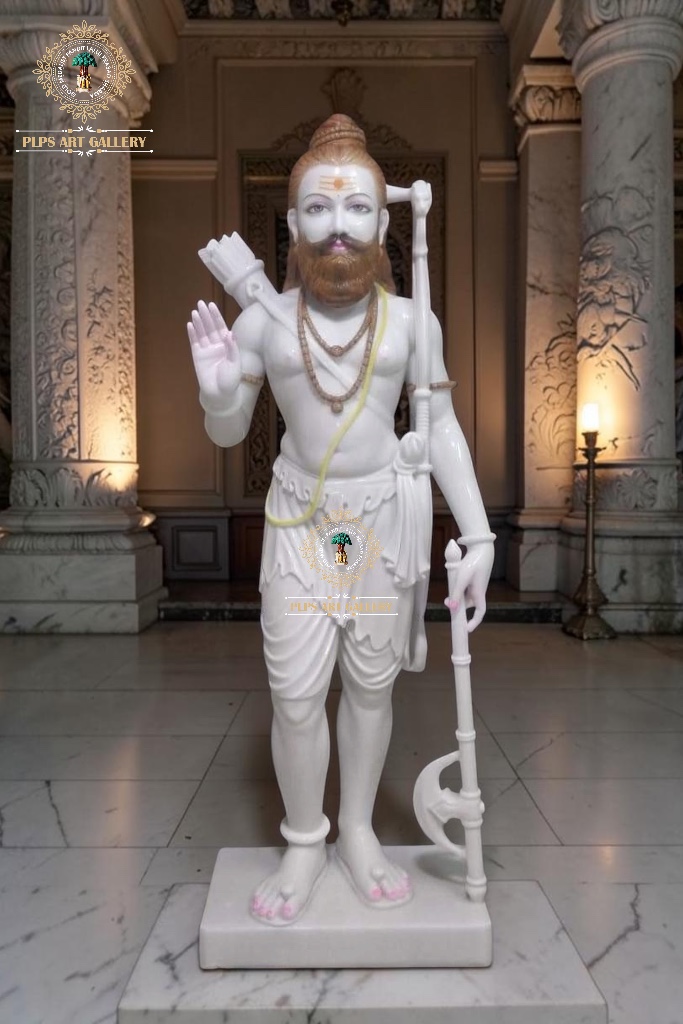
Made-to-Order Only
Our marble parshuram ji statue are crafted exclusively on commission. Share your size, marble type and iconography — our fourth-generation artisans will begin your piece at our Chandpole Bazaar workshop, Jaipur.
Start a Commission