
Ram Darbar Statue
The Ram Darbar is the visual embodiment of Ram Rajya — Lord Rama's ideal kingdom of dharma, held together not by power but by family unity. The composition of Ram, Sita, Lakshman and Hanuman anchors most North Indian household shrines as the central figure, and demand has grown sharply since the January 2024 Pran Pratishtha at Ayodhya Ram Mandir. White marble, luminous and cool, is the natural medium for a royal court where every glance and posture must read at once.
At our Chandpole Bazaar workshop a Ram Darbar is the most demanding god-statue commission we undertake. Four figures must be carved as a single harmonised composition — each distinct in stance and expression yet unified as one royal court. Ram's crowned serenity, Sita's poised grace, Lakshman standing alert behind with drawn dhanush, and Hanuman kneeling at Ram's feet — every proportion is fixed by Rekhankan before the first chisel-stroke. Four generations of PLPS Shilpis have refined this multi-figure discipline since 1950.
The classic Ram Darbar seats Ram and Sita on a shared throne — Ram to the devotee's right in Kshatriya posture, Sita on the left with head slightly inclined. Lakshman stands behind them, dhanush in hand as ever-watchful protector; Hanuman kneels at the base, folded hands in perfect devotion. Six-figure variants add Bharat and Shatrughan flanking the throne. Vastu places the murti in the North-East of the home mandir, facing East, on an elevated chowki — never in the bedroom or facing South.
Ram Darbar ranges from 8-inch travel pieces to 6-foot temple installations; 15-inch to 30-inch is the popular home mandir bracket where all four figures still read clearly. Custom throne detailing — lotus base, peacock-motif backrest, Ayodhya-inspired arches — is fully negotiable. Swarna Karya gold leaf lifts crowns, jewellery and dhanush; mineral pigments give Sita's saree its wedding red or a soft dawn peach. Ayodhya Ram Mandir replica compositions, following the newly consecrated murti's likeness, are our most-requested custom order.
Post-Ayodhya demand has stretched multi-figure lead times to 60–90 days — commission Ram Navami installations by January and Diwali pieces by August. Speak with the PLPS team to plan your Ram Darbar in Makrana or Vietnam White marble.

Frequently Asked Questions
A traditional Ram Darbar comprises four figures: Bhagwan Ram and Devi Sita seated together on a shared throne at the centre, Lakshman standing behind with his dhanush as ever-watchful protector, and Hanuman kneeling at Ram's feet with folded hands in pure devotion. This four-figure set is the composition most temples and homes have installed for centuries and remains our default arrangement. Some regional traditions add small vanar attendants around Hanuman; others include Jatayu at the base. Every additional figure is discussed at commissioning and priced accordingly.
The four-figure Ram Darbar shows Ram, Sita, Lakshman and Hanuman — the core court that returned to Ayodhya after the Lanka victory. The six-figure variant adds Ram's other brothers Bharat and Shatrughan, one flanking each side of the throne, completing all four sons of King Dasaratha as a symbol of unbroken family unity. The six-figure composition needs 20–30% more width, longer carving time and a larger mandir; it is chosen most often by joint families and community temples where the emphasis on brotherhood is central. Homes with limited mandir space usually stay with the four-figure classic.
Since the January 2024 Pran Pratishtha we have received a steady stream of requests for Ram Darbar compositions inspired by the Ayodhya Ram Mandir — either the new Bal Ram murti's likeness for the central figure, or the temple's sandstone arch replicated as the throne backrest, or both. We do not claim to reproduce the sanctum icon exactly, but our Shilpis can reference public darshan imagery to shape a devotional interpretation for your home. Marble grade, arch detailing, gold leaf on the throne and lotus base are all discussed at design stage. Expect 75–90 days for these commissions.
For a home mandir, 15-inch to 24-inch Ram Darbar statues suit the standard wall-niche or floor mandir where all four figures need to remain clearly distinguishable from arm's length. A 30-inch piece is our recommendation for a dedicated puja room where devotees stand back during aarti. Corridor and drawing-room central installations begin at 36 inches — at this scale the throne detail, Sita's ornaments and Hanuman's kneeling posture all read as intended. Temple-scale commissions start at 4 feet and can reach 6 feet. Below 12 inches the four figures crowd and lose expressive clarity.
A hand-carved Ram Darbar takes 60 to 90 days from the finalised design — longer than a single-deity murti because four separate figures must each pass Shila Pariksha, Rekhankan and Chikni before the composition is unified and polished. Ram Navami usually falls in late March or early April; to install on the day itself, place your order by January at the latest. Diwali-Deepotsav installations (Ayodhya's peak festival) need commissioning by August. Add two to four weeks for domestic shipping and up to six weeks for international. Rush orders under 60 days are rarely feasible without compromising detail.
The fragile zones on a Ram Darbar are Lakshman's raised dhanush and arrow-tips, Hanuman's folded fingers, Ram and Sita's crowns and the throne's arch-work. Dust weekly with a soft dry natural-hair brush — a small shaving brush reaches the recesses between the four figures where a cloth cannot. Wipe smooth surfaces with a barely damp muslin cloth then dry immediately; never use vinegar, lemon or acidic household cleaners as they etch marble permanently. If Swarna Karya gold leaf or mineral pigments have been applied to Sita's saree or Ram's crown, dust only. PLPS ships a care card with every statue.
Looking for a custom Ram Darbar Statue?
Every piece is hand-carved to order in our Chandpole Bazaar workshop, Jaipur. Share your size, marble type and iconography — our 4th-generation artisans will craft it for you.
Request a Quote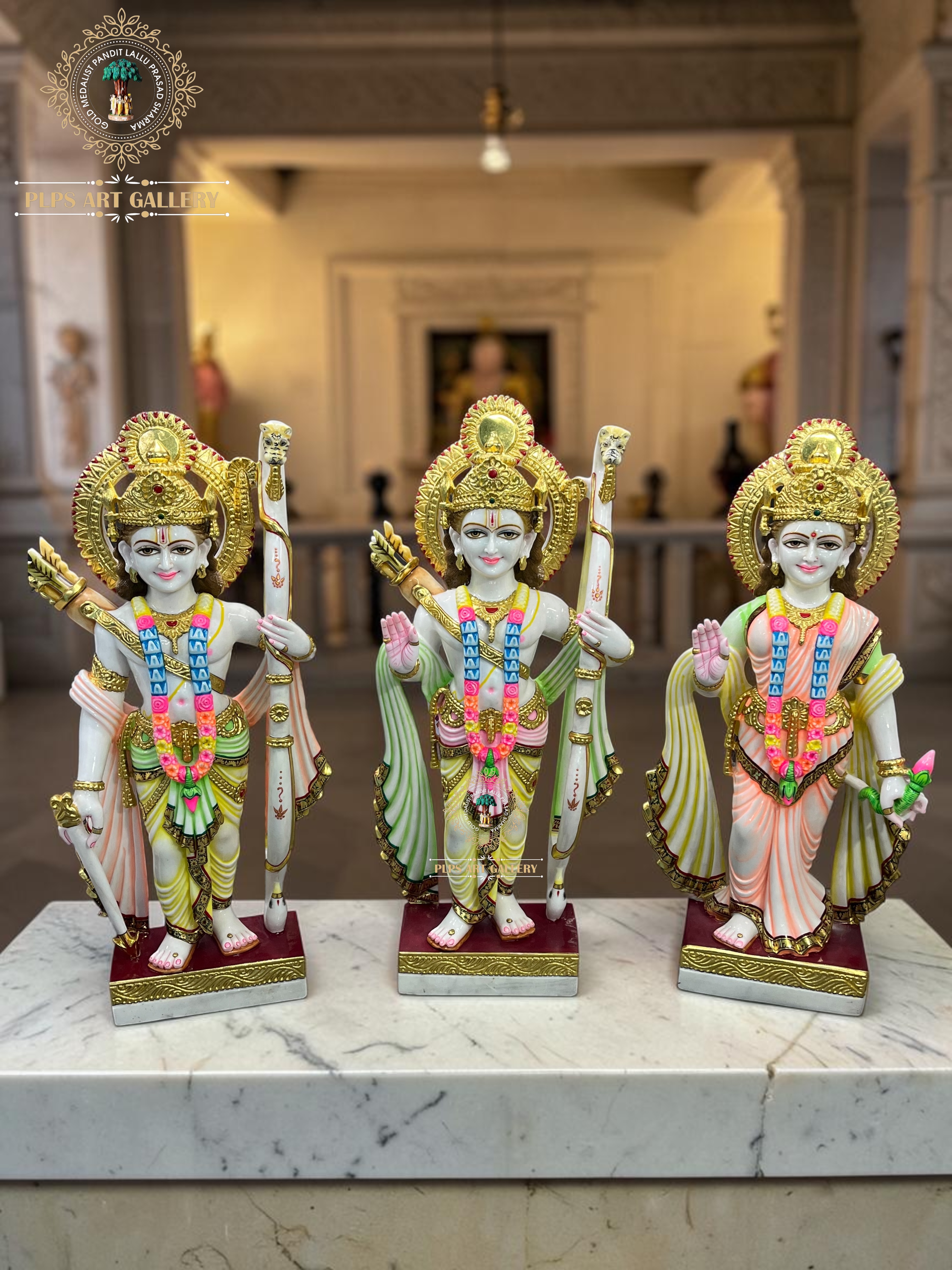
Made-to-Order Only
Our ram darbar statue are crafted exclusively on commission. Share your size, marble type and iconography — our fourth-generation artisans will begin your piece at our Chandpole Bazaar workshop, Jaipur.
Start a Commission