
Sai Baba Statue
Few saints of the modern era inspire the devotion Shirdi Sai Baba does. A 19th-century master worshipped as an incarnation of Sri Dattatreya, he is embraced by Hindu and Muslim households alike and welcomed on every Guruvar with a lit Thursday lamp. The ultimate reference for his image remains the marble statue in Shirdi's Samadhi Mandir, carved from Italian white in 1954 — which is why devotees choose Makrana, whose dense grain and luminous polish most closely mirror that revered original.
Carving Sai Baba tests our workshop like few commissions do. Unlike deity idealisation, where scriptural iconography guides the sculptor, Sai Baba demands portrait-level accuracy — the exact tilt of the head, softness in the eyes, length and separation of the beard, the drape of the kafni across the crossed knee. Makrana's fine grain holds facial expression at a level coarser stones cannot match. Four generations of PLPS Shilpis have refined the human portraiture skills this work requires — the Chikni polish that lifts the cheekbones and the Rekhankan detailing along the robe folds.
The classical Shirdi pose is a strict reference: right leg crossed over the left knee, right hand raised in abhaya mudra, left hand resting on the knee, head tilted slightly to the right, expression carrying a half-smile that is compassionate and knowing. In the home mandir, place him in the North-East corner facing East, or arrange the devotee to face East so the murti faces West — the traditional Samadhi orientation. Uniquely for Sai Baba, the murti sits at eye level, not above the head. Avoid bedrooms and walls shared with bathrooms.
PLPS carves Sai Baba from six inches to six feet. Home mandir sizes of 12 to 18 inches are most popular; dedicated Sai altars carry 18 to 24 inches. Larger commissions — three to six feet — are executed as faithful Shirdi Samadhi Mandir replicas, including the raised stone platform Baba is seated upon in the original. Custom options include Swarna Karya gold leaf along the kafni border, mineral-pigment finish on the eyes and beard for closer likeness, and a hand-carved base echoing the Dwarkamai brick from Baba's original throne.
Every Guruvar, PLPS ships Sai Baba installations to devotee families and Sai mandirs across India, the Gulf and North America. Commission a piece that honours the Shirdi original — and the boundless community that gathers each Thursday.

Frequently Asked Questions
The original 1954 marble statue in Shirdi's Samadhi Mandir was carved by sculptor Balaji Vasant Talim from Italian white marble, working from a single photograph of Baba. It fixes the canonical pose — seated on a raised platform, right leg over left knee, right hand in abhaya mudra, left hand on the knee, head tilted slightly right, and a half-smile expression. A faithful replica reproduces every one of these elements precisely; a modern interpretation may soften the pose, alter the mudra or restyle the beard for artistic effect. At PLPS, replicas are our most requested large commissions, especially for Sai mandirs and dedicated home altars.
For a shared home mandir where several deities are already installed, 12 to 15 inches is ideal — Sai Baba's seated form reads clearly at this scale without dominating other murtis. For a dedicated Sai altar, which many families create as a separate corner for Baba alone, 18 to 24 inches gives room for a stone base, an oil lamp, an incense burner and framed Shirdi photographs. Sai mandirs, bhajan halls and large drawing rooms commission 3 to 5 feet Samadhi replicas. Below 12 inches, the facial expression and beard separation begin to lose fidelity — we don't recommend miniatures for primary worship.
Thursday — Guruvar in Sanskrit — is the day of the guru, and Sai Baba is worshipped foremost as a spiritual guru rather than a scriptural deity. Devotees light a lamp, offer chameli or jasmine flowers, and read from the Sai Satcharitra on Thursdays; many refrain from non-vegetarian food and observe silence between morning and evening arti. For new statue installation, a Thursday morning under Pushya or Chitra nakshatra is traditionally chosen, and many devotees prefer the Thursday of Guru Purnima. PLPS ships to align with your intended Guruvar prana pratishtha — please share your consecration date at order confirmation.
The Shirdi original is carved from Italian statuario marble, prized for its bright white base and translucent grain. Makrana — the same marble the Taj Mahal is built from — shares that fundamental character: dense, fine-grained, capable of holding a mirror polish for generations, and warming beautifully under a diya. For classical devotional purity that most closely echoes Shirdi, Makrana is our first recommendation. Vietnam White is a fine alternative for smaller sizes at accessible price points; Bhainslana's deep black tone is chosen occasionally when devotees want a grounding, ashram-like tonality across Baba's kafni robe.
Place Sai Baba in the North-East (Ishaan) corner of the home mandir, with the statue facing East so the morning sun falls on him — or orient the shrine so the devotee faces East during arti, in which case the murti faces West, mirroring the traditional Shirdi Samadhi orientation. Unlike other deities placed above head-height, Sai Baba is uniquely installed at eye level so devotees can look directly at him, mirroring the guru-shishya relationship. Elevate him on a chowki, keep the surrounding space clean and well-lit, and offer fresh flowers daily. Avoid bedrooms, bathroom-adjacent walls, and any spot beneath a staircase.
Yes — many devotees request closer resemblance to a specific Shirdi photograph they cherish. We offer mineral-pigment tinting on the eyes and forehead, subtle painted separation of the beard strands, and hand-applied Swarna Karya gold leaf along the kafni border and headscarf edge. Share reference images at commissioning. For care, dust the beard and robe folds weekly with a soft dry natural-hair brush; the fine undercuts of the beard trap moisture and must never be wiped with a damp cloth. Clean the smooth face and hands only with a barely damp muslin cloth, dried immediately, and avoid citrus or acidic cleaners entirely.
Looking for a custom Sai Baba Statue?
Every piece is hand-carved to order in our Chandpole Bazaar workshop, Jaipur. Share your size, marble type and iconography — our 4th-generation artisans will craft it for you.
Request a Quote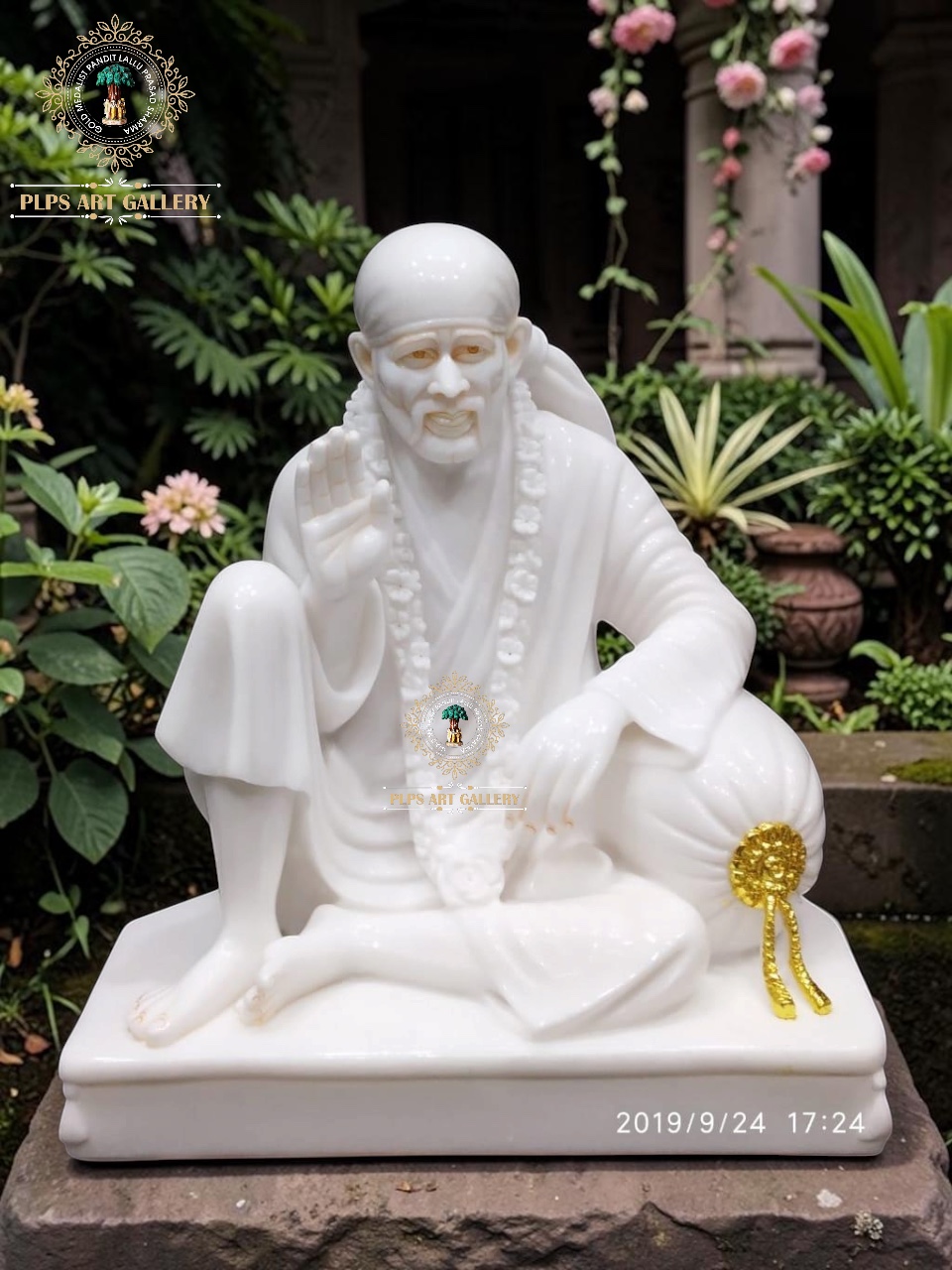
Made-to-Order Only
Our sai baba statue are crafted exclusively on commission. Share your size, marble type and iconography — our fourth-generation artisans will begin your piece at our Chandpole Bazaar workshop, Jaipur.
Start a Commission