
Santoshi Mata
Santoshi Maa is the goddess of santosh — contentment, satisfaction and the quiet fulfilment of a family's honest wishes. In popular Hindu tradition she is honoured as the daughter of Lord Ganesha, said to have taken form on Raksha Bandhan when Ganesha's sons Shubh and Labh asked him for a sister; her worship, though rooted in older folk streams, was carried into millions of Indian homes by the 1975 film Jai Santoshi Maa and became one of the most powerful women-led devotional movements of modern India. She is above all a household Devi, worshipped on Fridays by wives and mothers who take the Solah Shukravar Vrat — 16 consecutive Fridays of fasting and prayer for peace, harmony and the granting of a heartfelt wish. At PLPS Art Gallery, four generations of Jaipur artisans since 1950 have carved Santoshi Maa's benevolent form with the delicate attention her contentment-radiating character demands — a softly smiling maternal face, fine-featured jewellery, a raised kalash brimming with gud-chana prasad, and the sword and trishul held gently rather than fiercely. Founded by Late Pandit Lallu Prasad Sharma, Shilp Guru and Presidential Awardee (1991), our workshop favours Makrana marble for its classical white purity that carries the traditional red saree pigment without shadow, and applies Swarna Karya gold-leaf to the kalash rim, mukut and haar. Classical Santoshi Maa iconography seats her in Padmasana on a fully-opened lotus, four-armed: two upper hands hold khadag (sword) and trishul as symbolic protection of the household, while the lower two carry a kalash of prasad and a bowl of gud-chana in the varada abhaya gesture of granting wishes. Her face is deliberately benevolent — never fierce — crowned with an ornate mukut and framed by long open hair or a traditional Rajasthani chunari. Vastu convention places her in the North-East corner (Ishaan Kon) of the home mandir facing East, with the devotee also facing East during Friday puja; households running the Shukravar Vrat maintain a dedicated Santoshi altar with a jal-kalash and gud-chana bowl kept beside her through the 16 weeks. Our Santoshi Maa murtis range from 6-inch personal shrine pieces to 4-foot temple installations, with 12 to 20 inch sizes most popular for household mandirs. Every element accepts customisation: the traditional red saree can be painted in mineral pigments from deep sindoori to bright kumkum, the kalash and jewellery can receive full Swarna Karya gold-leaf, and the lotus base can be widened or tiered for a dedicated Vrat altar. For newly-married women beginning their first Solah Shukravar, families completing an Udyapan ceremony, or households seeking Santoshi Maa's presence for a specific wish fulfilment, contact PLPS Art Gallery at Chandpole Bazaar, Jaipur. Custom orders take 30 to 90 days with worldwide insured shipping.

Frequently Asked Questions
Santoshi Maa is the Hindu goddess of contentment, satisfaction and wish-fulfilment — santosh meaning inner contentment. In popular Hindu tradition she is honoured as the daughter of Lord Ganesha; the widely-told story places her origin on Raksha Bandhan, when Ganesha's two sons Shubh and Labh asked their father for a sister to tie rakhi. Ganesha is said to have manifested her from divine flame or from his own spiritual essence, making her his adopted daughter. Though her worship draws on older folk devotional streams, the 1975 film Jai Santoshi Maa carried her cult into millions of Indian households and established the modern iconography we carve today.
Friday (Shukravar) is Santoshi Maa's day because Shukra, the ruling planet, governs harmony, marital peace and household prosperity — the exact domains she blesses. On Fridays devotees bathe the murti, offer red flowers, light a ghee deepak and present gud-chana prasad. Vastu convention places the marble murti in the North-East corner (Ishaan Kon) of the home mandir on an elevated wooden chowki draped with red or yellow cloth, facing East so the devotee also faces East during puja. Households running the Solah Shukravar Vrat keep a dedicated Santoshi altar undisturbed for the full 16 weeks.
The Solah Shukravar Vrat is 16 consecutive Fridays of fasting and prayer at Santoshi Maa's altar for the granting of a specific wish. On each Friday the murti is bathed, dressed and offered gud-chana (jaggery + roasted gram) prasad, and the Santoshi Mata Vrat Katha is read aloud. The single most important rule is that no sour food or khatai — no tamarind, lemon, curd, pickles or citrus — is eaten by the vrati or served anywhere in the puja space; sourness is believed to disturb Santoshi Maa. The vrat concludes with Udyapan on the 16th Friday, when eight young boys are fed a full sweet meal at the murti's feet.
Makrana marble is the traditional heritage choice — its dense classical white carries the red-saree mineral pigment without shadow and is the same stone used for centuries in Rajasthani mandirs. Vietnam White gives a softer bright modern finish, and black Bhainslana suits families who prefer a dramatic dark-toned murti. Over this base, our artisans hand-paint the saree in mineral pigments Santoshi devotees traditionally prescribe: deep sindoori red for classical iconography or brighter kumkum for a more vivid altar reading. The saree border and pallu are edged in Swarna Karya gold-leaf, and the kalash rim, mukut and haar receive full gold-leaf application. All pigments are sealed with a natural fixative and remain reversible for shringar refresh.
Buyers often confuse the four goddesses because all four wear red and appear benevolent, but the iconographic markers are distinct. Lakshmi is seated on a lotus with two elephants beside her, holding lotuses and pouring gold coins from her palm — her domain is wealth. Durga is fierce, multi-armed and mounted on a lion or tiger with weapons drawn against Mahishasura — her domain is protection. Parvati is depicted with Shiva and Ganesha in family compositions — her domain is Shakti and motherhood. Santoshi Maa is uniquely identified by her softly smiling contentment-radiating face, her four arms holding sword and trishul above with kalash and gud-chana bowl below, and her seated lotus posture — her domain is santosh, the granting of heartfelt household wishes.
Dust the murti daily with a soft dry cloth, paying attention to the recesses of the kalash rim, mukut prongs and finger jewellery where dust settles fastest. Never use a damp cloth on the painted saree, hair or gold-leafed surfaces — moisture lifts mineral pigment and dulls gold-leaf; wipe only the exposed marble face and hands with a barely-damp cloth using plain water. Avoid all acidic, alcohol-based or citrus cleaners, which is especially fitting since Santoshi puja itself forbids sour substances. Custom orders take 30 to 90 days from Shila Pariksha stone selection through Rekhankan sacred marking, main carving, Chikni polishing, saree pigment and Swarna Karya gold-leaf finishing; families starting a Solah Shukravar Vrat should order at least 4 months in advance.
Looking for a custom Santoshi Mata?
Every piece is hand-carved to order in our Chandpole Bazaar workshop, Jaipur. Share your size, marble type and iconography — our 4th-generation artisans will craft it for you.
Request a Quote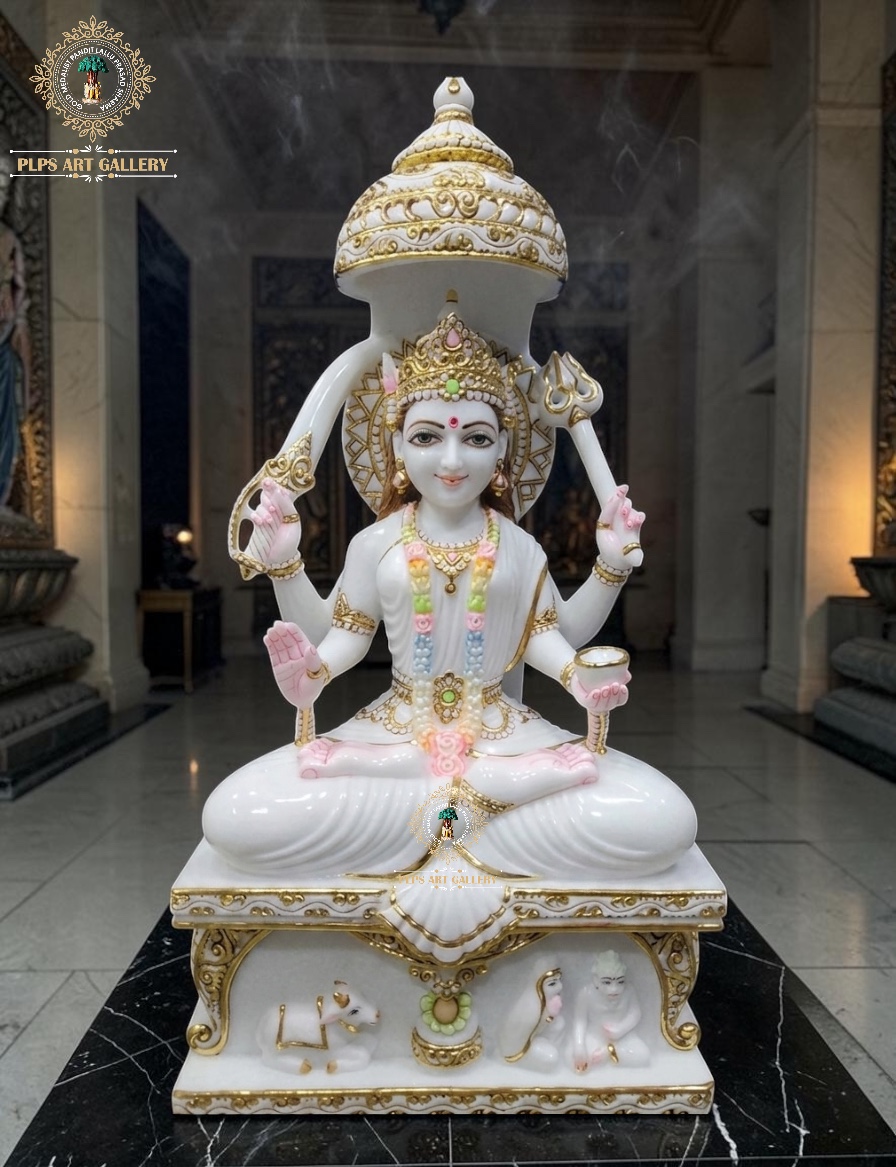
Made-to-Order Only
Our santoshi mata are crafted exclusively on commission. Share your size, marble type and iconography — our fourth-generation artisans will begin your piece at our Chandpole Bazaar workshop, Jaipur.
Start a Commission