
Shiv Pariwar
The Shiv Pariwar is the complete divine family — Bhagwan Shiva at the centre, Devi Parvati beside him, Ganesha and Kartikeya as their sons, and Nandi resting at Shiva's feet. Where a single-deity murti enshrines one aspect of the divine, the Pariwar composition invites the entire household of Shiva into the home mandir. For joint families, ancestral homes and Shaivite buyers who worship all five together, the full Pariwar becomes a living emblem of family unity that no isolated idol can match.
Composing five figures within a single unified block is the pinnacle challenge of multi-figure carving at our workshop — a step beyond even the Ram Darbar's four-figure grouping. Every proportion must convey hierarchy without imbalance: Shiva slightly taller, Parvati at complementary height, the two children scaled to childhood, and Nandi carved as a seated bull without dwarfing the human forms. Four generations of PLPS Shilpis, beginning with Late Pandit Lallu Prasad Sharma — Shilp Guru awardee and 1991 Presidential Award recipient — have refined this spatial choreography over decades in Chandpole Bazaar, Jaipur.
Traditional shilpa shastra places Shiva at the visual centre with jata, trishul, damru and Ganga in his locks. Parvati sits or stands on his left — the female side — draped in saree with a matching mudra. Ganesha holds his modak and ankusha on Shiva's right; Kartikeya carries his spear on Parvati's side, often shown with his peacock. Nandi rests at Shiva's feet, bell around the neck, gazing upward at his master. Vastu places the composition in the North-East of the home mandir, facing East, so the family faces West during aarti.
We carve the Pariwar from 12 inches for compact prayer alcoves up to six feet for temple installations, with 18-inch to 30-inch pieces most requested for full-family home mandirs. Choose Makrana Sangemarmar for the classic milky white finish, Vietnam White for a brighter tone, or Bhainslana black for a dramatic contrast piece. Optional Swarna Karya gold leaf on jewellery, weapons and Nandi's bell, mineral-pigment eye and saree work, and a custom Kailash-mountain base with carved rocks and pine motifs are all available on request.
Full Pariwar commissions take 60 to 90 days given the multi-figure complexity — Maha Shivratri and Sawan buyers should order by early autumn. Speak with our Chandpole Bazaar workshop for sketch approvals, marble grade selection and worldwide shipping.

Frequently Asked Questions
A Gaurishankar depicts only the divine couple — Shiva and Parvati together in ardhanareshwar or seated form — a two-figure composition suited to devotees who worship the union of Shiva-Shakti energies alone. The Shiv Pariwar expands the composition to five figures: Shiva, Parvati, Ganesha, Kartikeya and Nandi carved as one unified family scene. Families choose the Pariwar when they want the entire household of Shiva installed together, particularly in joint-family homes where multiple generations offer prayers side by side and expect every family deity to be present in the mandir. Gaurishankar suits couples' bedrooms and personal shrines; Shiv Pariwar belongs in the central home mandir.
Both are multi-figure family compositions but the theology and layout differ. The Ram Darbar shows Ram, Sita, Lakshman and Hanuman — four figures centred on royal authority and ideal kingship. The Shiv Pariwar shows the five-member Shiva household — divine parents, both sons and the sacred vehicle — centred on family unity and Shaivite worship. Choose the Ram Darbar if your household is Vaishnav or Ram-bhakt, and the Shiv Pariwar if you follow Shaivite tradition, celebrate Maha Shivratri as your primary festival, or already worship Ganesha and Kartikeya at home. Both are equally intensive commissions and command similar respect on the shelf.
Shilpa shastra places Shiva at the visual centre with Parvati on his left — the female side — in every canonical version. Ganesha, as the remover of obstacles, is placed on Shiva's right; Kartikeya stands on Parvati's side, often accompanied by his peacock. Nandi is carved at Shiva's feet, never detached from the base, and always faces the same direction as Shiva. Proportional hierarchy matters: Shiva tallest, Parvati slightly shorter, the two children clearly scaled as boys, and Nandi seated so his back reaches Shiva's calf. We follow these rules for every commission unless a buyer requests a documented regional variation.
For a standard apartment mandir cabinet, an 18-inch to 24-inch Pariwar keeps every figure legible without overcrowding the shelf — Shiva ends up roughly 15 to 18 inches with Nandi at 8 inches. For a dedicated puja room or built-in mandir alcove, 30 inches is ideal and lets devotees stand back during aarti. Independent bungalows with a full pooja hall or a stone shrine can go to 36 to 48 inches, and outdoor courtyard installations up to six feet. Below 12 inches we discourage the five-figure Pariwar entirely — the two children and Nandi lose expressive detail at that scale and the composition begins to look crowded.
Custom Shiv Pariwar commissions take 60 to 90 days from sketch approval to dispatch — longer than a single-deity idol because five figures must each pass Shila Pariksha, Rekhankan and Chikni before the composition is unified and polished. Maha Shivratri typically falls in late February or early March; to install by then, place your order by early December at the latest. For a Sawan-month installation in July, commission by April. Add two to four weeks for domestic shipping and up to six weeks for international dispatch depending on destination country and customs clearance. Rush orders under 60 days rarely finish without compromising detail.
Five-figure compositions have far more crevices — trishul prongs, Ganesha's tusk, Kartikeya's spear, Nandi's bell and horns, jewellery on Parvati, jata locks on Shiva — where dust accumulates faster than on a single-deity murti. Dust weekly with a soft dry cotton or microfibre cloth, and once a month use a natural-bristle brush to reach the recesses between figures. Never apply detergents, vinegar, lemon, alcohol or chemical polishes — all etch marble permanently. For Swarna Karya gold-leaf or mineral-pigment work, dry-dust only and never touch with water. If a hairline dulling appears, contact PLPS for professional re-polishing rather than home remedies.
Looking for a custom Shiv Pariwar?
Every piece is hand-carved to order in our Chandpole Bazaar workshop, Jaipur. Share your size, marble type and iconography — our 4th-generation artisans will craft it for you.
Request a Quote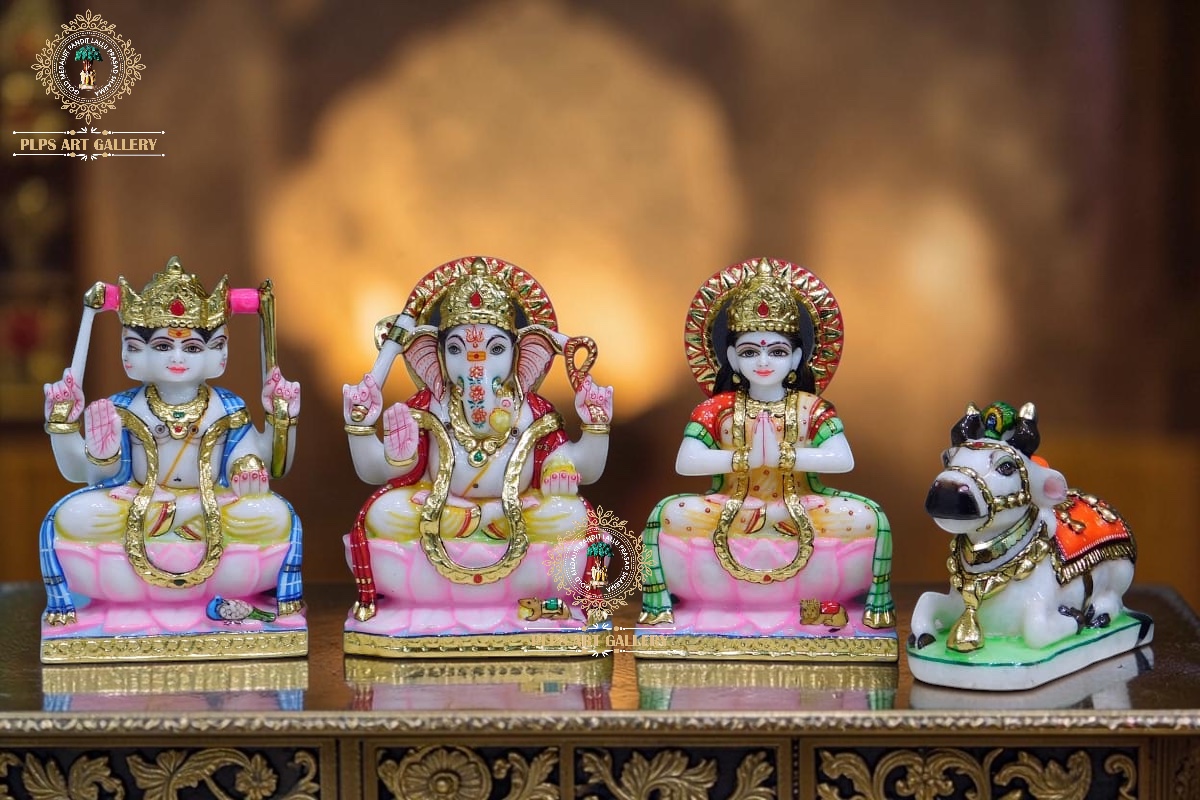
Made-to-Order Only
Our shiv pariwar are crafted exclusively on commission. Share your size, marble type and iconography — our fourth-generation artisans will begin your piece at our Chandpole Bazaar workshop, Jaipur.
Start a Commission