
Shiv Pariwar ( Gaurishankar)
Gaurishankar is Shiv and Shakti as an inseparable pair — Mahadev and Devi Parvati (Gauri) rendered not as a whole family but as the divine couple whose union is the source of creation itself. Where the broader Shiv Pariwar composition includes Ganesha and Kartikeya, Gaurishankar concentrates the entire narrative on marriage — the archetype of ideal partnership in Hindu tradition. White marble, cool and luminous, is the natural medium for a composition where masculine and feminine grace must read at once from every angle.
At our Chandpole Bazaar workshop a Gaurishankar is one of the most delicate two-figure commissions we undertake. Shiva's rugged yogi frame — jata, tiger-skin drape, angular shoulders — and Parvati's softer, jewel-adorned femininity must be carved in harmonious proportion, either from a single Makrana block or twin blocks matched at Shila Pariksha for grain and tone. Rekhankan fixes the pair's relative heights, gaze and body-line before the first chisel-stroke; Chikni polish then brings the male-female textural distinction to life. Four generations of PLPS Shilpis have refined this couple-composition since 1950.
Classic Gaurishankar seats Shiva to the devotee's right and Parvati on the left, hands raised in blessing or resting on the other's knee; the Ardha-embrace variant shows Parvati leaning into Shiva's shoulder in the Kalyanasundara wedding form. Shiva carries the trishul, damaru, a crescent moon at his jata and often a serpent at his neck; Parvati wears a red or amber saree, a mangalsutra, kundal earrings and a small bindi. Vastu places the murti in the North-East of the home mandir, on an elevated chowki, facing East — never inside the bedroom or facing South.
Gaurishankar ranges from 8-inch table pieces suitable as wedding gifts to 5-foot temple installations; 12 to 24 inches is the popular bracket for a couple's home mandir. Custom detailing is fully negotiable — Swarna Karya gold leaf on the crescent moon, trishul tips, Parvati's mangalsutra and jewellery; mineral pigments give the saree its wedding red, amber or subtle dawn peach. Pose customisations include seated together, standing side by side, the Kailash-throne composition, or a walking Kalyanasundara wedding-procession variant. Bhainslana black marble is offered for couples who prefer dramatic contrast over pure white.
For newlyweds, married-couple gifts and wedding blessings, speak with the PLPS team to commission a Gaurishankar in Makrana, Vietnam White or Bhainslana marble — a piece built to be a marriage-long heirloom.

Frequently Asked Questions
Gaurishankar and Shiv Pariwar are often confused on peer sites but they are two distinct compositions. Gaurishankar (Gauri + Shankar) is specifically the divine couple — Shiva and Parvati alone, rendered as an inseparable pair to symbolise the union of Purusha and Prakriti, the cosmic masculine and feminine. Shiv Pariwar is the whole family: Shiva, Parvati and their sons Ganesha and Kartikeya, sometimes with Nandi at the base. Choose Gaurishankar when the emphasis is marriage, partnership or Shiv-Shakti union — it suits newlyweds and couples. Choose Shiv Pariwar when the emphasis is family unity, children and household prosperity.
Gaurishankar is the archetypal wedding-blessing gift in Hindu tradition because the composition depicts Shiva and Parvati as ideal husband and wife — the Kalyanasundara form is even named after their marriage on Mount Kailash. Gifting a Gaurishankar to a newly-married couple signals the wish for the same devotion, mutual respect and lifelong companionship the divine pair embody. Popular gift sizes are 8 to 15 inches — small enough for a bedroom or living-room mandir shelf, substantial enough to feel like an heirloom. Wedding anniversaries and Griha Pravesh (housewarming) are the other traditional occasions for gifting a Gaurishankar.
By the iconographic convention our Shilpis follow, Shiva sits on the devotee's right and Parvati on the left when the murti is viewed head-on — meaning from the deities' own perspective, Parvati is on Shiva's vamanga, the left side of the body reserved for the wife in Hindu tradition. This is the same left-side principle that gives rise to the Ardhanarishvara depiction, where the goddess occupies Shiva's left half. The Ardha-embrace and Kalyanasundara wedding variants retain the identical convention, with Parvati leaning gently towards Shiva's shoulder. Confirm the orientation at commissioning if your home mandir has a specific facing constraint.
For Gaurishankar we recommend Makrana white as first choice — the same dense, cool-white stone used in the Taj Mahal. Its close grain holds fine features like Parvati's jewellery, Shiva's damaru strap and the delicate crescent moon without micro-fracture. Vietnam White is a softer alternative at a lower price point, well-suited to larger 24-inch and above pieces where cost per volume matters. Bhainslana black marble is our third option, chosen by couples who want dramatic contrast over pure white — its honey tone suits South-facing living rooms and pairs beautifully with gold-leaf jewellery accents. All three stones are Shila Pariksha-verified before carving begins.
Beyond the classic seated pair, our Shilpis carve four popular Gaurishankar pose variants. Standing side-by-side is a formal darshan pose with both figures facing forward in blessing mudra. The Kailash-throne composition seats the couple on a shared throne with Mount Kailash suggested behind them. The Ardha-embrace or Kalyanasundara wedding form shows Parvati leaning into Shiva's shoulder, hands entwined — this is the most-requested wedding-gift pose. A walking Kalyanasundara variant depicts the wedding procession, useful for a wide mandir where a horizontal composition suits the shelf. Nandi at the base and a fuller crescent moon behind Shiva can be added to any pose.
Fragile zones on a Gaurishankar are Shiva's trishul tips, damaru cords, crescent moon and serpent coil, and on Parvati her ear-kundals, mangalsutra links and the fine relief of her saree pallu. Dust weekly with a soft dry natural-hair brush — a small shaving brush reaches recesses between the two figures where a cloth cannot go. Wipe smooth surfaces with barely damp muslin then dry immediately; never use vinegar or lemon as they etch marble permanently. On lead times, standard Gaurishankar takes 30 to 60 days and elaborate custom commissions 75 to 90 days — order wedding gifts at least three months before the ceremony to allow for shipping.
Looking for a custom Shiv Pariwar ( Gaurishankar)?
Every piece is hand-carved to order in our Chandpole Bazaar workshop, Jaipur. Share your size, marble type and iconography — our 4th-generation artisans will craft it for you.
Request a Quote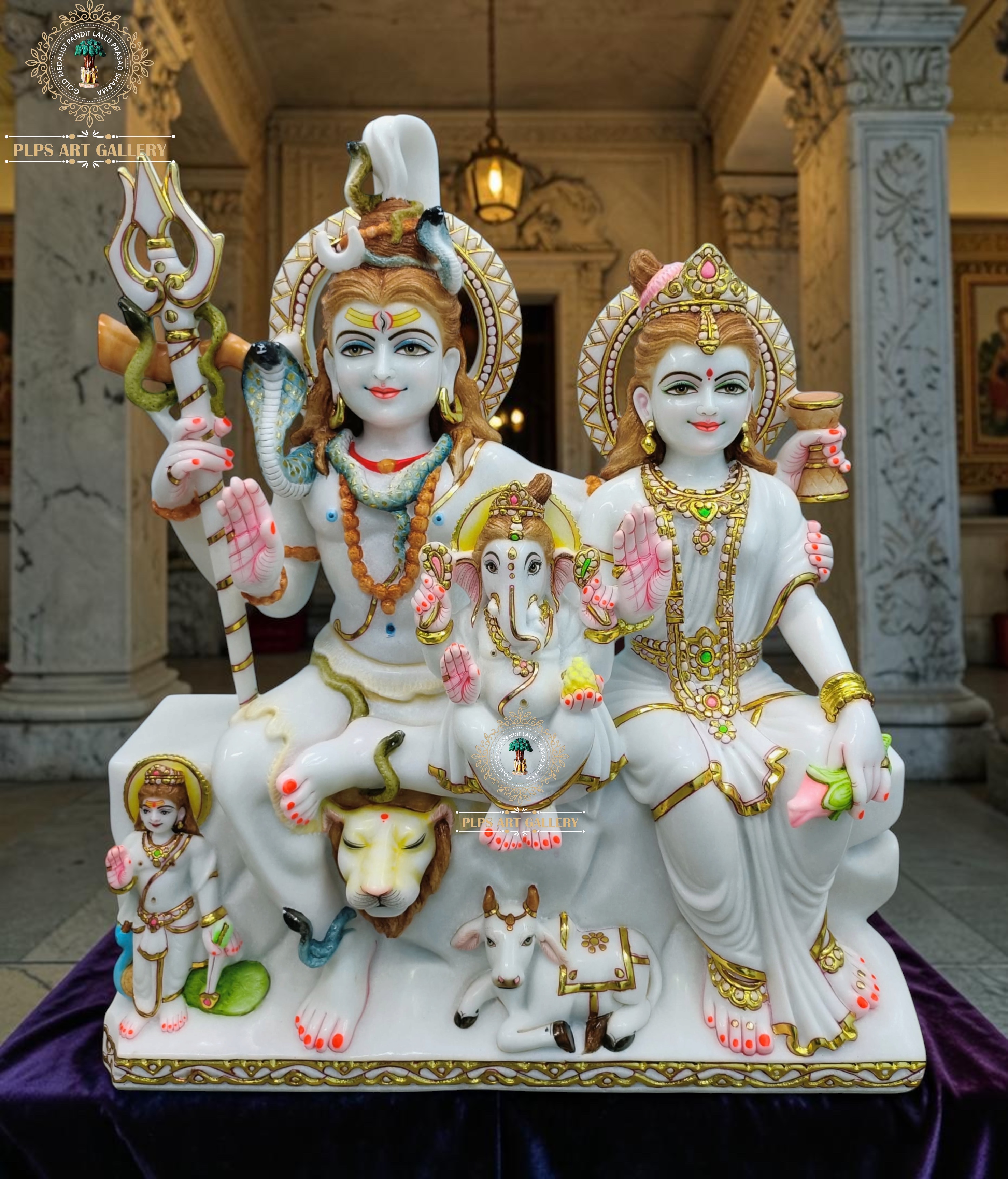
Made-to-Order Only
Our shiv pariwar ( gaurishankar) are crafted exclusively on commission. Share your size, marble type and iconography — our fourth-generation artisans will begin your piece at our Chandpole Bazaar workshop, Jaipur.
Start a Commission