
Shiva Nataraja
Shiva as Nataraja is the deity in his most philosophically charged form — the cosmic dancer whose Ananda Tandava sustains the ceaseless rhythm of srishti (creation), sthiti (preservation) and samhara (dissolution). The dance is not a metaphor. In Shaiva cosmology it is the mechanism by which the universe keeps existing at all, and the ring of fire (prabhamandala) that encircles him is the visible edge of that manifest cosmos. What makes a marble Nataraja an unusual object is that this form belongs, iconographically, to South India's Chola bronze tradition — perfected in the 10th to 13th centuries around the great Chidambaram temple, cast by the lost-wax method that lets molten metal hold an outstretched arm and a raised foot in a single pour. Marble Nataraja is a cross-tradition offering: the Tamil cosmic dance translated into the Jaipur ateliers of Rajasthan.
That translation is, technically, the hardest carving PLPS undertakes. Every other seated or standing deity is a compression of mass; the Nataraja is its opposite — motion held in stone. Our Shilpis begin with Shila Pariksha on a larger, longer block than any comparable statue requires, because the sculpture's real footprint is the prabhamandala, not the figure. Rekhankan proportions are taken from the Chidambaram tradition. The ring of fire is not a surrounding halo added on — it is carved as continuous undercut, hollowed away from the block behind the dancer so light passes through it. The matted jatas flying outward from the head are cantilevered from a single point at the crown. The raised left leg, the extended lower left arm making the gaja-hasta gesture, and the outstretched upper arms holding damaru and agni all defy gravity in a medium that has no tensile strength. Four generations of PLPS Shilpis, working in the workshop founded by the late Shilp Guru Pandit Lallu Prasad Sharma (Presidential Award, 1991), have refined the sequence of cuts that make it possible in marble at all.
Iconographic fidelity is the second axis of quality. A correctly carved Nataraja carries the damaru in the upper right hand (the first sound of creation), agni in the upper left (the fire of dissolution), the abhaya mudra in the lower right (fearlessness), and the gaja-hasta in the lower left pointing to the raised foot (the promise of liberation). The right foot presses down on Apasmara, the dwarf of ignorance; the left foot rises in the step of grace. The jatas hold Ganga, the crescent moon and a coiled serpent. For Vastu, Nataraja is best placed facing East or South-East, in meditation rooms, yoga studios, dance and music practice spaces or a dedicated puja area — never as the family living-room centrepiece, and never at floor level. The ring of fire needs visual breathing space; wall-mounting or crowding it into a niche kills the dance.
We carve Nataraja from 8-inch tabletop meditative pieces through 5-foot statement installations. The 12-inch to 20-inch range suits home altars and personal meditation spaces; 24 to 36 inches reads powerfully in yoga studios and classical-dance schools; anything above 4 feet becomes a temple- or institution-scale commission. Makrana marble gives the pure serene white of the Chidambaram bronze in negative; Vietnam White carves the finer facial and jata detail crisply on smaller pieces; Bhainslana lends a deep black tonality that offers a striking non-bronze contrast. Optional Swarna Karya (gold leaf) can be applied to the prabhamandala, damaru, agni and crescent moon; mineral pigment picks out the Apasmara dwarf and the coiled serpent. A sculpted double-lotus (padma-pitha) base is standard, and custom pedestals — inscribed with your mantra, dance-school insignia or dedicatee's name — are commissioned frequently.
A custom marble Nataraja takes 45 to 90 days depending on scale and detailing; larger pieces with a full carved prabhamandala require the longer window. If the statue is intended for a yoga studio opening, a dance-school anniversary or a personal sadhaka's shrine, begin the conversation early. Speak with our team at Chandpole Bazaar, Jaipur to commission your Nataraja.

Frequently Asked Questions
Nataraja is Lord Shiva in his form as the cosmic dancer — the deity whose dance keeps the universe in existence. The specific dance shown in the standard iconography is the Ananda Tandava, the dance of bliss, which enacts the five cosmic acts: srishti (creation), sthiti (preservation), samhara (dissolution), tirobhava (concealment) and anugraha (grace). Every element of the sculpture carries this meaning — the damaru drum sounds creation, the flame of agni dissolves it, the abhaya mudra reassures, the gaja-hasta gesture promises liberation, and the ring of fire is the boundary of the manifest cosmos itself. The image is a diagram of reality in the shape of a dance.
You are correct that Nataraja belongs, historically, to South India's Chola bronze tradition — the great 10th to 13th century workshops around the Chidambaram temple perfected the lost-wax casting method precisely because molten metal can be poured into a single mould that captures an outstretched arm, a raised leg and a flying ring of fire in one piece. Marble has no tensile strength, so it cannot support cantilevered forms the way bronze can. This is why almost every Nataraja on the market is metal. A marble Nataraja is a cross-tradition offering — the Tamil cosmic dance translated into Rajasthani marble by Shilpis willing to solve the structural problem cut by cut. PLPS is one of very few workshops that carves it seriously.
For a personal home meditation room or altar, a 12-inch to 20-inch Nataraja on a raised chowki reads intimately without dominating the space — the eye can travel around the ring of fire and rest on the deity's face at seated eye level. For a yoga studio, dance school or dedicated sadhana hall, 24 to 36 inches is the working range: large enough to anchor the room from across a mat, small enough to remain a presence rather than a monument. Above 48 inches, a Nataraja becomes an installation-scale commission — appropriate for institutional foyers, ashram halls or temple settings, and best specified with our team from the outset.
Every PLPS Nataraja follows the standard iconography codified in the Chola-Chidambaram bronzes and the Shaiva Agamas. The upper right hand holds the damaru, the upper left carries agni in a bowl or on the palm, the lower right forms the abhaya mudra, and the lower left performs the gaja-hasta gesture pointing to the raised foot. The right foot presses down on Apasmara, the dwarf of ignorance; the left foot lifts in the dance step. The jatas fly outward from the crown and hold Ganga, the crescent moon and a small serpent, and the whole figure is set within the flaming prabhamandala on a double-lotus pedestal. Rekhankan proportions are drawn from established Chidambaram references before the first chisel touches the block.
The prabhamandala is the single hardest element of the sculpture and the reason most workshops do not attempt marble Nataraja at scale. It is not a surrounding halo added on top — it is carved as continuous undercut from the same block as the figure, which means the Shilpi must patiently hollow away all the marble behind the ring so that light passes through it and it reads as a free-standing arc rather than a background disc. The individual flame tongues along the ring are then chiselled from the outside in, working symmetrically top and bottom to keep the piece structurally balanced during the weeks of cutting. Any error along the undercut is unrecoverable — the block cannot be re-added.
Nataraja is best placed in a meditation room, yoga studio, dance or music practice space, or a dedicated puja area — a space where its symbolism of cosmic rhythm and inner stillness within outer motion is contextually alive. Vastu tradition places the murti facing East or South-East, elevated on a pedestal or chowki so the deity is at least at chest height, never on the floor. The ring of fire needs visual breathing space around it — do not push the statue flush against a wall or crowd it into a niche, and avoid the bedroom, kitchen and walls shared with bathrooms. A clear surface, indirect natural light and a plain backdrop let the Tandava breathe.
The most fragile zones on a marble Nataraja are the cantilevered jatas flying from the crown, the undercuts of the prabhamandala, the outstretched arms holding damaru and agni, and the raised left leg. Dust these zones weekly with a soft, dry natural-hair brush (a clean shaving brush is ideal) — never a wet cloth on undercut areas, since trapped moisture darkens marble over time. The smooth body may be wiped with a barely damp muslin cloth and dried immediately. Avoid citrus, vinegar and every acidic cleaner — they permanently etch marble. If Swarna Karya (gold leaf) has been applied to the ring or attributes, dust only, never wipe. Handle the piece only by the pedestal, never by an arm or the ring. Every PLPS Nataraja ships with a care card and a custom crate designed around its cantilevers.
Looking for a custom Shiva Nataraja?
Every piece is hand-carved to order in our Chandpole Bazaar workshop, Jaipur. Share your size, marble type and iconography — our 4th-generation artisans will craft it for you.
Request a Quote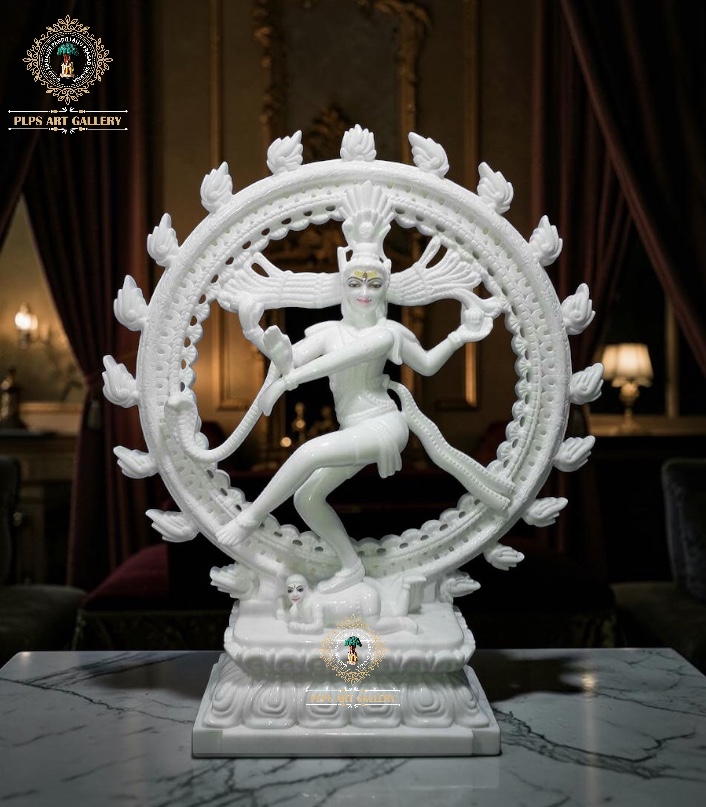
Made-to-Order Only
Our shiva nataraja are crafted exclusively on commission. Share your size, marble type and iconography — our fourth-generation artisans will begin your piece at our Chandpole Bazaar workshop, Jaipur.
Start a Commission