
Sindhi Saint Statue
Jhulelal — known also as Uderolal, Amarlal, Dariyalal and Zinda Pir — is the Ishtadev of the Sindhi community, revered as the earthly manifestation of Varuna, the Vedic lord of the waters. Sindhi tradition places his emergence in the tenth century at Nasarpur on the banks of the Indus, when the community's forty-day prayer at the river was answered with a child born to shield Sindhi Hindus from forced conversion under the ruler Mirkhshah of Thatta. That birth is celebrated each Cheti Chand — the Sindhi New Year on the first day of Chaitra (March-April) — and remembered again through Chaliho Sahib, the forty-day vigil observed from mid-July to late August. From Mumbai and Ulhasnagar to Ahmedabad, Pune, Dubai, Hong Kong, Singapore, London and California, wherever Sindhis have settled, Jhulelal's altar carries the community home.
Carving Jhulelal is a portrait discipline as much as a devotional one. The murti Sindhi families recognise — the serene sage in a Sindhi topi and flowing white robes, seated cross-legged on a lotus that rises from rippling water, mounted on the great palla fish, one hand resting on scripture and the other raised in benediction — is drawn from a long twentieth-century chromolithograph and Sindhi calendar-art tradition rather than from ancient shilpa-shastra texts. Four generations of Shilpis at PLPS, from the Presidential-award atelier of Late Pandit Lallu Prasad Sharma in Chandpole Bazaar, have quietly carried marble Jhulelal commissions for Sindhi families for decades. Makrana marble is our first recommendation — its dense, luminous grain holds the folds of the ajrak-bordered robe, the fine scales of the palla and the meditative expression the icon demands.
Every detail carries meaning. The palla (hilsa), sacred to the Indus, is Jhulelal's vahana; the lotus rising from moving water signals his identity as the Water Lord; the book denotes wisdom and dharma; the white robe and Sindhi topi anchor him unmistakably in Sindhi identity, while the softly benevolent face reads across generations. In the home mandir, place the murti in the North-East (Ishaan) corner or on a dedicated Jhulelal altar, facing East so the morning light meets the face. Elevate on a chowki, keep the shrine clean, and set a jyot — the Baharana Sahib lamp — alongside through Cheti Chand and the Chaliho.
PLPS carves Jhulelal from eight-inch personal murtis for shrine niches to five-foot commissions for jamat-khanas, panchayat halls and Sindhi community centres. Household sizes of twelve to twenty-four inches are the sweet spot; dedicated Jhulelal altars carry twenty-four to thirty-six inches. Customisation opens the piece to a family's own idiom — mineral-pigment tinting of the topi in traditional saffron, deep blue or ivory; Swarna Karya gold leaf on the book, belt and fish scales; a hand-carved lotus-and-water base; and Devanagari, Gurmukhi or Sindhi (Perso-Arabic) engraving on the plinth — most often "Jhulelal Ji Ki Jai", "Uderolal", the family surname, or the sacred Om.
Every Cheti Chand and every Chaliho Sahib, PLPS ships Jhulelal commissions to Sindhi families and panchayats in Mumbai, Ulhasnagar, Ahmedabad, Pune, Indore, Jaipur, Dubai, Hong Kong, Singapore, Kobe, London, New York and California. Commission a Jhulelal that carries the Indus into your household — with the craftsmanship, and the respect, the community deserves.

Frequently Asked Questions
Jhulelal — also called Uderolal, Amarlal, Dariyalal and Zinda Pir — is the Ishtadev of Sindhi Hindus, revered as an earthly manifestation of Varuna, the Vedic lord of the waters. Sindhi tradition holds that in the tenth century, facing forced conversion under Mirkhshah of Thatta, community elders undertook forty days of prayer on the banks of the Indus. Varuna appeared and promised deliverance through a child born at Nasarpur — Uderolal, later called Jhulelal for the cradle-song that rocked him. His life became the community's shield, and his image the single most cohesive marker of Sindhi identity across the diaspora.
Cheti Chand — the first day of Chaitra (March or April) — is the Sindhi New Year and the day observed as Jhulelal's birth. Families and panchayats carry the Baharana Sahib — a copper pot with water, a lit jyot, sugar-crystals and a small Jhulelal image — in procession to a river or the sea. Chaliho Sahib is the forty-day vigil from mid-July to late August, remembering the ancestral prayer that preceded Varuna's appearance. Through both, the marble Jhulelal sits at the centre of the home altar, jyot kept lit and Sindhi bhajans sung in Chej gatherings around it.
Sindhi worship of Jhulelal is quiet, family-centred and river-linked. A lit jyot before the murti and an offering of water are the daily minimum, opened with the greeting "Jhulelal Sain Ji Jai". On Cheti Chand and through the Chaliho, families gather for Chej — the Sindhi devotional dance — and sing bhajans such as "Aayo Lal Jhulelal" and "Lal Meri Pat Rakhiyo". Prasad is typically miso (sweet rice), thadal or a cooling sherbet — foods honouring the Water Lord. Many households also keep an image of the Baharana Sahib beside the murti as a reminder of the community's covenant.
The palla — the hilsa, celebrated along the Indus — is Jhulelal's vahana and the single most identifying element of his iconography. It marks him as lord of the river itself, and by extension of the community whose civilisation grew along the Indus. The lotus rising from moving water is a double sign: the Vedic marker of purity emerging above the material world, and, uniquely for Jhulelal, a reminder that his throne sits on water rather than land — he presides over what flows and sustains. Together, fish, lotus and ripples name him Dariyalal, the Water Lord.
Makrana marble is our first recommendation. Dense, fine-grained and warm-white, it holds the two most delicate passages a Jhulelal commission demands — the scales of the palla fish and the folds of the ajrak-bordered robe — at a fidelity coarser stones cannot support. Its Chikni polish deepens the meditative expression and photographs beautifully under a jyot. Vietnam White is a fine alternative for smaller sizes at accessible price points. Bhainslana, our deep-black marble, is chosen occasionally by families who want a dramatic, ashram-like tonality — especially in Sindhi households across Rajasthan and Gujarat where warm interior palettes dominate.
Yes — the plinth is our most requested customisation. PLPS engraves the base in Devanagari, Gurmukhi or Sindhi (Perso-Arabic) script — most commonly "Jhulelal Ji Ki Jai", "Uderolal", the family surname, or the sacred Om. For care, dust the topi, robe folds and fish scales weekly with a soft dry natural-hair brush; the fine undercuts trap moisture and must never be wiped damp, particularly where the topi carries mineral-pigment tinting. Wipe the smooth face and hands only with a barely damp muslin cloth, dried immediately. Keep the piece out of harsh sunlight, and avoid citrus and chemical cleaners entirely.
Looking for a custom Sindhi Saint Statue?
Every piece is hand-carved to order in our Chandpole Bazaar workshop, Jaipur. Share your size, marble type and iconography — our 4th-generation artisans will craft it for you.
Request a Quote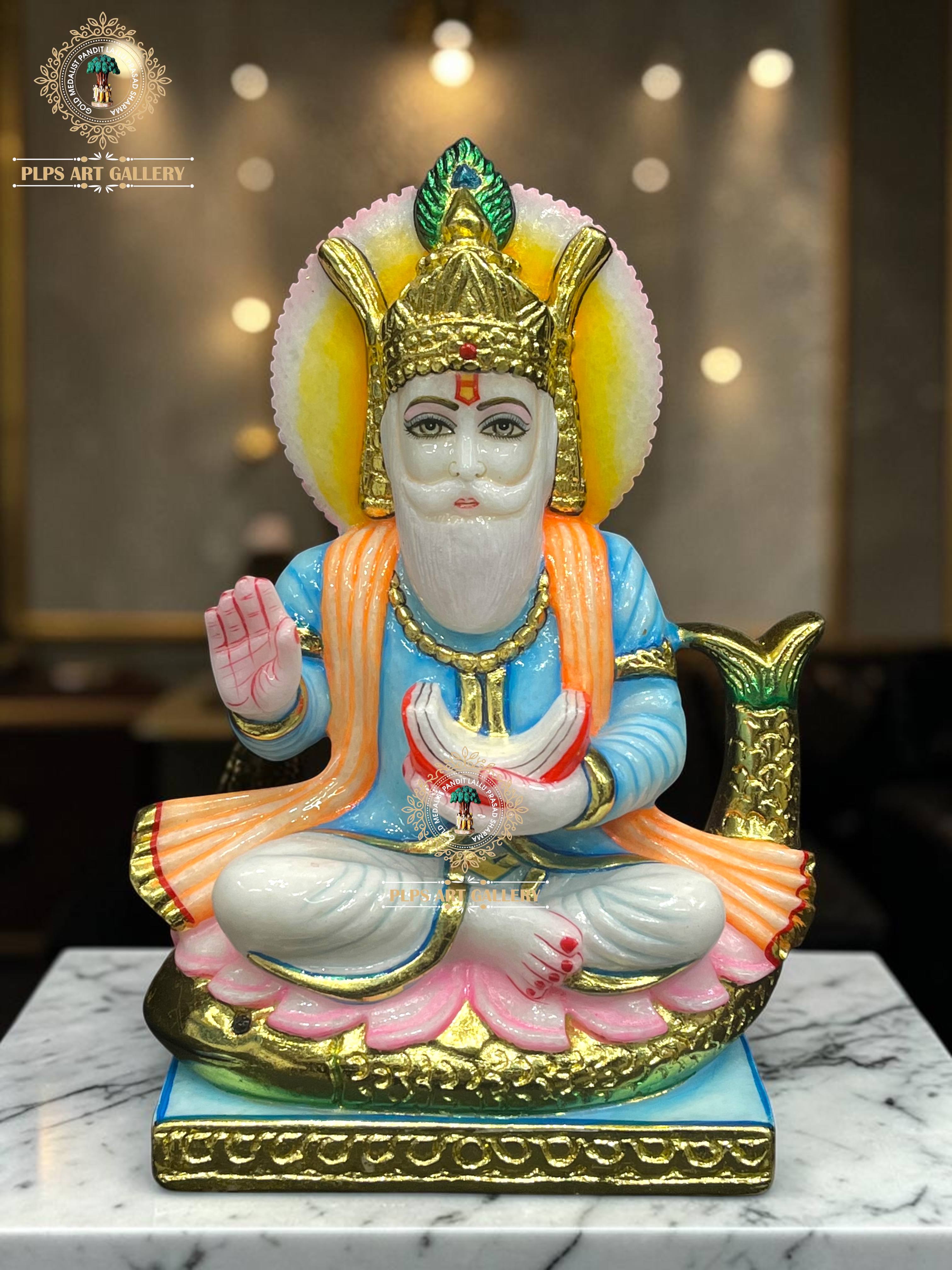
Made-to-Order Only
Our sindhi saint statue are crafted exclusively on commission. Share your size, marble type and iconography — our fourth-generation artisans will begin your piece at our Chandpole Bazaar workshop, Jaipur.
Start a Commission