
Swami Vivekananda statue
No modern Hindu monk is depicted in stone more often than Swami Vivekananda (1863-1902). Disciple of Sri Ramakrishna Paramahamsa, founder of the Ramakrishna Math and Mission at Belur, and the young sannyasi who opened his 11 September 1893 address at the World's Parliament of Religions in Chicago with the five words 'Sisters and Brothers of America' — drawing a two-minute ovation from seven thousand listeners — he is present in almost every school foyer, college quadrangle, Ramakrishna Math altar and Sangh institution in India. Since 1984, his 12 January birthday is observed nationwide as Rashtriya Yuva Diwas (National Youth Day), when every campus statue is garlanded afresh.
Carving Vivekananda is portrait discipline, not scriptural idealisation. A credible likeness must derive from the documented photographic record — chiefly the Chicago 1893 portraits that fixed his image in the modern imagination. The resolute arms-folded stance, the ochre-saffron bhagwa robe falling in heavy folds, the rounded turban wound high on the head, the broad forehead and deep-set eyes — each has a photographic anchor. Makrana marble, dense and fine-grained, is our first recommendation: it holds the fine undercutting the robe folds demand and takes a Chikni polish that lifts the resolute expression. Four generations of PLPS Shilpis in Chandpole Bazaar have refined the portrait-carving skills this work needs.
Two canonical forms dominate. The standing arms-crossed Chicago 1893 pose — chin lifted, gaze forward — is the institutional choice: schools, colleges, sports academies and public foyers where a declarative presence is intended. The seated meditative form in padmasana, eyes half-closed, hands folded, suits home altars, Ramakrishna Math meditation halls and Vivekananda Kendra centres. Placement favours an East-facing orientation on a clean chowki at or slightly above eye level; institutional statues sit on a raised marble or granite pedestal. One telling detail: the distinctive rounded turban Vivekananda adopted came from his parivrajaka years across Rajputana — carved by us in the region where he first wore it.
Sizes run from a 12-inch desk portrait to 8-foot institutional commissions. School and college installations cluster at 36 to 72 inches; home altars at 15 to 24 inches; Ramakrishna Math branches at 4 to 6 feet. Customisation includes kesari mineral pigment on the bhagwa robe in the authentic saffron tonal range, Swarna Karya gold leaf along the sash border, and custom base engraving of the four canonical quotations — 'Arise, awake, and stop not till the goal is reached', 'Sisters and Brothers of America', 'They alone live who live for others', 'You cannot believe in God until you believe in yourself' — in Devanagari or English. Full Vivekananda Rock Memorial reference variants, referencing Sitaram S. Arte's 1970 Kanyakumari bronze with rock base and wave motif, are quoted separately.
Every 12 January, PLPS ships Vivekananda commissions to schools, colleges, Sangh institutions, Vivekananda Kendra branches and Ramakrishna Math centres across India — and to the Ramakrishna-Vedanta Society network in the US, UK, Canada, Australia and Singapore. Commission a portrait that carries the young sannyasi's resolve into your institution — with the historical accuracy his legacy demands.

Frequently Asked Questions
The two canonical modern forms serve very different intents. The standing arms-crossed pose — chin lifted, gaze forward, ochre robe falling in heavy folds — comes from the 1893 Chicago Parliament of Religions photographs and reads as declarative, resolute, outward-facing. It is the pose chosen by almost every school, college, sports academy and public institution because it embodies the 'Arise, awake' spirit. The seated meditative form in padmasana, hands folded and eyes half-closed, derives from the Belur Math and Kanyakumari meditation photographs; it reads as contemplative and inward. Choose it for a home altar, a Ramakrishna Math meditation hall, or a Vivekananda Kendra centre. Institutional foyers almost always request the standing Chicago form.
For a school foyer, a college quadrangle or a sports academy entrance, 3 to 6 feet is the standard institutional size — large enough to be read across an open space and garlanded on National Youth Day without appearing tokenistic. For a college auditorium stage or a large campus foyer, commissions run 6 to 8 feet on a raised marble or granite pedestal. For a home altar or a personal study, 15 to 24 inches is the sweet spot; below 12 inches the facial expression and the folds of the bhagwa robe begin to lose fidelity, and we do not recommend miniatures for a portrait of this specificity. Ramakrishna Math branch altars typically commission 4 to 6 feet in the seated meditative form.
The Chicago 1893 photographs taken during the World's Parliament of Religions — arms folded at the chest, ochre-saffron bhagwa robe, rounded turban wound high on the head, resolute forward gaze — remain the primary visual record of Swami Vivekananda and the reference every credible sculpture must derive from. PLPS carves directly from those photographs, cross-referenced with the Belur Math archival images and the Sitaram S. Arte 1970 bronze at the Vivekananda Rock Memorial. Portrait sculpture is a different discipline from deity idealisation: there is no scriptural template, so the tilt of the head, the set of the jaw, the fold of the sash and the drape of the robe all have to be resolved from photograph to stone. Reference images are welcomed at commissioning.
Yes — on request, PLPS applies kesari mineral pigment to the bhagwa robe in the authentic saffron tonal range worn by the sannyasa order Vivekananda belonged to. The colour is not a modern acrylic paint but a traditional mineral tint bound with a light polish sealant, which is why it warms rather than glares under interior light and resists fading for decades if kept out of direct harsh sunlight. Some patrons — especially Ramakrishna Math branches and Vivekananda Kendra centres — prefer the plain Makrana white finish, which reads more classically monastic. Both are equally faithful to how Vivekananda is depicted across Belur Math and the Rock Memorial; the choice is a matter of institutional convention.
12 January — Swami Vivekananda's birthday and, since 1984, Rashtriya Yuva Diwas (National Youth Day) — is by far the peak commissioning window for schools, colleges, Sangh institutions, Vivekananda Kendra branches and Ramakrishna Math centres. A standard 3 to 5 foot institutional commission in Makrana, with kesari pigment on the robe and a canonical quote engraved on the base, requires ten to twelve weeks from confirmed order to delivery within India. Larger 6 to 8 foot pieces and full Vivekananda Rock Memorial reference variants need fourteen to sixteen weeks. International shipping to Vedanta Society branches adds three to four weeks. For a 12 January installation, confirm by late September.
The rounded turban folds and the heavy drape of the bhagwa robe are the two areas most vulnerable to careless cleaning. Dust them weekly with a soft dry natural-hair brush (a clean shaving brush works well); never wipe undercut folds with a damp cloth, as trapped moisture dulls the polish and fades kesari mineral pigment. Keep pigmented statues out of direct harsh sunlight. Custom base engraving is standard: the four canonical quotations — 'Arise, awake, and stop not till the goal is reached', 'Sisters and Brothers of America', 'They alone live who live for others', 'You cannot believe in God until you believe in yourself' — are offered in flowing Devanagari or English, with an institution or family name added below on request.
Looking for a custom Swami Vivekananda statue?
Every piece is hand-carved to order in our Chandpole Bazaar workshop, Jaipur. Share your size, marble type and iconography — our 4th-generation artisans will craft it for you.
Request a Quote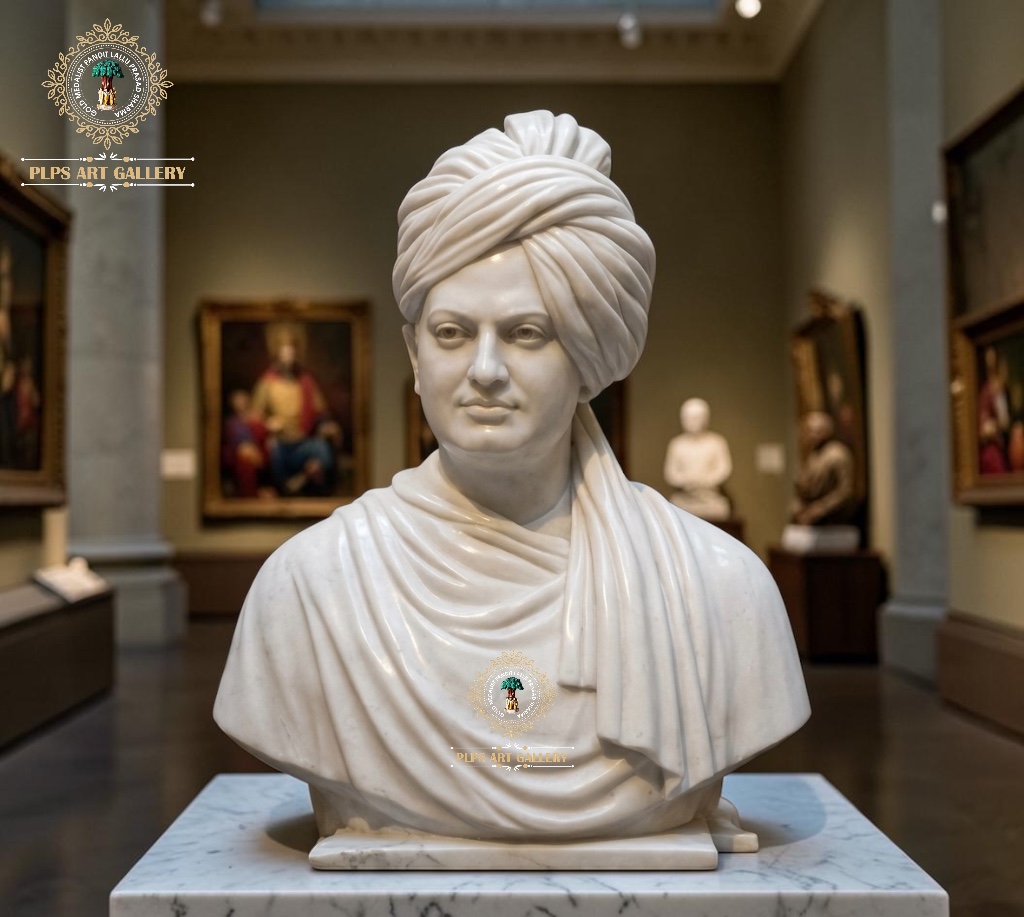
Made-to-Order Only
Our swami vivekananda statue are crafted exclusively on commission. Share your size, marble type and iconography — our fourth-generation artisans will begin your piece at our Chandpole Bazaar workshop, Jaipur.
Start a Commission