
Tulsi Gamla
In Hindu tradition, Tulsi is not a plant kept for its herbal virtues — she is the earthly form of Goddess Lakshmi, married ritually to Lord Vishnu each year at Tulsi Vivaah in the month of Kartik. Watering her at dawn, lighting a diya at her base at dusk, and circumambulating the pedestal three times is a rite that has anchored Hindu households for a thousand years. A marble Tulsi Gamla, or Tulsi Vrindavan, is the architectural vessel that makes this daily worship possible — a shrine and a planter in one object, engineered to live outdoors and to be passed down as an heirloom.
PLPS carves the Tulsi Gamla as a discipline distinct from statue work. The traditional silhouette is a square or octagonal pillar in Makrana marble, its four principal faces bearing hand-carved deity motifs — most commonly Krishna in his venu-gopal form, since Tulsi is considered Krishna's beloved. A shallow plant chamber crowns the pillar, with a hand-drilled drainage hole positioned to survive monsoon overflow, and a stepped base that lifts the shrine off the ground. Om, Shri Yantra, and Ganesh motifs are alternative choices, with Swarna Karya gold-leaf applied selectively to the sacred symbols. Makrana — the same quarry that supplied the Taj Mahal — is our default stone because its density and near-zero water absorption make it the only marble that endures decades of watering, sun, and monsoon without pitting or lichen.
Vastu Shastra is unusually specific about Tulsi placement. The plant belongs in the front courtyard or the North, North-East, or East quadrant of the home; it must never sit in the South. The pedestal should be elevated so worshippers do not bend to it, kept accessible for daily watering, and surrounded by clear space. Traditional heights range from 24 inches for balcony use to 48 inches for a courtyard centrepiece, with grand pieces reaching 5 to 6 feet for temple forecourts and haveli entrances.
We carve Tulsi Gamlas from 12 inches to 6 feet. Compact 18 to 24 inch versions with a self-contained saucer suit apartment balconies; 30 to 48 inch pillars are traditional for bungalow entrances and courtyard centres. Every piece is customisable — jaali pattern on the pillar shaft, choice of Krishna / Ganesh / Om deity face, gold-leaf accents, saucer inclusion for indoor use, and drainage aperture sized to the family's watering routine. Nothing is stock.
Families commissioning a piece for Tulsi Vivaah should place the order 6 to 8 weeks before Kartik. Apartment-balcony compact versions and courtyard heirloom pieces are both handled from our Chandpole workshop — share your placement dimensions and preferred deity motif and we will draft a proportioned design.

Frequently Asked Questions
Tulsi is regarded as the earthly incarnation of Goddess Lakshmi, married ritually to Lord Vishnu each year at Tulsi Vivaah in Kartik. Daily watering at dawn, a diya lit at her base at dusk, and three circumambulations of the pedestal are considered acts that invite prosperity, marital harmony, and protection into the home. The Tulsi Gamla is the architectural vessel that houses this living deity — it turns a plant pot into a shrine, elevates the sacred basil to eye level, and gives the family a dedicated point of daily worship distinct from the indoor mandir.
Vastu prescribes the North, North-East, or East quadrant of the home; the front courtyard is traditionally ideal, with placement in a bungalow entrance being the second-best option. Apartment dwellers should choose the North-East or East corner of the balcony. The pedestal must be elevated, accessible for daily watering, and never sit in the South or South-West. Avoid placing the Tulsi under a staircase, directly against a bathroom wall, or in an enclosed dark corner. Sunlight for at least four hours daily is essential for the plant itself — Vastu and horticulture agree on this.
For a 3x3 foot balcony corner, a compact 18 to 24 inch Tulsi Gamla with a self-contained saucer works best — it lifts the plant to hand-watering height, fits alongside a small chowki for the diya, and does not crowd the walking path. For bungalow entrances, a 30 to 36 inch pillar strikes the traditional silhouette. Courtyard centrepieces call for 40 to 48 inches so the piece anchors the open space visually, and haveli forecourts or temple installations can go to 5 to 6 feet. Always leave 18 inches of clear circumambulation space on all sides.
Makrana is the only sensible choice for a piece that lives outdoors year-round. It is roughly 98% calcium carbonate, extremely low water absorption, and the same stone used in the Taj Mahal — it endures decades of daily watering, direct sun, and monsoon overflow without pitting, yellowing, or lichen growth. Vietnam White, though beautiful, is softer and more porous; in humid climates it develops surface staining within a few years of outdoor exposure. For indoor Tulsi Gamlas placed in a covered puja area, Vietnam White is acceptable, but every outdoor commission from our workshop is carved from Makrana by default.
Tulsi Vivaah falls on Kartik Shukla Ekadashi, typically in early to mid November. A custom-carved marble Tulsi Gamla takes 30 to 60 days of workshop time depending on scale, jaali density, and gold-leaf work, plus 7 to 14 days for insured domestic shipping and 3 to 5 weeks for international freight. Families commissioning a piece for Tulsi Vivaah should place the order 6 to 8 weeks in advance for domestic delivery, and at least 10 weeks in advance for international. Rush orders on smaller balcony pieces can sometimes be accommodated — enquire directly with our Chandpole workshop.
Rinse the pillar with clean water weekly and wipe with a soft cloth — no detergents, no acidic cleaners like vinegar or lemon, both of which permanently etch marble. Check the drainage hole monthly for soil blockage, especially after monsoon, since standing water at the plant chamber is the primary cause of pillar staining. Twice a year, apply a marble-safe penetrating sealer to the exterior faces to repel water and slow lichen growth. Diya oil marks near the base clean off with a baking soda paste applied with a soft brush.
Looking for a custom Tulsi Gamla?
Every piece is hand-carved to order in our Chandpole Bazaar workshop, Jaipur. Share your size, marble type and iconography — our 4th-generation artisans will craft it for you.
Request a Quote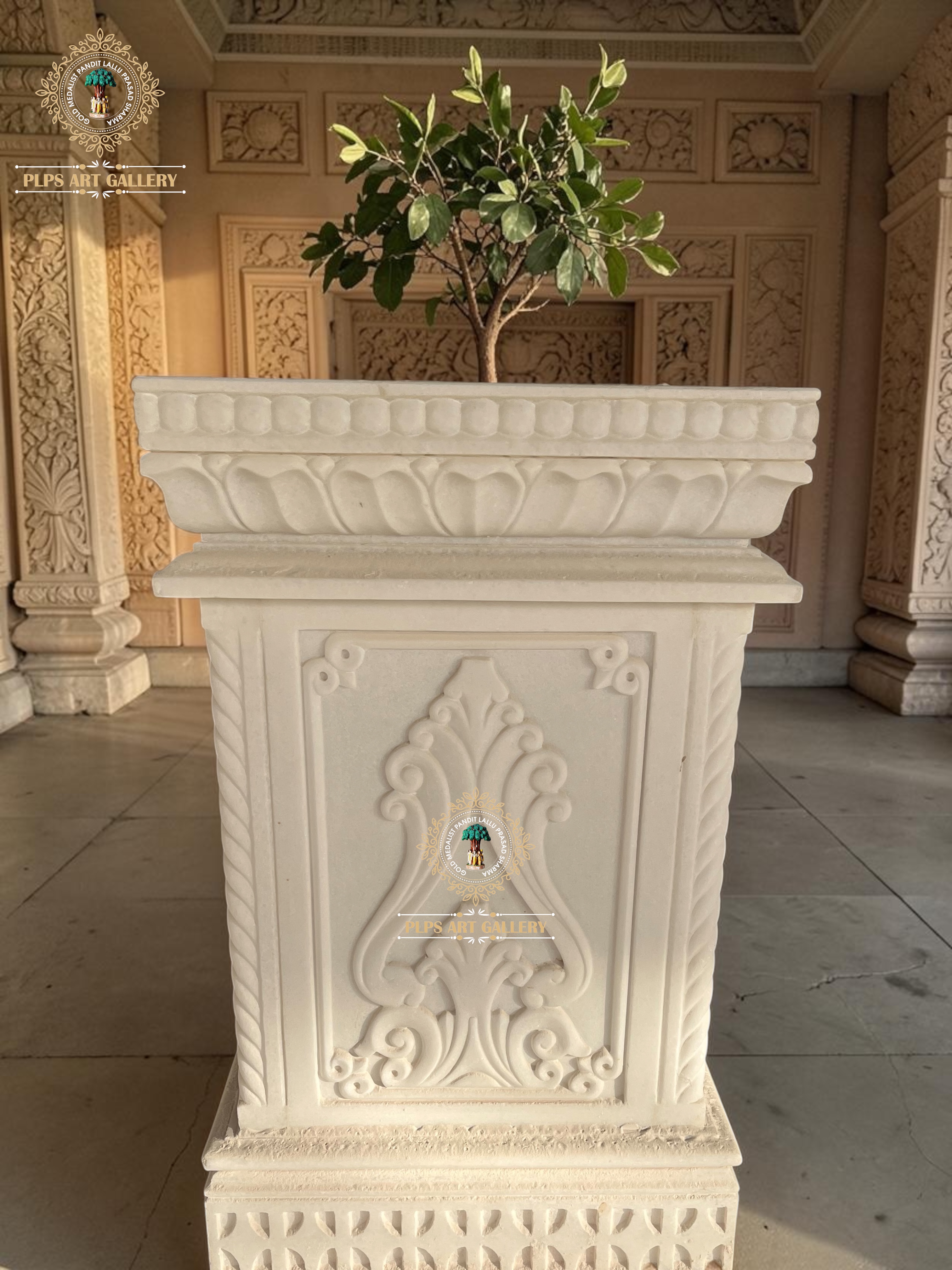
Made-to-Order Only
Our tulsi gamla are crafted exclusively on commission. Share your size, marble type and iconography — our fourth-generation artisans will begin your piece at our Chandpole Bazaar workshop, Jaipur.
Start a Commission