
Vishnu Laxmi Statue
Vishnu Laxmi, revered together as Lakshmi-Narayan, is the divine couple at the heart of Vaishnav worship — the preserver of dharma seated beside the goddess of abundance, inseparable and eternally auspicious. Vaishnav households across South India, Gujarat, ISKCON temples and Sri Sampradaya families install this pair not as a Diwali icon but as the daily archetype of an ideal marriage: Vishnu the steady, protecting husband and Laxmi the devoted, prosperous consort. That distinguishes a Lakshmi-Narayan murti from a standalone Laxmi, which centres wealth invocation on Diwali and Fridays. A Lakshmi-Narayan is worshipped every morning as one — the presence of Vishnu grounds Laxmi's fortune in dharma, and no unstable prosperity is invited into the home.
At PLPS Art Gallery, four generations of the Sharma lineage in Chandpole Bazaar Jaipur — founded by Late Pandit Lallu Prasad Sharma, honoured with the Presidential Shilp Guru award in 1991 — treat the Lakshmi-Narayan commission with the extra rigour a paired composition demands. Two figures on a single asana must balance proportion, gaze and hand-work; a heavier Vishnu with a lighter Laxmi throws the panel off. Our sculptors begin with Shila Pariksha to select a wider block of Makrana, Vietnam White or Bhainslana marble; Rekhankan lays down Vishnu's four arms with shankh (conch), chakra (Sudarshana discus), gada (Kaumodaki mace) and padma (lotus), and Laxmi's lotus and kalash. Chikni polish silks the skin surfaces; Swarna Karya applies real gold leaf to crowns, girdles, the discus rim and the kalash lip. A carved Garuda base or a coiled Ananta-Shesha platform can be added as a separate commission.
Three canonical forms are commissioned from our workshop. The seated Lakshmi-Narayan on a full-bloomed lotus or on the eagle-mount Garuda is the most requested home form, both deities upright and gazing forward with Laxmi to Vishnu's left. The standing Lakshmi-Narayan is the temple-scale variant, well-suited to larger South Indian mandirs. The Sheshashayi (Yoga-Nidra) Vishnu reclines on the coiled cosmic serpent Ananta-Shesha with Laxmi seated at his feet gently pressing them — a rarely-commissioned but scripturally central form drawn from the Bhagavata Purana. Vishnu is described in scripture as Neelavarna — the deep blue hue of a monsoon cloud or the shoreless ocean — and clients choose between mineral-pigment application over the carved marble or leaving the stone plain white in the South Indian temple tradition. Vishnu's four attributes follow the Chaturvinshati (24-form) arrangement of the Padma Purana — the specific order in which shankh, chakra, gada and padma are held determines the form (Keshava, Narayana, Madhava, Govinda and so on), and we carve to your family's ishta. Vastu places Lakshmi-Narayan in the north-east Ishan corner mandir, facing east so morning surya-arghya falls on the pair; avoid the bedroom entirely and any wall shared with a bathroom or staircase.
We carve Lakshmi-Narayan from an 8-inch desktop pair for personal altars up to 6-foot temple installations. The 15–30 inch seated form on lotus-padma or Garuda is the most requested home size, scaled to sit comfortably in a Vaishnav mandir with a Tulsi plant beside. Customisation options include mineral-pigment application on Vishnu's Neelavarna skin and Laxmi's red-gold saree, 22-carat gold leaf on jewellery, discus rim, kalash and crowns, a separately-carved Garuda or Ananta-Shesha base, family-name or ashta-mantra engraving on the pedestal, and choice of the specific Chaturvinshati form per your family purohit's guidance.
For Vaishnav households, ISKCON devotees, Sri Sampradaya families and any home that wants dharma and prosperity established together at the altar, our workshop crafts each Lakshmi-Narayan to the scriptural specifications your tradition requires. Speak to our craftsmen and commission a pair sculpted only for your family.

Frequently Asked Questions
A standalone Laxmi murti is the wealth-invocation icon lit up on Diwali and every Friday, centred on abundance and coin-flow blessings, and is often paired with Ganesh and Kubera for the puja. A Vishnu Laxmi or Lakshmi-Narayan murti belongs to the Vaishnav daily-worship tradition and is not primarily a Diwali icon — it represents the inseparable divine couple, the archetype of an ideal marriage, and is worshipped every morning together. Vaishnav, ISKCON and South Indian Sri Sampradaya families install Lakshmi-Narayan as the mandir's principal murti; a household focused specifically on Diwali wealth-flow more often installs standalone Laxmi.
For a Vaishnav home altar the seated Lakshmi-Narayan on a lotus asana or on Garuda is the most practical and widely-adopted choice — both deities gaze forward at the worshipper, the composition sits neatly on a home mandir platform, and daily abhishekam and shringar are simple to perform. The standing Lakshmi-Narayan is a temple-scale form best suited to larger mandirs and public shrines. Sheshashayi Vishnu with Laxmi at his feet is scripturally profound but visually horizontal and requires a wide, deep altar shelf; we recommend it for dedicated shrine rooms or larger family temples where its Yoga-Nidra symbolism can be honoured with a full aarti path around it.
Yes. Vaishnav households of the Sri Sampradaya, Madhva Sampradaya, Pushtimarg (Gujarati Vallabh tradition) and ISKCON revere Lakshmi-Narayan as the principal householder murti. South Indian Vaishnav families — particularly Iyengar, Tamil and Kannada communities — traditionally prefer plain white marble left unpainted, with only the ornaments and attributes highlighted in gold leaf, as this echoes the temple-idol aesthetic of Tirupati, Srirangam and Guruvayur. North Indian Vaishnav and ISKCON altars typically prefer full mineral-pigment colouring — Vishnu's Neelavarna blue skin, Laxmi's red or golden saree, painted eyes and lotus. Our workshop delivers both aesthetics per your family tradition.
Vishnu is described in the Vishnu Sahasranama and Bhagavata Purana as Neelavarna — of the deep blue hue of a monsoon cloud or the shoreless ocean — and scripturally the painted-blue form is entirely correct. In practice the choice is regional and traditional. Full mineral-pigment painting of Vishnu in blue with Laxmi in red-gold saree is standard for ISKCON, North Indian and Gujarati altars. Plain white marble with only the jewellery, crown and attributes gold-leafed is the classical South Indian temple aesthetic. Both are scripturally correct; consult your family purohit or ISKCON temple mentor before commissioning. Our workshop supplies either, and re-pigmenting or re-leafing in future is always possible.
Place Lakshmi-Narayan in the north-east Ishan corner of the home, seated on a raised wooden or stone chowki at heart level, with the pair facing east so morning sunlight and surya-arghya fall on their darshan. Never install the murti in the bedroom, on the floor, beneath a staircase, or on a wall shared with a bathroom or kitchen — Vaishnav worship of Lakshmi-Narayan demands the same shaucha (ritual purity) accorded to the temple deity. Keep a Tulsi plant close to the altar, ideally to Vishnu's right, and offer fresh Tulsi leaves in daily worship as scripture prescribes for Vishnu.
A Lakshmi-Narayan pair takes noticeably longer than a single-deity murti because two figures must be proportionally balanced on one composition and Vishnu's four arms with shankh, chakra, gada and padma require additional Rekhankan detailing. A standard 15–24 inch seated pair from our workshop takes 45–60 days from confirmed measurements, marble selection and advance. Larger 3–6 foot temple installations, a Sheshashayi Vishnu with Laxmi at his feet, or a full Swarna Karya gold-leaf commission runs 75–110 days. International Vaishnav clients commissioning for a Janmashtami, Vaikuntha Ekadashi or house-warming date should reach the workshop at least four months in advance.
The dual figures, Vishnu's four attributes and Laxmi's lotus and kalash carry more fine detail than a single-figure murti, and gold-leaf jewellery on both deities compounds the care effort. Dust weekly with a soft dry brush, working outward from each attribute — shankh, chakra, gada, padma — and from the kalash lip and crowns. If mineral pigment has been applied to Vishnu's Neelavarna skin or Laxmi's saree, wipe only with a barely-damp soft cotton cloth, never a chemical, ammonia or acidic cleaner. Keep the murti away from direct harsh sunlight and monsoon window spray. Our workshop offers periodic re-leafing and mineral-pigment restoration for lifelong upkeep.
Looking for a custom Vishnu Laxmi Statue?
Every piece is hand-carved to order in our Chandpole Bazaar workshop, Jaipur. Share your size, marble type and iconography — our 4th-generation artisans will craft it for you.
Request a Quote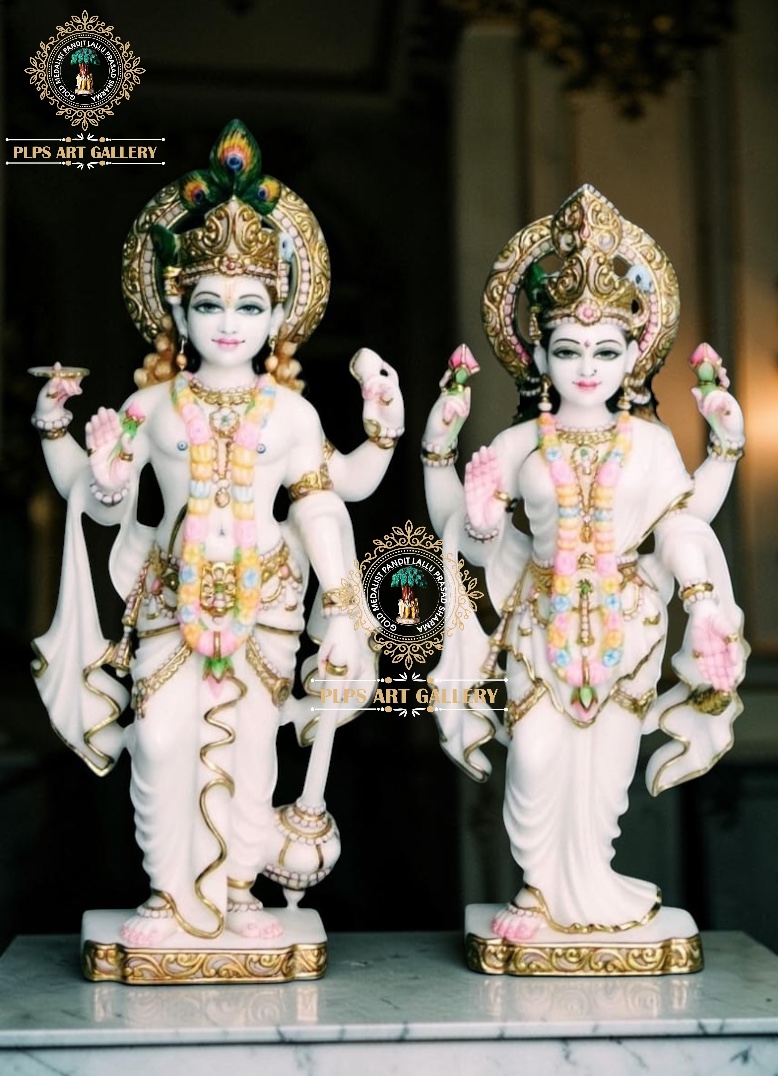
Made-to-Order Only
Our vishnu laxmi statue are crafted exclusively on commission. Share your size, marble type and iconography — our fourth-generation artisans will begin your piece at our Chandpole Bazaar workshop, Jaipur.
Start a Commission