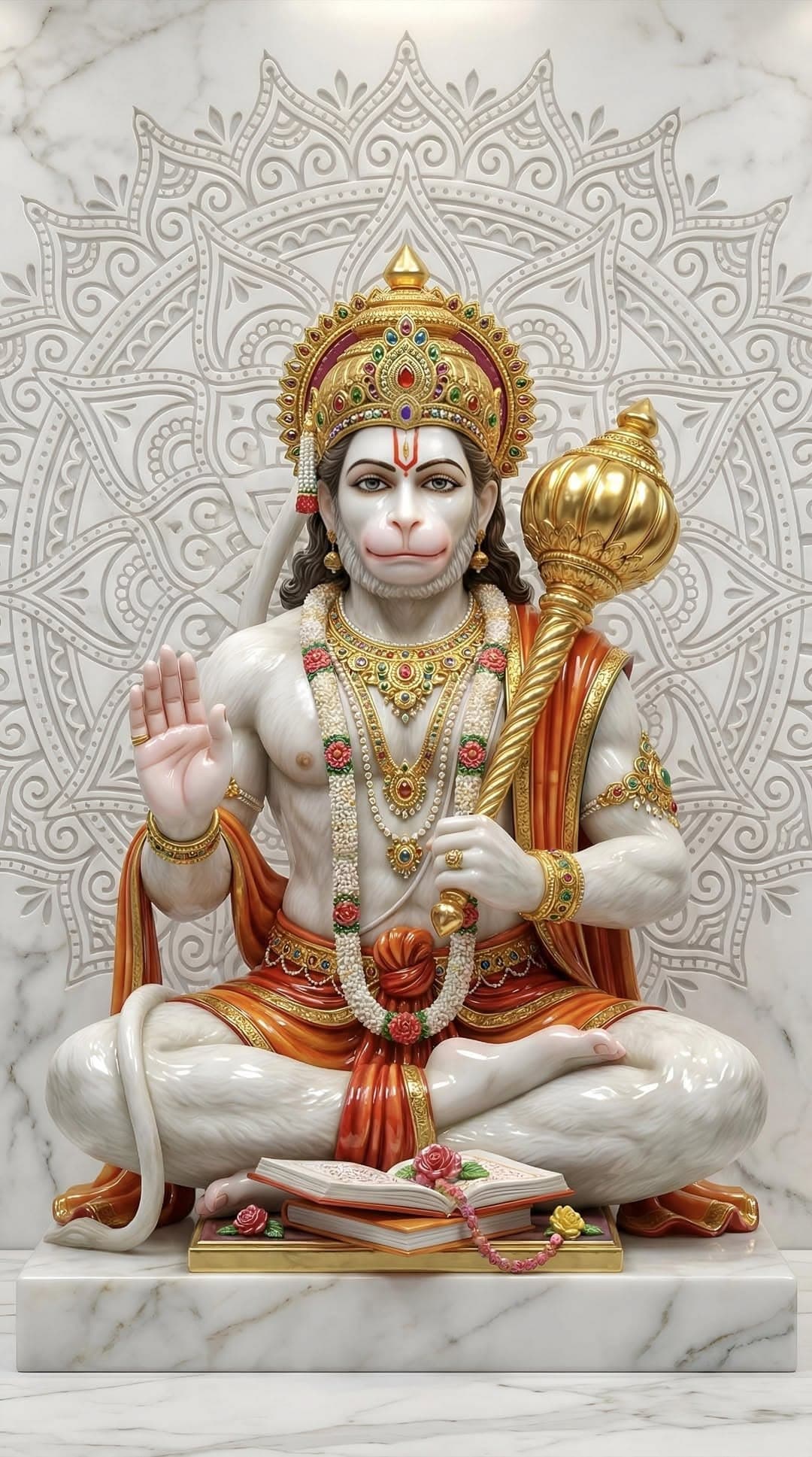
Few deities inspire the fierce, unwavering devotion that Hanuman does. Called Bajrangbali for his diamond-hard body, he is the boundless servant of Ram — the deity most sought for pure protective energy. Homes install him at entrances to guard the family, gyms place him for strength and discipline, and offices commission him to clear obstacles from work. Marble is the ideal medium — dense enough to hold his powerful musculature, refined enough to carry the tender bhakti in his eyes.
Choosing the right marble Hanuman is not a small decision. The form you commission (Panchmukhi, Sankat Mochan, Veer, Sanjeevani, chest-opening, or Viraat) shapes what he protects you from and what he grants. The marble you choose (Makrana white, golden Bhainslana, or Vietnam White) decides whether he arrives in his sindoor colour naturally or through paint. The size determines whether he anchors a mandir, dominates a gym wall, or greets guests at the gate. This guide walks you through every one of those choices for a handcrafted marble Hanuman statue — grounded in what our four-generation Shilpi lineage has learned about carving Bajrangbali since 1950.
मनोजवं मारुततुल्यवेगं जितेन्द्रियं बुद्धिमतां वरिष्ठम्।
वातात्मजं वानरयूथमुख्यं श्रीरामदूतं शरणं प्रपद्ये॥
"Swift as thought, mighty as the wind, master of senses, wisest of the wise — son of the wind god, chief of the Vanaras, messenger of Sri Ram — in you I take refuge."
The Forms of Hanuman You Can Commission
Panchmukhi Hanuman is the five-faced protective form — Hanuman (East), Narasimha (South), Garuda (West), Varaha (North), and Hayagriva (Upward) — assumed to defeat the demon Mahiravana and worshipped for 360-degree protection. Our most detail-intensive commission, best carved at 24 inches or larger.
Sankat Mochan Hanuman, the obstacle-remover in a seated blessing pose, is the most requested home murti. Veer Hanuman stands with a raised gada — the pure warrior form ideal for gyms and entrances. Sanjeevani-flying Hanuman, the miracle-worker in mid-flight with the mountain, is the most technically demanding pose we carve. The chest-opening form reveals Ram and Sita enshrined in his heart — a profound statement piece for deep devotees. Viraat Hanuman is the colossal cosmic form for temples and outdoor installations.
Reading His Iconography — What Every Element Means
Every attribute in a Hanuman sculpture is a symbol chosen by centuries of iconographic tradition. Understanding what you are looking at deepens the devotion, and helps you choose a form whose symbolism matches your intention.
The Gada (Mace): the weapon of righteous force. When raised, it signals readiness to defend; when rested on the shoulder, quiet vigilance. In a home installation, a raised gada is protective; a resting gada is contemplative. Gym commissions almost always take the raised form.
The Sanjeevani Mountain: the moment Hanuman lifted an entire mountain to save Lakshman's life — the ultimate symbol of selfless service and the willingness to move any obstacle for those you love. This form is often installed after a family recovery from illness or as a prayer for one.
The Curled Tail: Hanuman's tail is never accidental in traditional carving. A tightly coiled tail signals restrained power; a tail curved into an arch signals leaping motion. In our Sanjeevani-flying form the tail streams behind — a technical undercut that only master chisels can achieve without cracking the stone.
The Sindoor Body: the origin lies in Sita's own sindoor. Seeing her apply it, Hanuman asked what it was for; when told it brought long life to her husband Ram, he covered his entire body in sindoor as an offering of devotion. This is why sindoor-painted marble Hanuman remains a devotional standard, and why our golden Bhainslana marble — echoing that colour in stone itself — is our most authentic recommendation.
The Ram-Nam: traditional Hanuman statues carry "श्री राम" carved or painted across the chest or gada. It is the mantra Hanuman himself is said to repeat with every breath. On PLPS commissions this is optional and hand-inscribed.
The Chest-Opening: when Hanuman parts his own chest to reveal Ram and Sita enshrined within, he is silently answering the question — where does your devotion live? For homes with a serious daily practice, this form carries unmatched emotional weight.
When Devotees Bring Him Home
Certain moments in a family or business owner's life traditionally call for a Hanuman installation. Knowing these helps you time your commission — most custom pieces take 30 to 90 days, so plan ahead.
Hanuman Jayanti (Chaitra Purnima, March–April)
The most auspicious day of the year to install a new Hanuman murti. Devotees commission Sankat Mochan or Panchmukhi to be ready and installed before the Jayanti — many arrange the pran pratishtha on the day itself.
Griha Pravesh (Housewarming)
Hanuman is often the first murti installed in a new home — as a protective sentinel at the entrance or in the South-West mandir. A 12 to 18 inch Sankat Mochan is the most common choice.
New Gym or Fitness Studio Opening
For a home or commercial gym, Veer Hanuman at 3 to 6 feet is now a signature installation — the message being that physical training is spiritual discipline. Commission 60 to 90 days before opening.
Office or Business Inauguration
Sankat Mochan blesses ventures with obstacle-removal and strength through setbacks. Placed at reception or in the owner's cabin, he becomes the silent partner in every difficult decision.
Family Recovery, Exam Season, or a Vow Fulfilled
Panchmukhi Hanuman is commissioned as a mark of gratitude after a serious illness recovered from, as a prayer during a child's competitive exams, or when a personal vow is completed. His 360-degree protection makes him the natural choice for these transitions.
Why South-Facing is Auspicious for Hanuman
In Vastu Shastra, most deities are placed to face East or North. Hanuman is the rare exception — for him, South-facing placement is not only acceptable but auspicious. In the Mahiravana legend, Hanuman descended into the South to defeat the demon and rescue Ram and Lakshman. South, in Vastu, is where negative energies traditionally enter. Hanuman standing sentinel facing South turns him into the household's protector against every kind of harm.
Vastu Placement — Quick Reference
Best zone: South-West of the home, facing South or the entrance
Elevation: always on a chowki or pedestal — never bare floor
Worship days: Tuesday and Saturday
Avoid: bedrooms, walls shared with bathrooms, kitchen, under staircases
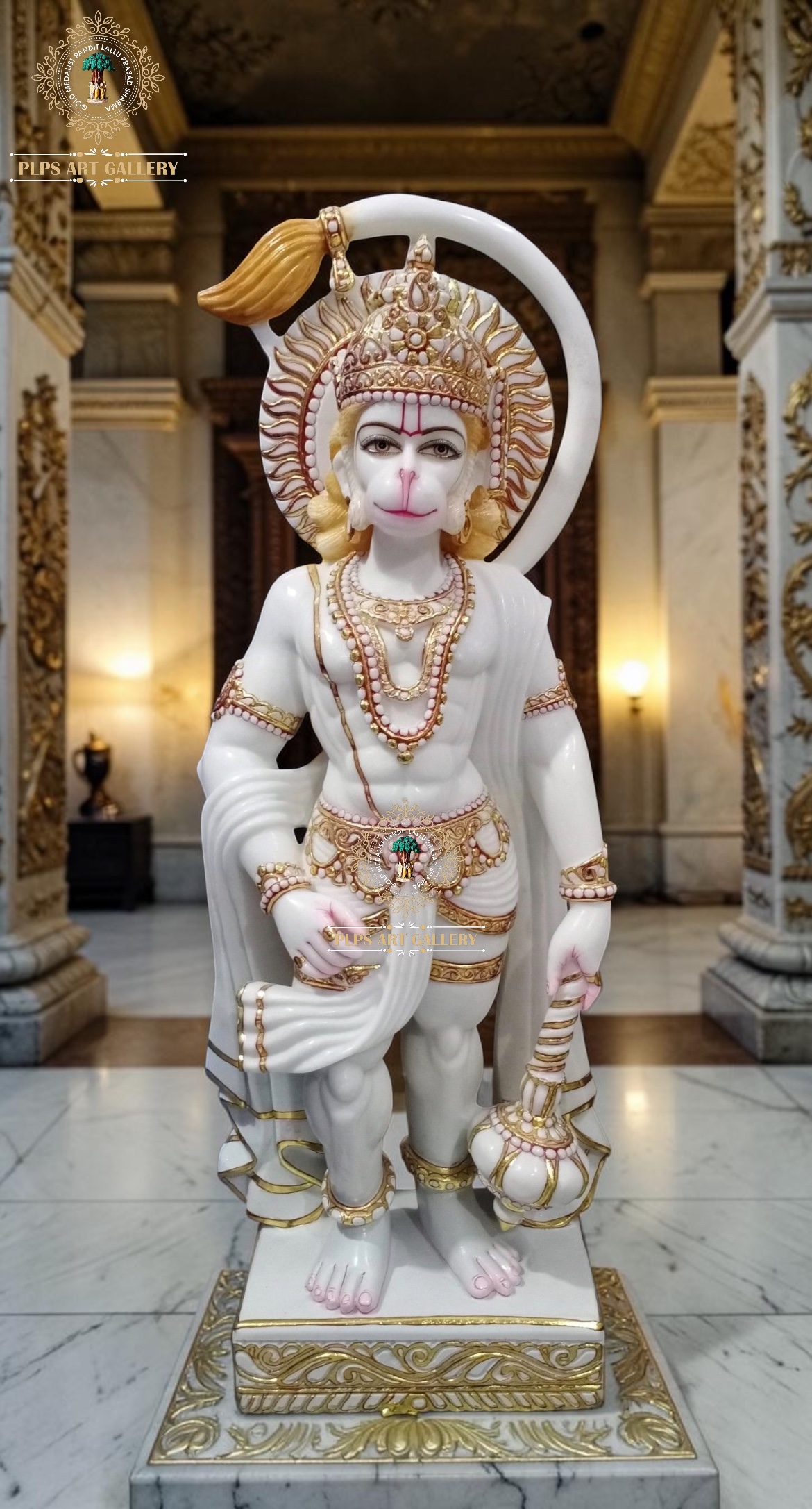
A handcrafted marble Hanuman from our Chandpole Bazaar workshop, Jaipur
Size, Marble & Finish — A Buyer's Framework
Sizes: Home mandirs suit 12 to 18 inches — expressive without crowding. A dedicated puja room can carry 24 to 36 inches, especially for Panchmukhi. Home gyms deserve 3 to 5 feet — Veer Hanuman at this scale reads powerfully from a distance. Commercial gyms, akhadas, and outdoor entrances take 6 to 8 feet standing installations.
Marble choice matters more than usual for Hanuman because his traditional colour is sindoor orange. Our rare golden Bhainslana echoes that colour naturally — you install him in his authentic sindoor tone without any surface paint. Makrana is the classical devotional white, perfect if you want a painted sindoor body or a gold-leafed mace. Vietnam White is slightly softer, ideal for finely detailed smaller pieces where facial expression matters most.
Finishes: traditional sindoor-orange body paint, 24-carat gold leaf on the gada and mukut, or plain marble for a contemporary temple aesthetic. Every option is available on custom commission.
Why Hand-Carved Matters — Doubly, for Hanuman
Machine-carved statues cut a shape. Hand-carving reads the stone. For Hanuman, the difference is structural — every form concentrates weight and detail in areas tools cannot reach: the raised gada that must balance without cracking, the muscular chest that must catch light like living flesh, the curling tail with its undercut angles, and Panchmukhi's five faces each with independent expression. At PLPS every marble Hanuman is carved from a single block by our Shilpis — the same four-generation lineage that produced our founder Shilp Guru Pandit Lallu Prasad Sharma. No assembly, no joins, no shortcuts.
Bring Bajrangbali Home
Every marble Hanuman at PLPS is hand-carved to order. Share your form, size, marble, and finish preferences — our fourth-generation Shilpis will craft your Bajrangbali in our Chandpole Bazaar workshop.
Request a custom quote · plpsartgallery@gmail.com · +91-7737257289
Custom commissions typically take 30 to 90 days. Worldwide shipping in specialized wooden crating.
What Devotees Ask Most
What is the difference between Panchmukhi, Sankat Mochan and Veer Hanuman?
Panchmukhi is the five-faced protective form worshipped for 360-degree protection against negative energy. Sankat Mochan is the obstacle-removing, boon-giving form usually shown seated — the most popular choice for daily home worship. Veer Hanuman is the standing warrior with a raised gada, ideal for gyms and entrances where scale and inspiration matter.
What is the correct Vastu direction for a Hanuman statue at home?
Hanuman is the rare deity for whom South-facing placement is auspicious — a reference to the Mahiravana legend where he vanquished evil approaching from the South. Place him in the South-West of the home facing South, or near the entrance if it faces East or South. Always elevate on a chowki, never bare floor. Avoid bedrooms, bathroom-adjacent walls, kitchen, and spaces under staircases.
Which marble is best for a Hanuman statue — golden Bhainslana or white Makrana?
Bhainslana carries a warm golden undertone that echoes Hanuman's traditional sindoor colour, letting you install him in his authentic hue without surface paint — a favourite for permanent stone finish. Makrana is the classical devotional white and pairs beautifully with a sindoor-orange painted body or gold-leafed mace. Vietnam White is ideal for finely detailed smaller pieces. We match the marble to your form, size, and mandir lighting.
What size is right for a home mandir versus a home gym?
For a home mandir, 12 to 18 inches is ideal — expressive without overwhelming the shrine. A dedicated puja room can carry 24 to 36 inches. For a home gym, 3 to 5 feet gives Hanuman's inspirational strength the presence it deserves. Commercial gyms and outdoor entrances often commission 6 to 8 feet standing installations.
How do I care for a marble Hanuman statue?
Dust the raised gada, tail, chest details and — for Panchmukhi — each of the five faces weekly with a soft dry natural-hair brush. Never wipe undercuts with a wet cloth; trapped moisture darkens marble over months. For the smooth body, a barely damp muslin cloth is safe; dry immediately. If a sindoor painted finish or gold leaf is present, dust only — never wipe. Avoid all acidic cleaners including citrus, vinegar, and household sprays. Every PLPS statue ships with a written care card.
Can Hanuman be worshipped by married women?
Yes. Hanuman is celibate himself, but he blesses the marriages, families, children and safety of all devotees regardless of gender or marital status. Daily aarti, offerings, and prayers are entirely welcomed. Sindoor offerings, in particular, are a woman-led tradition in many parts of India.